
 3 hours ago
2
3 hours ago
2

The Barbican is aptly named. From the Old French barbacane, it historically means a fortified gateway forming the outer line of defence to a city or castle. London’s Barbican marks the site of a medieval structure that would have defended an important access point. Its architecture was designed to repel. Some might argue, as they stumble out of Barbican tube station and gaze upwards, not much has changed in the interim.
The use of the word “barbican” was in decline in this country until the opening in 1982 of the Barbican Arts Centre. Taking 20 years to build, it completed the modernist megastructure of the Barbican Estate, grafted on to a huge tract of land devastated by wartime bombing. The aim was to bring life back to the City through swish new housing, energised by the presence of culture. Nonetheless, the arts centre, the elusive minotaur at the heart of the concrete labyrinth, was always farcically difficult to locate. To this day, visitors are obliged to trundle along the Ariadne’s thread of the famous yellow line, inscribed in what seemed like an act of institutional desperation, across concrete hill and dale.
The minotaur is also ageing. Just like people, buildings also physically decay and get into bad habits, necessitating the odd hip replacement or hair transplant. Approval has now been granted by the City of London Corporation for a multi-million-pound programme to upgrade and transform the Barbican, in time for the 50th anniversary of its opening in 2032. From June 2028, it will close its doors for a year to undergo the most ambitious makeover in its history. There will be a fair few architectural equivalents of hip replacements.
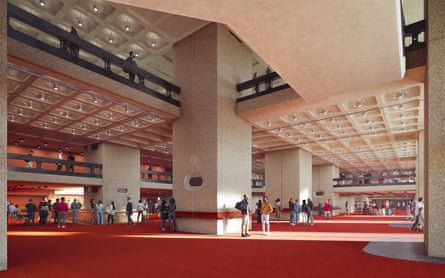
The Grade II-listed complex suffers from leaks, crumbling fabric, outdated services and accessibility issues. Navigability is a perpetual bugbear, with apocryphal tales of famous people (including a celebrated explorer) getting lost in the cat’s cradle of walkways, decks and staircases, conceived by its architects, Chamberlin Powell & Bon, in an era when such things were seen as exciting and novel.
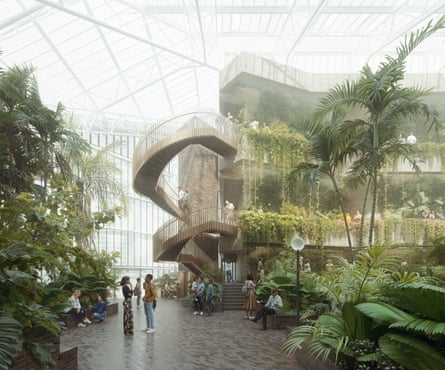
Sectional drawings made at the time show the building as a heroic, concrete layer cake, sprung from the imagination of a modern Piranesi, with levels stacked around the cavernous volumes of the concert hall and theatre. Most heroic of all is the conservatory, which took the void around the theatre fly tower, enclosed it in glass and filled it with plants. In the refurbishment proposals, this hugely popular urban greenhouse, a Kew Palm House for the East End, will be spruced up and made more accessible to the public.
Over time, the Barbican’s fortunes have fluctuated, but now, in the manner of the structure it was named after, it has successfully defended itself from public opprobrium, swatting away squeals of “concrete monstrosity” to become a kind of architectural national treasure. You can buy Barbican mugs, models, tea towels and other ephemera valorising its uncompromising brutalist heft.
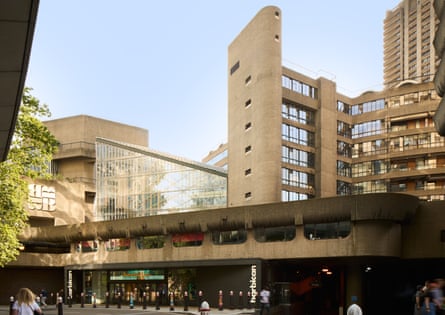
Remedial strategies have been tried before. In the early 1990s, Theo Crosby of design group Pentagram introduced some ill-advised pointillist stippling, along with gilded fibreglass statues, all contrived to “soften” the concrete. Derided as “feeble tinkering” by Geoffrey Powell, one of the original architects, it was a decidedly unflattering smear of lipstick on a rather fabulous gorilla.
A subsequent rebranding and remodelling by modernist fanboys Allford Hall Monaghan Morris (AHMM) went slightly better, allowing the uncompromising brutalist heft to speak for itself, but below stairs, things were creaking and leaking, and have now got to the point where doing nothing is not an option.
Fears that the Barbican would be “starchitect-ified” by its latest glow-up appear unfounded. This is a “fabric first” approach, concerned with diligently making good, decarbonising, and fitting for the future – now common architectural practice for buildings of this size and significance. The overhaul will be overseen by Allies and Morrison along with Asif Khan Studio, which will collectively be thoughtful, steady hands on the tiller; just what an ageing minotaur needs. Turner prize-winners Assemble will get a crack at sorting out the wayfinding, though it’s probably impossible to improve on the yellow line. In short, the Barbican will become more like the Barbican.
The only blot on the escutcheon concerns possible new neighbours. Plans have been submitted for two new 20-storey towers on Silk Street, directly across from the arts centre, to replace an outdated 1980s office block. Designed by American architects SOM, the hulking, Jenga-esque extrusions will loom imperiously over the Barbican’s east end, like a pair of corpulent bouncers. Residents’ groups and heritage bodies are vigorously opposing the development in its present form. “The Barbican is one of the most important postwar residential and cultural developments in the country, if not the world,” says Catherine Croft, director of the Twentieth Century Society, “and its status as a prominent, architecturally outstanding London landmark should be respected as much as the fabric itself.” It seems the Barbican may still have some repelling to do.







 English (US)