
 3 hours ago
2
3 hours ago
2

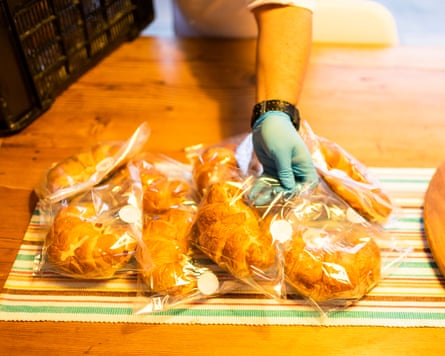
It’s two days before Thanksgiving and Hillary Cohen and Samantha Luu are trying to figure out how they’re going to cook 120 turkeys with limited oven space in their food warehouse in downtown LA. “We’re going to have to do a bit of spatchcocking. It’s not very showbiz,” Cohen says.
It’s the busiest time of year for Cohen and Luu, assistant directors who founded not-for-profit organisation Every Day Action during the Covid pandemic. Designed to help unhoused people and those facing food insecurity across the city, the idea was born when Cohen noticed the amount of food waste on film and TV sets, and looked into redistributing it to those in need. “I remember asking, ‘Why can’t we donate this food?’ I kept being told it was illegal and that people could sue us if they got sick.” It didn’t take Luu, who grew up working in a soup kitchen her father founded, long to establish this was not the case. “In the US, there’s the Bill Emerson Good Samaritan Act that’s been around since 1996,” she says. “It protects food donors from liability issues.”
They’re not the only women trying to turn the big screen green. In 2009, trailblazer Shannon Bart founded EcoSet, an environmental production resource based in Hollywood that introduced recycling and composting to sets and began donating creative materials to nearby artists, theatres and schools. In the UK, Albert is a nationwide initiative from Bafta that helps the film and TV industry be more sustainable. One of its biggest goals is to phase out fuel generators on sets, which has the ability to wipe out as much as 5% of all emissions created by the sector. April Sotomayor, Bafta’s head of industry sustainability, says: “We’re also trying to encourage talent not to use private jets. Even getting them into first class goes a long way to reducing the carbon footprint of a production.”
At the production coalface, Green Rider is a collective that sets environmental guidelines for productions, including using grid power, introducing ride-sharing for cast and crew and using beef-free caterers. Their efforts have reduced pollution on productions, including Wolf Hall and Gangs of London, by up to 80%. Tilly Ashton, whom Sotomayor calls a “darling of the sustainability industry”, co-created Wales’s first sustainability coordinator training programme for aspiring creatives last year. And PropUp is a London-based non-profit set up by ex-producers Emma Chaplin and Kate Allan to rehome and recycle props and sets from popular TV shows. Despite preconceptions, what they do is serious business. “One prop can be life-changing,” Allan says. “Whether that’s a belt that means someone can wear something comfortable to a job interview or a rucksack that can help a child escape domestic violence.”
These eco initiatives across film and TV are thriving. Every Day Action now redistributes more than 80,000 meals a year. It also works with big studios including Warner Bros and Disney, the latter of which recently found itself in hot water when it was revealed the production of its live-action Snow White emitted 3,153 tonnes of carbon dioxide equivalent. They are also needed more than ever in cities such as LA, where 25% of the population face food insecurity.

Every Day Action can also offer supplementary income to people starting out in the entertainment business through its industry driver programme. It works because they’re insiders who understand set protocols and timings and can easily read site maps. Most importantly, though, they don’t get starstruck. “We can send them on set and they’re OK with only seeing mashed potatoes,” says Cohen.
As for PropUp, it has now rehomed more than 50,000 props and partnered with ITV ReLoved, meaning fans can buy merch and niche memorabilia from its online shop – such as a Free Marlon Dingle poster from Emmerdale or Frankie Bridge’s I’m a Celebrity T-shirt – the profits of which are funnelled back into charitable causes. “We recently sold the Fernando’s sign from Take Me Out,” Chaplin says. Every Day Action has a similar tale to tell. “We were once given a bag of 200 flavoured condoms and a bunch of butt plugs from the set of Euphoria,” Luu says. They were rehomed by a local sex worker outreach programme before their landlords, religious order Daughters of Charity, caught wind, in case you were wondering.
Women are dominating the space. A 2023 report found that 58% of chief sustainability officer roles are held by women. The broadcasting world, especially, is leading the charge, with women such as Danielle Mulder and Sara Peacock heading up sustainable drives at the BBC and S4C respectively.
The end goal for Every Day Action and PropUp is to inspire more grassroots action, with a few small tweaks to regular programming. The duo in LA have their eyes on an industrial fridge-freezer, while in the UK Chaplin and Allan hope to open a bricks and mortar shop. “We’re not sustainability experts, we’re just two women who saw a problem and wanted to do something about it,” Chaplain says. “It’s not rocket science.”






 English (US)