
 1 day ago
3
1 day ago
3

Did you know that the zipper only came about because a Swedish-born engineer named Gideon Sundback fell in love with a factory owner’s daughter? Or that it took longer for it to be developed than it took for the Wright brothers to invent the aeroplane? You probably know that pockets have become a symbol of gender privilege – but were you aware that in the 18th century, women’s pockets were big enough to hold tools for writing, a small diary and a snack for later? Perhaps most surprising is that layering, which has made Uniqlo one of the biggest brands in the world, was in effect invented in the 1940s by a man named Georges Doriot, who was also famous for inventing venture capital.
All these nuggets and more are included in Articles of Interest, a podcast by 34-year-old Avery Trufelman. Listeners tune in for the smarts but also her disarming sense of fun. Not to mention her low, husky voice, which seems made for podcasting. “I don’t take care of it, if that’s what you’re asking,” she says over video call from her apartment in New York.

Now in its seventh series, Articles of Interest launched in 2018 and explores the history, politics and power of fashion, treating it – unlike many fashion podcasts – as culture. The detail about layering comes courtesy of the latest, longform season, titled Gear, in which Trufelman unpicks the links between American military clothing and civilian outdoor wear, right up to the Arcteryx gorpcore beanies worn by Americans queueing for cortados.
Originally a spin-off from another podcast Trufelman worked on, the much-loved design podcast 99% Invisible, she started Articles of Interest because: “Over the years, as we talked about design, I was like: we’re kind of leaving something out. We’re not talking about clothes.” At first she felt a lot of pressure to cover “all the cool stuff”. “They talked about architecture and they talked about concrete and they talked about queue theory … and I was like ‘I’m down with this’.” But she wondered “‘why don’t we apply the same logic to clothes?’ for some reason, it’s totally different. It becomes like Zoolander when you talk about fashion.”
Trufelman’s smart, animated approach treats a world often seen as elitist, or simply uninteresting and shallow, with heft and historicism. Episodes have been downloaded more than 10m times. It has been voted among the 100 best podcasts of all time by Time magazine, and consistently ranks in the New Yorker’s annual of the best podcasts. Trufelman herself has been called a fashion anthropologist.
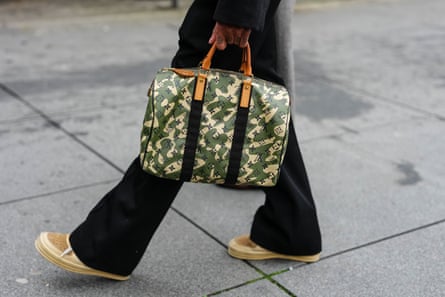
Gear is a rich and unexpected listen, and one that exposes the uncomfortable connections between civilian clothing and the bloody business of war. “Almost every garment I have reported on has some connection to war,” says Trufelman. And, in the US at least, it’s not just a matter of aesthetics: “The US military is involved in a very practical way in the creation of clothing itself.” From sweat-wicking outer shells to the abundance of camo, “American civilians and the military have never been more intertwined than we are now, in our clothing.”
She got the idea for Gear after her first multiparter, American Ivy, a deep dive into the world of preppy fashion that “got me thinking about the other pillars of American clothes”. It examines the reasons for US army uniforms shifting from blue to khaki, posits a theory about the increased visibility of special forces during the “war on terror” and the rise of gorpcore, and looks at why military surplus became a thing after the second world war – apparently, as the Manhattan Project was top secret and there were plans for many more years of war, millions of uniforms were made that wouldn’t be needed. (The next season will be about cowboy style – another excavation of the archetypes that make up American fashion. But so far, she says, “I just have books.”)
It’s clear that many people from beyond the world of fashion tune in. Sometimes, Trufelman’s listeners contact her – including “a conservative Jewish woman in Toronto, and this Indigenous guy who lives on a reservation. Part of the reason I got started on this military series is I heard from so many soldiers and veterans,” she says.

Her main takeaway from the series is that the military is an inexorable part of her life. “This is like what my taxes go to … I need to stop pretending I have nothing to do with it – and, in fact, demand more from it.” Demanding more from an army meant to serve civilians feels particularly pertinent: we talk just a few days after the newly elected New York mayor Zohran Mamdani’s visit to the White House, where he challenged Donald Trump about his threat to deploy the national guard in the city. “It’s very real and it’s very strange,” she says.
Gear took two years to make, in part because Trufelman was doing it at the same time as writing a book about the Antwerp Six, a group of experimental Belgian designers, including Ann Demeulemeester, Walter van Beirendonck and Dries van Noten, whose work established Antwerp as a fashion capital in the 1980s. Part of the writing process was “going back and forth to Belgium and learning Dutch”.
Trufelman’s podcasts burst at the seams with fascinating characters and facts that deserve to be mainstream knowledge. There have been standalone episodes on plaid, and its journey from Scotland to India, Kenya and US slave plantations; paisley; and the colonial roots of Hawaiian shirts. In an episode on suits she links the flamboyant dress of Charles I to the growth of liberalism, and points to Beau Brummell as “arguably the most important single figure in fashion”. The flamboyant Regency dandy may also be in part to blame for skinny jeans – he chose trousers so tight that he needed an assistant to help him put them on.
Articles of Interest is not just a riposte to wrong-headed snobbery about fashion. It’s also the perfect antidote to the clickbait micro-trends that characterise much of the fashion industry and the media that cover it. I ask Trufelman why (aside from the obvious: patriarchy) it is so often necessary to reiterate that fashion doesn’t just mean what Kim Kardashian is wearing, but also why Kim Kardashian’s fashion choices have plenty to tell us.
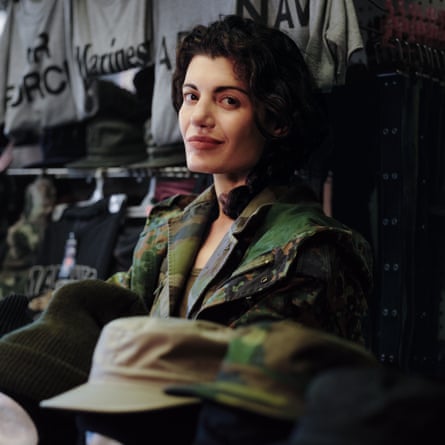
“Everything has trends and styles, but the thing about fashions in clothing is that they’re so external,” she says. They are an expression of your lived experience at that moment; and for some people, that feels like facing their own mortality. “Everybody wants to pretend that they’re not going to die: they’re going to live for ever, their tastes are eternal and they are not living in time. Fashion is an expression of your temporality, an acknowledgment that this too shall pass.”
Given her deep understanding of fashion, and wealth of knowledge about even the most seemingly innocuous garment, does she ever get bogged down getting dressed? (Today she’s wearing a beautiful hand-pleated top by the Paris-based designer Julia Heuer.) “It just makes me love everything,” she says. Camo, for example: “It’s just so rich and so complicated. It’s so interesting. Which is probably bad. But I spend so much time with all these things, in the end I’m like: ‘Wow.’” It’s a brilliantly joyful direction to take.








 English (US)