
 2 hours ago
2
2 hours ago
2

Esme StallardClimate and science reporter

 Reuters
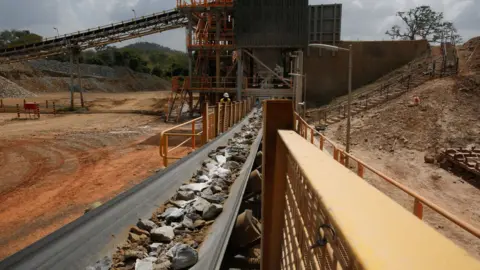
Countries are racing to obtain the critical minerals and rare earths needed to make everything from smartphones to electric cars.
US President Donald Trump has made access to these minerals a priority, with potential mining deals part of his plans for both Greenland and Ukraine.
But it is China which dominates processing and upon which the world relies for usable supplies.
What are critical minerals?
Critical minerals are those which a country considers vital for its economy, or national security, but which it may struggle to get hold of.
Some of the critical minerals and rare earths expected to see the biggest growth in demand in the coming years are:
- copper - used in energy infrastructure and construction
- lithium - energy storage
- cobalt - portable batteries and high-strength alloys, often used for wind turbines
- graphite - fuel cells, batteries, lubricants and nuclear power
Critical minerals lists vary between nations, depending on the resources they have and the industries they run.
What are rare earth elements?
Rare earth elements appear on the critical minerals lists of many countries.
With important electrical and magnetic qualities, rare earths consist of 17 elements in the lanthanide group of the periodic table, plus scandium and yytrium.
They are vital in microchips, which are crucial for almost every sector from defence to healthcare.
- Yytrium - laser technology used in communications and medical procedures
- Neodymium - permanent magnets for electric vehicles and renewable energy
- Lanthanum - rechargeable batteries
However, despite their name, rare earth elements are not that rare. For example, neodymium is found at 20 parts per million in the Earth's crust, in comparison copper is at 27.
Where are critical minerals found?
The most common critical minerals are distributed globally, although some countries have particularly large reserves.
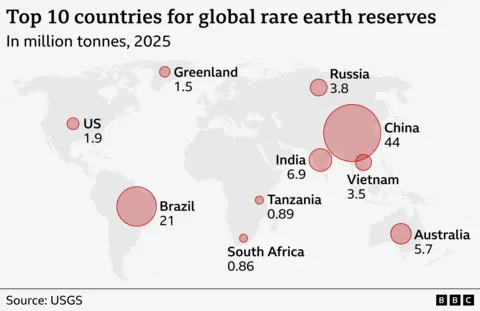
China is estimated to have 44 million tonnes of rare earth reserves, while Brazil has 21 million tonnes and Australia about six million.
Australia, Indonesia and Chile are just some of the countries that have significant mining operations.
Australia is the leading producer of iron ore, gold, zinc, nickel, cobalt, and lithium, whilst Indonesia accounts for half of the global production of nickel.
Why does China dominate production?
The presence of minerals under the surface of the Earth is not the only factor that affects supply, it is also how easy they are to access and process.
Many countries do not have capacity to process critical minerals.
For example, the UK critical minerals assessment said that while silicon metal is mined in more than 30 countries, only three can process it into the polysilicon used in microchips.
It is China that dominates the processing of many critical minerals including rare earths, lithium and cobalt.
For some rare earths, China is responsible for more than 95% of the processing.
 Reuters
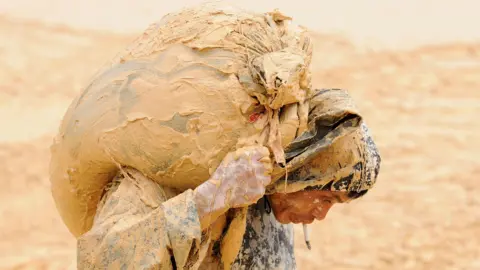
Rare earth mines in China have been associated with significant environmental damage and land grabs
Bob Ward, of The London School of Economics (LSE) Grantham Research Institute on Climate Change and the Environment, has told BBC News that China recognised the growth in green energy 10 years ago and "strategically pursued" processing.
This has left the US and other countries highly reliant on China and potentially vulnerable.
A 2023 report by a US Government Select Committee warned that the failure of the US to shore up its critical minerals supply chains could cause "defense production to grind to a halt and choke off manufacturing of other advanced technologies".
In 2025, the European Central Bank said that the "pivotal" role of China in the supply chain of rare earths highlighted "vulnerabilities to geopolitical disruptions".
President Trump has made it clear that he wants to bolster the US' production of minerals to reduce this dependency.
In October 2025, the US signed a critical minerals deal with Australia, at which Trump declared: "In about a year from now, we'll have so much critical mineral and rare earths that you won't know what to do with them."
Although the US has rare earth mineral reserves, just over 2% of global supply according to the US Geological Survey, it could take years to establish processing capabilities.
"No single country currently possesses the financial resources or technical capabilities to independently outpace China's dominance," said Gracelin Baskaran, director at the Centre for Strategic and International Studies think tank.
Lower environmental standards in China around its mining and processing activities has helped it to keep costs lower than competitors.
BBC News has recently documented uncovered toxic waste ponds, deforestation and soil erosion at rare earth mines in Northern China.




 English (US)