
 4 hours ago
2
4 hours ago
2

If life had worked out differently, Serena would by now be coming to terms with an empty nest. Having brought up seven children, she and her husband might even have been enjoying a little more money and time for themselves. But as it is, three of their adult children are now at home: the 23-year-old finishing his degree; the 28-year-old, a teacher, saving for a house deposit; and the 34-year-old, after a mental health crisis. At 63, Serena comes home from her job as a social worker to a mountain of laundry, and a spare downstairs room requisitioned as a bedroom.
Having a houseful is “really good fun”, she says, and makes life richer and more interesting. But it took a while to get used to partners staying over – “I’m not a prude, but you don’t necessarily want to be part of that life for your children, do you?” – and lately, she has felt the lack of an important rite of passage. “I’ve become old and I never really felt it, because I’ve been in that parent mode for such a long time,” she says. “It’s suddenly hit me that I didn’t have that transition that often happens, with kids who leave when you’re in your 40s and 50s – that just hasn’t happened. It’s odd.”
And she isn’t alone. Robert and his wife were planning to go travelling next year, once they had retired, to “try to remember who we each are” in this new child-free phase of life. But their eldest is now back home having left university this summer without a job in a tough year for graduate recruitment, and his parents are reluctant to leave him ploughing through demoralising job interviews alone. It’s hard, says Robert, to know where responsibility for an adult child begins and ends. “If he was 18 I’d be much more involved, but I’m trying not to be – I’m trying to be interested in what he does, but to draw that line. He doesn’t like being told what to do.”

Children flying the nest once felt like a full stop, the moment family life changed for good. But increasingly it’s the beginning of a new and fluid stage, of adult fledglings coming and going, potentially for years. According to an analysis by the Institute for Social and Economic Research (ISER) at the University of Essex, 15% of 21- to 35-year-olds boomeranged back at least once after leaving home between 2009 and 2020, often after a relationship breakup or job crisis.
For many families, keeping the door open is the natural response to punishingly high rents, rising youth unemployment and a sense that gen Z simply can’t afford the lives their parents had at the same age. But supporting children for longer, and sometimes putting retirement or downsizing plans on hold to do it, has consequences.
One study of middle-aged parents across 17 European countries, led by researchers at the London School of Economics, found that those whose empty nests unexpectedly filled back up experienced a decline in their quality of life comparable to having an age-related disability. Resuming family responsibilities after tasting freedom may have felt, the researchers concluded, like “a violation” of this life stage.
Yet, for their kids, being back at home is increasingly the norm. And while for some that’s a source of frustration or even shame, the stigma may be fading now that 43% of 25-year-olds in the UK live with their parents, according to the Institute for Fiscal Studies. TikTok is awash with jokes about raiding the parental fridge and gatecrashing their fancy holidays. Boundaries between gen Z and their often remarkably accommodating gen X parents, meanwhile, seem to be blurring, as more families embrace multigenerational living.
“The empty nest phase was agony. I found it one of the hardest things ever,” says Barbara, a widowed mother of 23-year-old twins who have just graduated and are both back with her in London, job-hunting. Though at first she felt sad for the boys being unable to fly the nest, lately she has begun wondering whether flat-sharing is really the essential life stage it once seemed. “Just because we were able to go out and rent and then buy a property [at that age] doesn’t mean that’s something they have to do. I say to them: ‘There’s lots of things you have that we didn’t.’ The world is different. It helps that all their mates are in the same position.” She has enjoyed meeting her sons’ friends, introducing them to hers, and getting to know them as grown men. “It’s not even childhood going on longer; it’s a different type of adulthood.”
Is “full nesting” really only about hard economic times? Or is it sometimes meeting a deeper need for togetherness?
In his final year at university, Julia’s eldest son is one of the lucky few in his cohort to land a job offer. But when he starts work, he won’t be moving into a flatshare like she did: instead, he is moving back home to live with his parents and two younger siblings, to save money.
“My parents when I graduated were like, ‘Off you go’ – there was never any question of moving home,” his mother says. “But rents were so much cheaper then. You could just look in Loot, get a room in a shared house.” Julia could even afford to enjoy London life on her earnings from working in a bookshop, but that world is gone. “Drinking is so expensive now. Going on a date is expensive … I’d love him to go into a house with his friends, and I think that’s really what he wants to do. But it’s just so expensive.” She has friends, she says, who are still subsidising the rent or holidays of children who are well into their 20s and have left home.
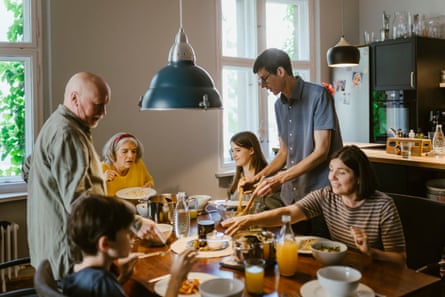
Julia plans to charge her son rent – in return for two meals a day, all laundry and the services of the family cleaner – but to bank the money as a deposit for him later. “You do what you can for them. I wouldn’t want to be 21 again now.”
She enjoys her son’s company, but the arrangement is not what she imagined for this stage of her life. Her husband had dreamed of buying a boat. She had promised herself that she would quit her PR job and retrain in something creative when the children left. But if the younger two follow their elder brother’s path, she will be in her 60s by the time they all leave, though she suspects her daughter will make different choices. “It’s a very attractive life, with central heating, your mum doing your laundry, getting your dad to give you a lift to the pub occasionally. But I think girls are a bit more independent.” The figures bear her out: 61% of 18- to 24-year-olds living at home are men.
Kate’s 19-year-old son is in his first year of university in Birmingham, living at home and commuting in. His 17-year-old brother has similar plans. Both boys were fearful of racking up huge debts with no guarantee of a job afterwards, she says, and keen to avoid taking maintenance loans. But that’s not the only advantage. “They’re coming home, having a shepherd’s pie, getting clean clothes – they’re not in freezing halls eating Pot Noodles.” In turn, she enjoys having them around a little longer. “I’ve been going to the gym with my eldest sometimes and it’s really lovely to go and do things like that together.” Kate has already told them that when they do leave, they’re welcome to move back later to save for a house deposit – the only way she can imagine them ever being able to buy.
Kate does worry that they’re not learning the life skills acquired by living independently. “I started off saying, ‘Right, come and learn how to do a stir-fry,’ but the truth is I still do absolutely everything. It’s just easier. If you’re putting a white wash on and it’s just half a load, you’re going to go round all the washing baskets to see if you can fill it, aren’t you?” But for her older son in particular, who suffered from anxiety towards the end of school, she thinks it was comforting to know that he wouldn’t have to leave home at 18 as she did.
Kate isn’t the only parent I speak to who mentions either mental health issues or a lack of emotional readiness to leave home, nor the only one who instinctively connects it to growing up during a pandemic.
“You know how we had lockdown and everyone was around each other all the time? Well, we’re used to it. We’re used to being a unit in some ways; we really learned how to tolerate each other in quite intense circumstances,” says Kate. It makes living together feel more natural, she thinks – though, as was the case in lockdown, she worries about young people whose families can’t or won’t take them back in. “You’re trapped then, aren’t you? And you have fewer chances in life.”
For home, it turns out, is an important safety net. The ISER team at the University of Essex found that far from being depressed about moving back into their old teenage bedrooms, on average boomerang kids’ mental health scores improved after they returned home, suggesting that they found it a relief. “A lot of young people who are living independently are often in rather poor housing, with a lot of stress, living in unstable private rented housing,” notes Prof Emily Grundy, the study’s co-author. Going home may feel like going backwards, but it often beats whatever sent you there.
Fiona was 37 when she moved back home with her baby son, after her partner’s death from a sudden illness. Still reeling from the loss, she had spotted a little house in the village where she grew up, hundreds of miles from her then home in London: the plan was to live with her parents for a year while it was renovated. In the end, she stayed nearly eight years.
At first, she was embarrassed to admit she had moved back to the house she left at the age of 17. “You do feel that you’re not a proper adult.”
Yet living together as adults has transformed her relationship with her parents in unexpected ways. “Moving back in was such an eye opener, seeing your parents as adults from an adult perspective,” she says. “I realised so many things about my relationship with them, and how I am as a person.”
Fiona has had issues around food and her weight, and coming home made her realise that her mother did, too. But with that understanding came a deeper bond. “I know them so much better now, and now that I’ve moved out again and I’ve got a bit more distance I have more empathy for them.” Her new house is only minutes away, so her parents still help with childcare. As they get older, she anticipates spending more time looking after them. “Before, I saw the idea of them getting older and needing help as being a burden. And now I view it completely differently – because of everything that’s happened, I’m closer to them.”
What are the ground rules for successful “full nesting”? At 77, Rob is a veteran: his daughter Jess moved back temporarily once after university, again when changing jobs, and is back again (this time with her five-year-old daughter, Evie) after separating from her husband, while her family home is being sold.
Over the phone from what was once their spare bedroom-cum-office, but is now, he sighs, “absolutely full of clutter”, Rob says he and his wife have found having their granddaughter around an immeasurable joy. But he recommends setting rules for who does what household chores, to stop everyone falling unthinkingly back into childhood roles, and charging rent. “I think every parent who has got adult children who moved home will recognise that all of a sudden the adults become children again. You do make assumptions about ‘whoever normally does the cooking will just carry on and cook extra for me’.” They have also learned to meet halfway over the state of the house: “If my daughter was here she’d say I was over-tidy, and I would say she was untidy. You have to be prepared to compromise.”
But while they have always got on well, he says, there are also perhaps deeper reasons for their closeness as a family. Jess was born a twin, and her sister died during the pandemic. “It brought us together against the world, really,” says Rob, quietly. “There was no way we weren’t going to do this.”
Financial planner Jane Gow, meanwhile, advises that parents shouldn’t jeopardise their own security in retirement when trying to help their children out.
“I say: ‘You need to put your own oxygen mask on first,’” says Gow, whose own four adult children have all boomeranged back at various points. Once children leave, she argues, parents are perfectly entitled to downsize, or to rent their old bedrooms out if they need the money; to stop paying for their phones and car insurance, and to ask for rent if they do return. “This is when, really, the big pension contributions should be coming in, in the last few years while we still can.”
For parents of younger children, she recommends encouraging independence early by getting them to do their fair share of chores and to save small amounts of pocket money. If they’re at university: “It’s sitting down and budgeting with them, or when they get used to paying bills.”
And if it’s too late for all that? Maybe don’t make any plans to redecorate.
“If I went home in the 90s to my parents, they would have said: ‘But we’ve turned your bedroom into something else,’” says Kate, resignedly. “You’re not thinking that now, are you?”









 English (US)