
 2 days ago
4
2 days ago
4

Kate WhannelPolitical reporter

 PA Media
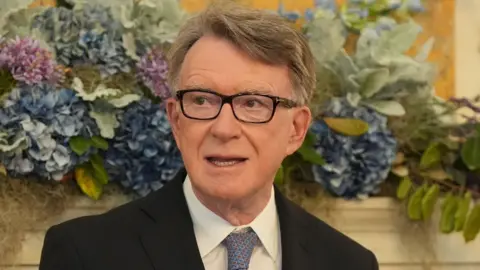
Peter Mandelson has resigned from the Labour party over fresh revelations about his close friendship with the late convicted paedophile Jeffrey Epstein.
Lord Mandelson, who was sacked as the UK's ambassador to the US in September last year, appears repeatedly in the latest release of files by the US Department of Justice.
With the latest tranche of documents, which reveal more details about the relationship between the financier and the politician, Lord Mandelson's public career appears at an end.
It is a staggering fall for a man whose political life was spent at the heart of the Labour party.
Mandelson was born into Labour Party royalty - his grandfather was Herbert Morrison, a cabinet minister in Clement Attlee's 1945 government, revered by Labour members.
He began working for Labour in the 1980s, when the party was at its lowest ebb, suffering successive defeats to Margaret Thatcher's Conservatives.
The painful 1992 defeat - when Neil Kinnock's Labour were unexpectedly beaten - spurred Mandelson in his belief that the party needed to modernise if they were ever to get back into government.
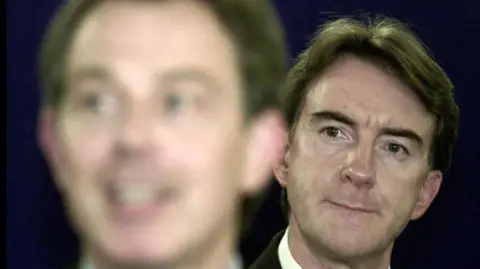
In 1994, he played a pivotal role in getting Tony Blair elected as party leader - crucially backing him over Gordon Brown, who had been seen as the heir apparent.
For a long time it seemed that Brown would never forgive his former ally for this, in his eyes, betrayal.
 PA Media
Peter Mandelson was seen as instrumental to Tony Blair's landslide victory in 1997
Despite lingering tensions, the three men continued to work together and were the key architects of New Labour, the rebranding aimed at making the party electable.
In 1997 their work paid off, and following the landslide victory, Mandelson was given the job of minister without portfolio and then trade secretary.
The archetypal spin doctor, his reputation as a behind-the scenes fixer, schemer and schmoozer earned him the nickname, "the Prince of Darkness".
In 1998, he was forced into the first of his government resignations when it was revealed he had received a secret loan of £373,000 from his ministerial colleague Geoffrey Robinson.
Less than a year later he was back in government taking on the position of Northern Ireland secretary.
He lasted in that job until January 2001, when he quit over allegations of misconduct over a passport application for the Hinduja brothers. An inquiry later cleared him of wrongdoing.
His indignation at being booted out came boiling over later that year when he held onto his constituency seat of Hartlepool, despite challenges from left-wing candidates.
In an extraordinary and emotional victory speech, he said: "It was said that I was facing political ruin. My career in tatters, apparently never to be part of the political living again.
"Well, they underestimated Hartlepool. And they underestimated me. Because I am fighter and not a quitter!"
Two years later he quit as an MP to become the EU's trade commissioner.
"I'm a fighter, not a quitter" - Peter Mandelson's famous line from election night in 2001
When Brown became prime minister in 2007, another comeback in British politics for Mandelson looked unlikely.
But in a shock move, a beleaguered Brown, suffering low polling ratings, appeared to bury the hatchet and appointed his former friend as business secretary, making him a peer at the same time.
Mandelson was tasked with reinvigorating the government, which appeared to have run out of steam after a decade in power.
While many Labour backbenchers and members acknowledged Mandelson's presentational skill and strategic nous, they held him responsible for ditching some of the party's key socialist principles.
He was held in such suspicion, that Tony Blair once said the New Labour project would only be complete when party members had "learnt to love Peter Mandelson".
Mandelson himself said that was setting the bar too high. However, he seemed to have succeeded at the 2009 Labour Party conference when Mandelson delivered a rousing speech to despondent delegates, telling them: "If I can come back, we can come back."
 Reuters
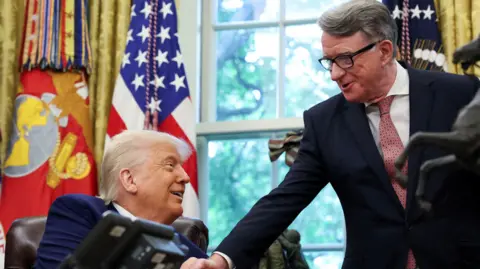
Donald Trump had praised Lord Mandelson for his work as ambassador
After Labour lost power, Mandelson started international lobbying firm, Global Counsel, where he was able to continue amassing influential contacts in business and politics.
These contacts, along with his ability to charm (he was nicknamed "silver tongue" by US President George W Bush), were among the reasons he was considered a strong candidate when Prime Minister Sir Keir Starmer was looking for a new ambassador in Washington.
He had holidayed with Trump's Treasury Secretary Scott Bessent and made connections with Mark Burnett, the TV producer of the Apprentice, the show that sparked Trump's rise to power.
Given the job in December 2024, he was the man Sir Keir tasked with building links to the incoming Trump administration.
Mandelson had been widely-considered to have performed well in his first months as ambassador, but following the public release of his embarrassing correspondence with Epstein - and the threat of more to come - No 10 decided to jettison him.
Throughout his career, Mandelson's ability to hob-nob with the rich and powerful has been an asset but repeatedly got him into trouble.
Earlier this year, a friend of Mandelson told the BBC: "He has weaknesses. He likes the high life. A lifestyle he can't afford."
Former MP Ben Bradshaw, who was in the cabinet with Mandelson, likened him to "a sort of Icarus type figure".
"He's proved himself to be extremely effective in a number of jobs but at times he's flown too close to the sun," he told the BBC's World at One.
At the age of 72, having been forced out of office three times across four decades, it could be that this really does mark the last chapter in Peter Mandelson's extraordinary career.
At the start of this year, he gave an interview to the BBC, where he said he never saw girls at Epstein's properties.
He initially declined to apologise to the late paedophile's victims for maintaining his friendship with the American because he was not "knowledgeable of what he was doing".
He offered an "unequivocal apology" to the victims shortly afterwards, explaining "I did not want to be held responsible for his [Jeffrey Epstein's] crimes of which I was ignorant, not indifferent, because of the lies he told me and so many others".
In February, the latest release of files by the US Department of Justice revealed documents suggesting Epstein made $75,000 (£55,000) in payments to Lord Mandelson in three separate $25,000 transactions in 2003 and 2004.
Lord Mandelson then quit the party he has been a leading player in for more than three decades, saying he did not want to "cause further embarrassment".
In his letter to Labour's general secretary, Lord Mandelson said: "Allegations which I believe to be false that he made financial payments to me 20 years ago, and of which I have no record or recollection, need investigating by me.
"While doing this I do not wish to cause further embarrassment to the Labour Party and I am therefore stepping down from membership of the party.
"I want to take this opportunity to repeat my apology to the women and girls whose voices should have been heard long before now."



 English (US)