
 1 hour ago
2
1 hour ago
2

Dearbail JordanBusiness reporter

 Getty Images
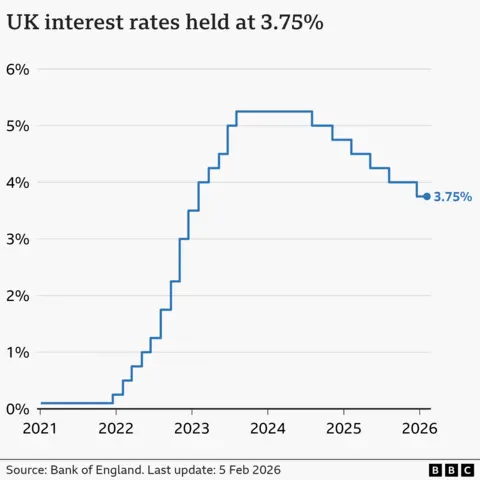
The Bank of England has held interest rates at 3.75% after a knife-edge vote but has opened the door to cuts later this year.
Borrowing costs were widely expected to be unchanged after the Bank reduced them from 4% in December.
Bank of England governor Andrew Bailey reiterated his forecast that inflation – which measures the pace of price growth - would fall close to the Bank's 2% target from April onwards, against a previous expectation it would hit that level in 2027.
"That's good news," said Bailey. "We need to make sure that inflation stays there. All going well, there should be scope for some further reduction in [the] Bank Rate this year."
The most recent inflation data showed the rate increased to 3.4% in December, above the Bank's target.
However, the Bank said policies announced in the Budget, such as cuts to household energy bills, as well as lower wholesale gas prices were expected to help cut the rate.
Despite this, the Bank cut its forecast for UK economic growth in 2026 – from the 1.2% growth it forecast last November to 0.9%. The unemployment rate is also expected to tick higher this year, according to the Bank, up from an initial forecast of 5% to 5.3%.
The decision to hold interest rates this month was a close call, with four of the Bank's nine-member monetary policy committee (MPC) voting for a quarter point cut which would have taken borrowing costs to 3.5%.
The only member to change their position from December's vote was Bailey. He voted to hold rates, but said he could "see scope for some further easing of policy".
Announcing its latest decision, the MPC said: "On the basis of the current evidence, [the] Bank Rate is likely to be reduced further.
"Judgements around further policy easing will become a closer call. The extent and timing of further easing in monetary policy will depend on the evolution of the outlook for inflation."
Analysts said the Bank's comments have brought forward expectations over when the next rate cut will be, with the focus now on the MPC's next two meetings in March and April.
"It seems it wouldn't take much to prompt a majority of MPC members to vote for another cut to 3.50% in the coming months," said Paul Dales, chief UK economist at Capital Economics.
"We've pencilled in the next cut for the meeting in late April, but wouldn't completely rule out March," he added.
Lindsay James, investment strategist at wealth management firm Quilter, said: "Markets had not been fully pricing in the first rate cut until June, but this has shifted to April following today's report."

Bart Ambrozik has decided that now is the right time to buy a home.
The latest vote comes as the housing market gears up for what is generally the busiest time of the year.
Analysts and mortgage brokers said some buyers – or those renewing a mortgage deal – may have been disappointed that rates were left unchanged.
"Today's decision to hold rates, coupled with uncertainty over exactly when further cuts may materialise, may feel unsettling for homeowners and prospective buyers hoping for further improvements in the mortgage market," said Alice Haine, personal finance analyst at Bestinvest.
But she said there were further cuts in the pipeline, which could eventually lower new, fixed mortgage rates.
Bart Ambrozik, a HGV driver from Coventry, has been trying for three years to buy his first house.
Interest rates on mortgages were so high that it was too expensive for him to do so, but he says now they are lower it is the "perfect" time.
"I feel happy, and also quite confident putting offers down but I found that there's more people trying to do the same thing, so getting a mortgage or property is more difficult than it was a few years ago," he says.
But he says he will keep trying because now "paying a mortgage would be cheaper for me than renting".
For savers, more than two-thirds (70%) of savings providers have cut their rates since the start of the year, according to financial information service Moneyfacts.
Meanwhile, inflation has been lingering above target - so the spending power of savings is being eroded.
A lower inflation rate would help the latter, but savers may have to brace for further cuts to their returns in the coming months, analysts say.
While the Bank's inflation forecasts have improved, economic growth is expected to be lacklustre this year as the cost of living continues to affect households and those who have spare cash are choosing to save rather than spend.
Chancellor Rachel Reeves's decision to lift National Insurance Contributions for employers as well as increasing the minimum wage also continues to weigh on businesses and the jobs market.
Firms who spoke to Bank of England agents across the UK indicated that instead of passing on the higher cost of employment to customers by raising prices, they have reduced jobs or taken a hit to their profit.
While there have been redundancies, there was more evidence that companies are simply not hiring and a recent rise in unemployment "has been concentrated among the youngest age groups".
Looking ahead, businesses told the Bank they believed that food price inflation "has peaked". Prices for goods such as cocoa and cattle rose sharply last year but companies and producers said these have since fallen from recent highs.
Bailey 'shocked' by Mandelson revelations
It follows suggestions Mandelson sent market-sensitive information to Epstein while serving as a Cabinet minister.
"A year ago I had to give evidence in a legal case around this issue," Bailey said. "I was having to push back on the lies we were being told consistently.
"I am shocked by what we heard at that time about the financial crisis period.
"We have to remember that the most important thing is the victims in all of this."
Additional reporting by Kevin Peachey and Adam Woods




 English (US)