
 8 hours ago
3
8 hours ago
3

12 minutes ago
Mark Poynting and Esme StallardBBC News Climate & Science

 Reuters
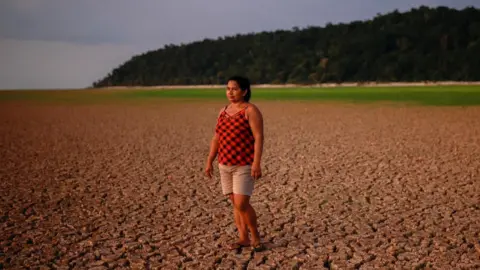
El Niño and human-caused climate change intensified the severe Amazon drought of 2023-24, scientists say
The latest phase of the natural La Niña weather pattern has come to an end, US science agency Noaa has announced.
The opposite El Niño phase is expected to develop later in 2026, with initial signs suggesting it could be a particularly strong event.
La Niña and El Niño are among the most important natural weather patterns on Earth, and can affect temperatures and rainfall around the world.
What are El Niño and La Niña?
El Niño and La Niña are the two opposite states of a natural climate phenomenon called the El Niño Southern Oscillation (ENSO).
El Niño and La Niña occur in the Pacific but can affect weather systems across the world.
The two states are often identified by sea surface temperatures in the tropical eastern and central Pacific Ocean. During El Niño, these waters are warmer; during La Niña, they are cooler.
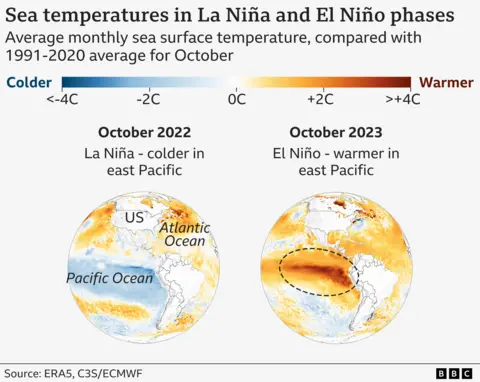
The phases can also be distinguished by differences in atmospheric pressure. During El Niño, pressure is above normal at Darwin, Australia (western Pacific) and below normal at Tahiti, French Polynesia (central Pacific). For La Niña, the opposite is true.
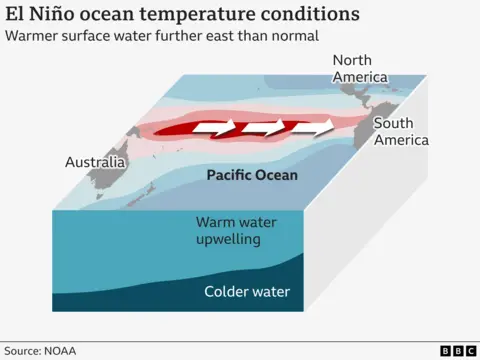
In "neutral" conditions - neither El Niño nor La Niña - surface water in the Pacific Ocean is cooler in the east and warmer in the west.
Trade winds tend to blow east-to-west, and heat from the Sun progressively warms the waters as they move in this direction.
During El Niño, these winds weaken or reverse, sending warm surface waters eastwards instead.
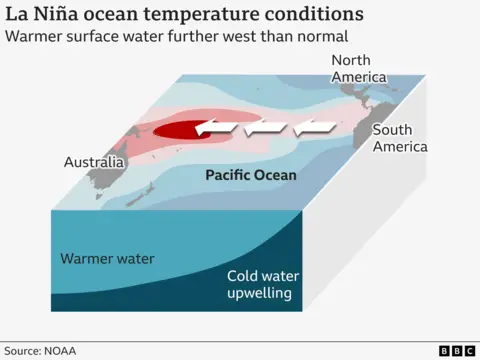
In La Niña periods, the normal east-to-west winds become stronger, pushing warmer waters further west.
This causes cold water to rise up - or "upwell" - from the depths of the ocean, meaning sea surface temperatures are cooler than usual in the east Pacific.
The phenomenon was first observed by Peruvian fisherman in the 1600s, who noticed that warm waters seemed to peak near the Americas in December.
They nicknamed it "El Niño de Navidad" - Christ Child in Spanish.
How do El Niño and La Niña change the weather and environment?
Not every event is the same, and the consequences vary between regions and times of the year.
However, scientists have observed some common effects.
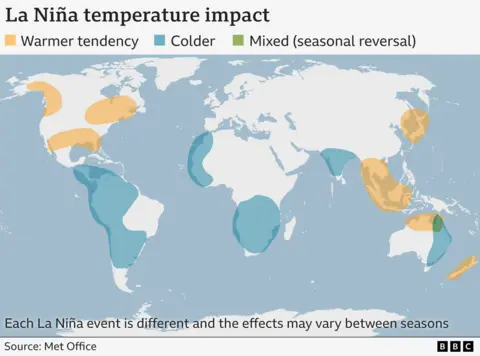
Global temperatures typically increase during El Niño, and fall during La Niña.
El Niño means warmer water spreads further, and stays closer to the surface. This releases more heat into the atmosphere, creating wetter and warmer air.
But the regional effects are complicated, and some places may be both warmer and cooler than expected at different points in the year.
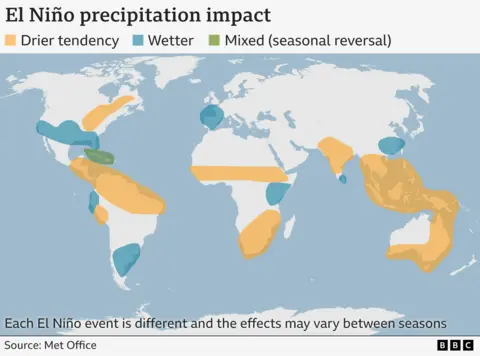
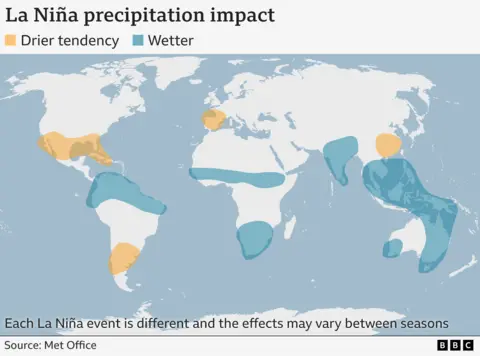
The maps below show some typical effects, but they may only be true for parts of the year.
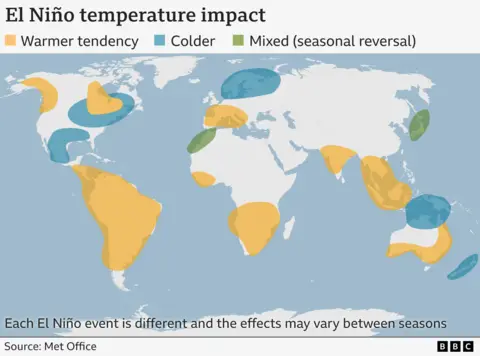
The way the two systems affect UK temperatures is complicated, and can vary.
But El Niño may increase the chance of a mild start and cold end to UK winter, according to the Met Office, whereas La Niña can make a colder start and mild end to UK winter more likely.
During El Niño, the warmer water pushes the Pacific jet stream's strong air currents further to the south and the east.
This brings wetter weather to southern United States and the Gulf of Mexico.
Tropical regions like southeast Asia, Australia and central Africa typically experience drier conditions.
La Niña typically brings wetter conditions to parts of Australia, Indonesia and equatorial South America, and drier conditions to the southern United States.
El Niño tends to bring more tropical storms in the tropical Pacific, but fewer in the tropical Atlantic, including the south-east US.
During La Niña, the reverse is typically true.
Carbon dioxide (CO2) levels
If plants grow less quickly due to drought, they absorb less CO2, while more wildfires in places like South Asia mean more CO2 is released.
Why do the El Niño and La Niña climate patterns matter?
The extreme weather events worsened by El Niño and La Niña affect infrastructure, food and energy systems around the world.
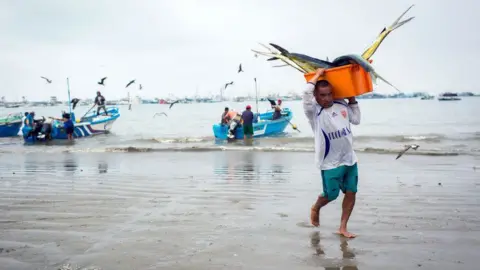
For example, when less cold water comes to the surface off the west coast of South America during El Niño events, fewer nutrients rise from the bottom of the ocean.
That means there is less food available for marine species like squid and salmon, in turn reducing stocks for South American fishing communities.
 Getty Images
Fishing stocks can be affected by the effects of El Niño
How often do El Niño and La Niña episodes happen?
El Niño and La Niña episodes typically occur every two to seven years.
They usually last for nine to 12 months, although they can persist for longer, and they don't necessarily alternate.
La Niña had been largely present since mid-2024 but has now come to an end.
It means conditions in the Pacific are now "neutral" – neither El Niño nor La Niña.
But El Niño is likely to begin between May and July and last at least until the end of 2026, Noaa says.
Some forecasts suggest it could be a particularly strong "super El Niño".
Is climate change affecting El Niño/La Niña?
In 2021, the UN's climate scientists, the IPCC, said the ENSO episodes that have occurred since 1950 are stronger than those observed between 1850 and 1950.
But it also said that tree rings and other historical evidence show there have been variations in the frequency and strength of these episodes since the 1400s.
The IPCC concluded there is no clear evidence that climate change has affected these events.
But this is a complex and uncertain area of science and there is no clear consensus.
Additional reporting by the Visual Journalism team.




 English (US)