
 3 hours ago
3
3 hours ago
3

A broken upright piano, tilted like the sinking Titanic, stands part-buried in a garden at Glasgow’s Counterflows festival. Experimental composer Annea Lockwood swipes a hand across its exposed strings and beams at the metallic clang. “Great piano!” she says, inviting other musicians and the audience to make their own strange noises by scratching and tapping it with garden debris.
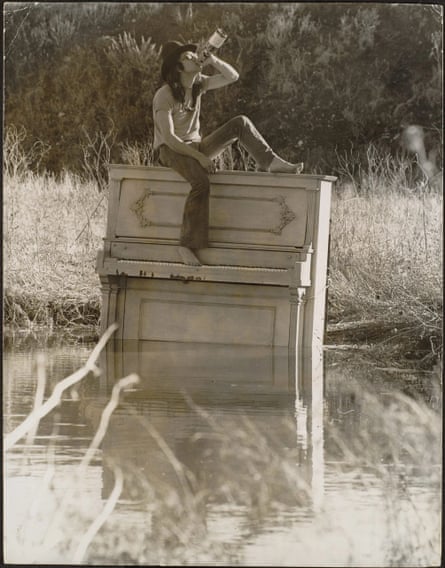
It’s one of many pianos Lockwood, 86, has buried, burned or drowned since the 1960s, exploring their changing sounds as they are destroyed – though she says “transformed”. A pioneer of field recordings, her work has ranged from “sound maps” of entire rivers to music made with the peace walls demarcating areas of mid-Troubles Belfast. As she revisits two significant works at Counterflows and prepares a new release of 1975’s World Rhythms, she takes me through her radical career from the very start.
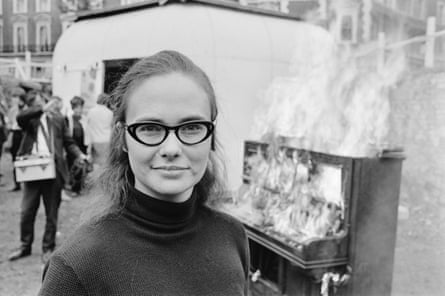
In her hotel, she laughs as we watch a 1966 BBC interview capturing rehearsals of her first major work The Glass Concert, amplifying glass objects being played or broken. “I’ll leave you to your music,” the interviewer says, to which the 27-year-old Lockwood smiles before slamming a towel-wrapped object through a windowpane. The New Zealand native tells me that after moving to the UK and completing her University of Canterbury music degree in 1961, she studied electronic music around Europe, but found only “dead sound”. Environmental sound attracted her with “its complexities, its instabilities and, often, its unrecognisability”. The glass experiments asked a question she has considered ever since. “What if we listened to a single sound event in the way we would a musical phrase?”
It foregrounded 1968’s Piano Burning, setting an old piano alight to record its splitting wood and popping strings. Wrapping the microphone in asbestos – “those were innocent times!” – the first recording at a London festival was ruined by chattering bystanders, so they burned a second at night. “It was even more beautiful in the dark. We fastened balloons all over it so they would pop.” Gathered with friends afterwards, “we did a seance for Beethoven to see what he thought”. Setting a tape recorder running, her friend called “‘Ludie? Ludie?’ When we quiet down, you hear a decidedly strange sound on the tape recorder.” Whatever Beethoven’s opinion, Piano Burning still captures imaginations. When I mention experimental rap trio Clipping’s 2019 version, she nearly jumps from her seat. “That is the most beautiful recording!”
Imagining “a natural process modulating an instrument” inspired 1969’s Piano Garden, revived at Counterflows: “planting” a piano to see how its sound changes as plants grow through the mechanism. After planting three near her Essex home, “an old man walked in from the lane and started playing Für Elise.” How did it sound? “Beautifully out of tune.” Sadly, these were removed when she left for America in 1973, invited by experimentalist Pauline Oliveros.
At Counterflows, an audience in Glasgow’s Community Central Hall watch a performance of Lockwood’s Bayou-Borne. Written for Oliveros shortly before her death in 2016, it is inspired by six converging bayous near her birthplace of Houston, Texas. An accordionist onstage is slowly joined by a percussionist, trumpeter, flautist and two violinists, improvising as they enter from the room’s edges. It is a captivating tribute to Oliveros, who changed Lockwood’s life by introducing her to another composer: Ruth Anderson.
In 1973 Anderson secured a sabbatical from teaching at New York’s Hunter College, and Oliveros suggested Lockwood replace her. “Ruth and I fell for each other right off the bat,” Lockwood says wistfully. She’d visit Anderson’s cottage in New Hampshire, where she was making her tape piece SUM: State of the Union Message – “there were bits of tape pinned all over the room” – and they phoned each other every day. Anderson recorded many of those calls, collaging snippets with old love songs into Conversations, a piece the pair kept private. “We said to each other: ‘We’re going to play this when we get old.’”

They did grow old together, eventually marrying. Sitting by a lake one day listening to their surroundings, they wondered: “Wouldn’t it be amazing if we could hear all the world rhythms folded into one enormous rhythm?” Lockwood’s World Rhythms mixes recordings of earthquakes, volcanoes, geysers and human biorhythms – someone would strike a tam-tam, only striking again when the physical sensation of moving had entirely passed. A new expanded version, revised by Lawrence English using remasters of the original tapes, reveals even more of the sounds that Lockwood collected. For the similarly ambitious A Sound Map of the Danube, she travelled Europe’s second-longest river collaging recordings of the wildlife and people, asking them: “Could you live without it?”
Anderson died in 2019, and Lockwood rediscovered Conversations – she and Anderson had forgotten to listen back to it. “When she died, I wanted to be talking to her, and I wanted to go back to the places where we had been together in that first year.” Lockwood returned to their favourite nature spots and combined field recordings with samples of their phone calls into the intensely poignant piece For Ruth, released alongside the original, no-longer-private Conversations. For her, the pieces “talk to each other”.
Lockwood’s experiments continue. Last year’s sombre On Fractured Ground features recordings of Belfast’s walls dividing Catholic and Protestant neighbourhoods. She recalls when collaborator Pedro Rebelo “picked up a leaf and he started running the leaf’s stem across the wall – we were getting beautiful high sounds,” but at this her smile fades. “All of this sound-generating stuff – it has such tragedy. It’s encased in such tragedy,” she says. “I started doing a lot of reading around the Troubles before we started work,” moved by stories of figures like Bernadette Devlin and the 1969 Battle of the Bogside. “It’s still with me.” The sounds she pulls from these walls are hard to place, but for her that’s part of the point. “In the process of not being able to recognise a sound, we listen more intently.”
It’s true. After seeing Piano Garden, I describe a heightening in the ambient sound I’ve noticed. Lockwood punches the air, having devoted her life to music less about making sound than encouraging listening. However strange the sounds might be, “if you’re focusing your attention so strongly on listening, it’s a form of meditation,” she grins. “Which is so nourishing.”







 English (US)