
 2 hours ago
3
2 hours ago
3

Outside the V&A’s new outpost in east London, a nondescript young person stares blankly out across the old Olympic Park. This five-metre-tall sculpture is generic by design, an amalgam of “images, 3D scans and observations” of local people. It is easy to see why Thomas J Price’s idea appealed to a museum eager to engage with the area’s diverse communities – here is the quintessence of east London youth, executed at the scale of Michelangelo’s David – but by smoothing out the differences between individuals it sends out a confusing message.
To aggregate data and identify common denominators is, after all, the logic of the algorithm. So the worry is that this museum will likewise second-guess the desires of its audience based on predictive models, guiding visitors towards things they are predisposed to “like” and away from opinions they are presumed not to share. So it is a relief to find, on entering the building, a vision of how people make and cultures meet that is infinitely richer, more heterogenous and more open-ended than those first impressions suggest.
The first of two galleries displaying items from this new museum’s collection is a delight. A zinging constructivist rug by Eileen Gray rhymes with Derek Jarman’s punk set designs and costumes by Vivienne Westwood and Rei Kawakubo. Yet even these are upstaged by Althea McNish’s glorious printed fabrics, which show how a designer working within the infrastructures of mass production effected a more profound influence on the look of postwar Britain than any number of haute couturiers. Here is a salient example of how difference – McNish speaks in an accompanying video about bringing the colours of her native Trinidad to her new home – not only enriches but comes to define a culture.
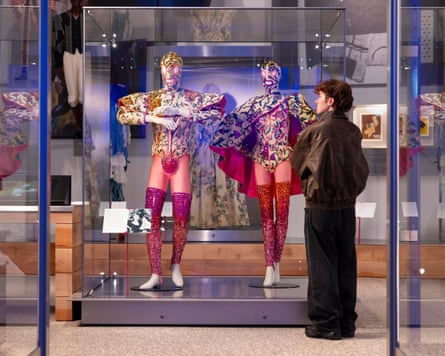
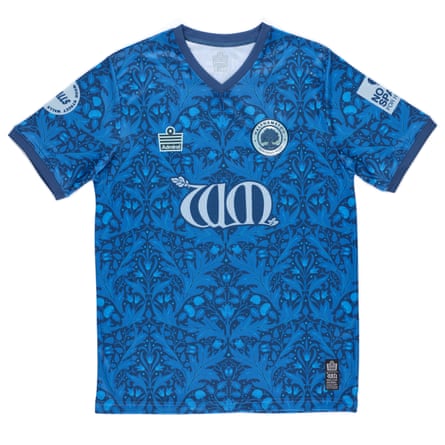
More themes emerge. The placement of a painted Japanese screen recording the arrival of European sailors next to a textile documenting the 2011 Egyptian revolution suggests that attention will be paid to colonial expansion and imperial violence, two things that haunt the V&A’s collection. A display exploring the connection of William Morris to nearby Walthamstow serves notice that objects will consistently be pegged to the place where they were produced. Like McNish, who produced fabric patterns for British Rail as well as Liberty prints, Morris showed how the integration of art into the fabric of everyday experience could improve the living conditions of every member of society.
That our wellbeing is a function of our environments is epitomised by a sinuous wooden armchair from the sanatorium designed by Alvar Aalto, while an extraordinary talismanic shirt, inscribed with the entire text of the Qur’an, offers another example of how everyday items are invested with restorative properties. Arakawa and Gins’ model for a “life-extending villa”, which reimagines the home as an obstacle course to keep residents nimble, makes a neat analogy for a curatorial strategy that encourages visitors to choose their own route and make their own connections. Not everything works, but the principle is admirable.
It also points to the real value of the museum. As a resident of the borough, I can attest that one thing Hackney does not lack is creatives “celebrating their creativity” (they regularly celebrate their creativity in my apartment block, for instance, when I am trying to sleep). But looking past the language of the press release, it is clear that the curators have not mistaken the arrival of a new museum in this part of London for the arrival of culture. Instead, they position the museum as something closer to a toolbox or kitty, a shared fund of precedents and models that aspiring artists and designers are invited to raid.
It is easy to imagine, for example, how a shirt woven entirely out of salmon skins by a Nivkh craftsperson might inspire a young designer working with renewable materials; or how a photomontage by Claude Cahun could encourage a young person constrained by the identity assigned by society. The most useful resource for those who want to change the future is always, ultimately, the past. A bamboo house by Indonesian architecture practice Ibuku is typical of how a new generation of designers are returning to traditions suppressed during modernity in order to renegotiate our relationship to each other and the natural world.
Entering The Music Is Black: A British Story, the museum’s inaugural temporary exhibition, you receive headphones fitted with a sensor that guides you through this labyrinth of videos, costumes, sculptures and photographs with the songs they chronicle. This admirable attempt to trace the manifold musical cultures that came out of the violent displacement of African people by the slave trade is, inevitably, a victim of its own vast ambition. But in this necessarily synoptic history of Black music are the seeds for many other exhibitions, from the media hysteria surrounding the birth of grime at the turn of the century to 2 Tone and the anti-racist coalitions of the late 1970s.
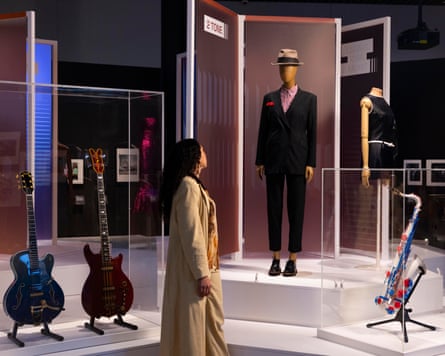
Perhaps this seeding of ideas is the point – because The Music is Black establishes an exhibition model well suited to the institution. A story pertinent to the V&A’s own colonial history is told through the culture that emerged from and contests it. The combination of powerful music with contextualising information produces the complexity that only comes when the senses and the intellect are forced to operate at the same time, and cannot find alignment.
The show does not attempt to square the horrors of the slave trade or the racism experienced by Black Britons with the music that emerged from those experiences. The visitor is instead asked to hold those two things in their minds and their bodies, and to reflect on the capacity of music to express suffering even as it provokes joy.








 English (US)