
 1 hour ago
2
1 hour ago
2


Pablo Iglesias Maurer
Asking any of us to believe that Fifa is not influenced by Donald Trump is an absurdity. It is tantamount to asking us to believe he was awarded its “peace prize” on merit alone. Infantino’s relationship with Trump has long been a cozy one, a mutually beneficial symbiosis where Trump gets the type of sycophantic praise and attention he thrives on and Infantino gets the keys to the biggest commercial market in the world for Fifa’s cash cow.
What Trump does not realize – or perhaps he simply doesn’t care – is that he has done the whole of American soccer no favors by putting his thumb on the scales.
The USMNT have reached their current station in the tournament on their own merits, riding three exceptional performances and one bang average one to the last 16. Balogun has been arguably the their best player throughout that run.
Yet even without the Monaco striker, there was no shortage of pundits and oddsmakers pegging the US as likely to win against Belgium. The perception the US have been handed an unfair advantage here – they have, to be clear – taints their potential advancement. This is true in the States, but much more so globally where Trump has become the latest in a long line of ugly Americans who are perceived, fairly or unfairly, to have expected preferential treatment.

Alexander Abnos
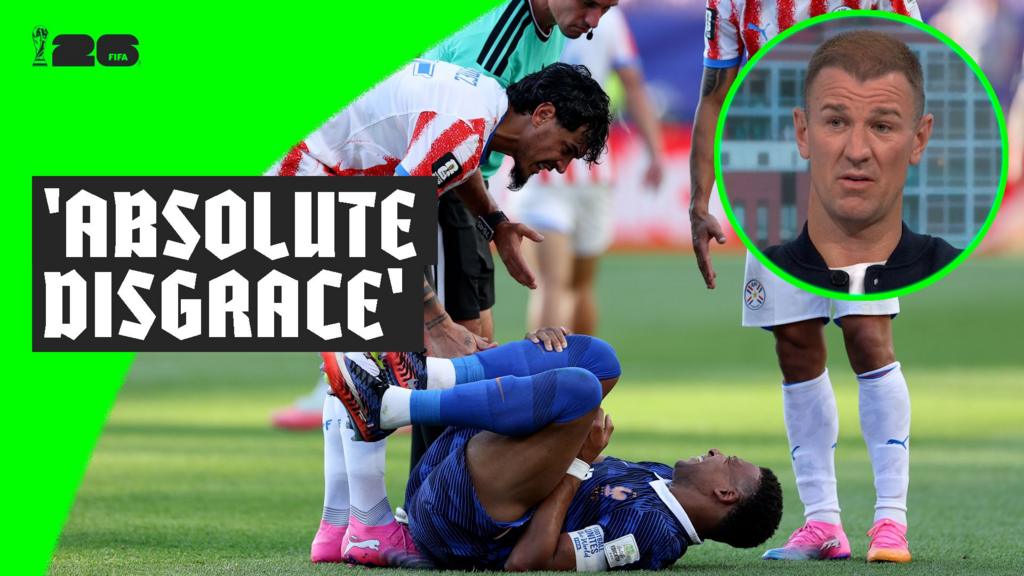
Mauricio Pochettino hailed Fifa’s shock decision to suspend Folarin Balogun’s one-game ban on Sunday, reiterating his claim that the call to issue the US striker a red card was harsh.
“Everyone that really loves the sport and trusts ethics and integrity, I think we celebrate all that decision,” Pochettino said. “We were punished enough against Bosnia Herzegovina to play with 10 men for 30 minutes [because of] a decision that was completely unfair. … 99.9% of people agree there was an unfair red card.”
As a Fifa media officer read aloud the statement confirming the governing body’s shock reversal of US striker Folarin Balogun’s suspension on Sunday, Belgium coach Rudi Garcia and goalkeeper Thibaut Courtois put their poker faces to work. Garcia stared straight down the aisle of the press conference room at Seattle Stadium. Courtois’s eyes fluttered about, perhaps masking some rolls as he faced a press pack eager to make sense of an unexpected World Cup twist.
Balogun’s reinstatement came across as a joke to the Belgian boss, though he hardly seemed ready for a laugh.
“I didn’t know that 5 July was equal to 1 April [April Fools’ Day] at Fifa,” Garcia said in his native French. “I think we should refer to the [statement] of my federation, the Belgian federation. I think a lot of things are in it. The federation does not defend itself, it does not defend the national team – it defends football in general. It defends its integrity. It defends its ethics.”
Through four games, Belgium have retained 57% of possession with a 65% field tilt – a possession metric weighing only final-third touches – but haven’t found a way to maximize that advantage.
While possession can be a noisy statistic, viewing it in stylistic terms can be informative. So far at this World Cup, Belgium have won the possession battle in all four of their games, with Senegal playing them closest in a 52-48 split. The United States have maintained a 58% share of the ball in their four games, neck-and-neck with Garcia’s Belgium. If Mauricio Pochettino’s side can keep the ball off Belgian feet more often than not, it could unsettle the Red Devils.
Senegal nearly beat Belgium by using width, quickly getting the ball to their wingers and creating overloads by having full-backs join the attack.
Alexander Abnos
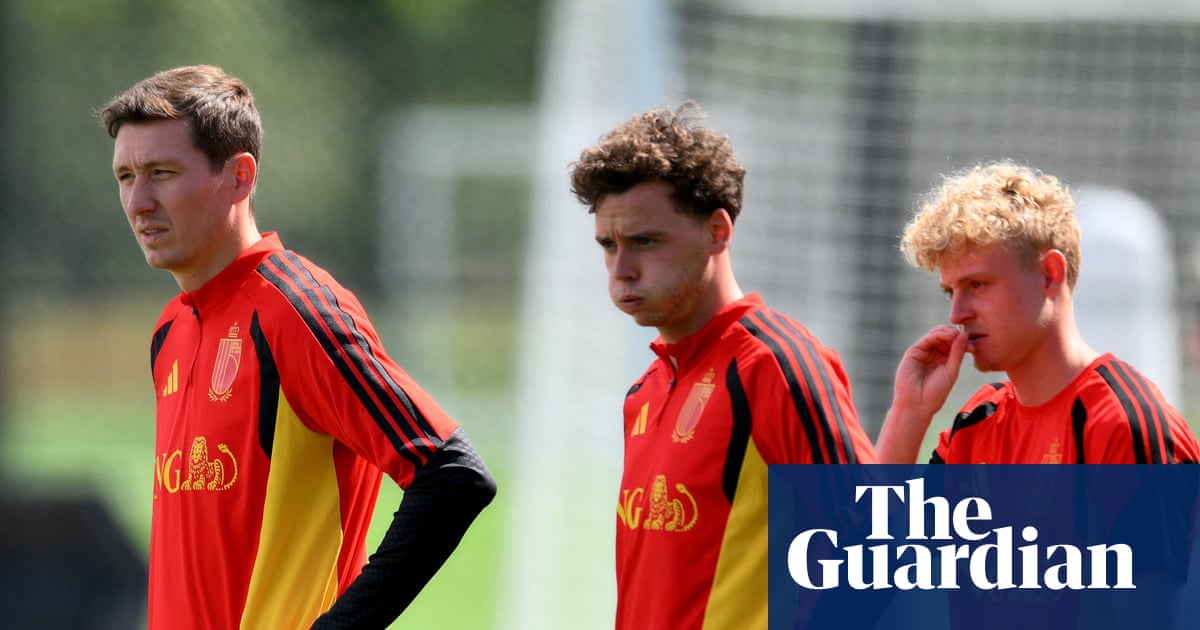
A raucous, pro-US crowd is expected in Seattle for the Americans’ last-16 match against Belgium on Monday, but the Red Devils say that they don’t fear the atmosphere that will await them.
“I think we just have to … show balls on the pitch,” left-back Maxim De Cuyper said on Friday. “Try to play your own game. If you play against 80,000 supporters or with 80,000, you have to try to do the same.”
Alexander Abnos
To longtime US soccer fans, the question of whether to support this particular team at this particular time is barely a question. Or if it is one, it’s vaguely along the lines of “should I breathe?”
But there are plenty of newcomers along for the ride now, who may only watch the team at a World Cup, if ever. Within this group, it stands to reason that plenty will be uncomfortable with the idea of supporting a US national sports team at all. I can hardly blame them.
If you’re looking for a reason to support the US men’s national team, I beg of you, look out your window. If there is a moment of triumph to be had when the team play Belgium, there will probably be thousands upon thousands of people in your immediate vicinity experiencing the purest joy that one can feel; the kind only sports can deliver with regularity. They will be your neighbors and friends, your co-workers, the clerk at the grocery store, the kitchen staff at your favorite restaurant. They have been in your life before this US run. And they will be there after.
While Malik Tillman was unsure what to expect from the United States’ last-32 clash with Bosnia and Herzegovina, he certainly must have assumed he would finish the game with his boots intact.
Fifteen minutes after swapping his ripped right boot, his new shoe made its mark. Playing down a man after Balogun’s red card, the US won a free-kick just beyond the edge of the box. After consulting with Antonee Robinson, Tillman hit a pearl of a free-kick over the Bosnia and Herzegovina wall and into the net.
Tillman’s technique on his free-kick goal against Bosnia was sublime. Tillman became just the second player in USMNT history to score from a direct free-kick at a World Cup, joining Eric Wynalda’s loop in 1994.
Fifa has released a pair of statements in the wake of its change in handling Folarin Balogun’s red-card punishment. The latest is a 13-point defense of its operation, distancing itself from the influence of Donald Trump and adding a $40,000 fine to Balogun’s bill. Capology estimates that Balogun earns $70,856 (€61,923) per week with AS Monaco.
“Under Article 27 of the [Fifa Disciplinary Code], the FIFA Disciplinary Committee has the discretion to suspend the implementation of any disciplinary measures so long as they do not relate to match manipulation—which, of course, did not occur here. … Said suspension of the implementation was decided considering all of the specific circumstances surrounding the incident and evidence available.”
Ella Brockway
We could see another record viewership for this World Cup version of Monday night football…
The United States’ last-32 win over Bosnia and Herzegovina had an average of 24.429 million viewers on Fox, making it the most-watched English-language soccer broadcast in US history. The Fox telecast peaked at 31.883 million. Telemundo, which holds the Spanish language rights to World Cup broadcasts in the US, reported 9.1 million viewers over the total game window.
This year’s NBA Finals between the New York Knicks and San Antonio Spurs – which had their highest audience in nearly three decades – averaged an audience of 20.5 million, with Game 5 averaging 24.5 million and peaking at 33 million. The final game of last year’s World Series averaged 27.3 million viewers in the US.
Pablo Iglesias Maurer
As we prepare for our fifth US match, it has to be stressed: the red-and-white, “wavy flag” themed kits the USMNT have sported this summer are quite possibly the most popular shirts the US has ever worn. They are absolutely, positively everywhere, seen in far greater numbers than the other fan favorites of the past — the “Waldos,” the “Bomb Pops,” etc ...
Ironically, the second-most frequently spotted kits this summer are easily Adidas’ old “Denim Kits” from 1994, which were always a curiosity to see in years past. Adidas re-released them ahead of this summer’s tournament, and they’ve sold thousands upon thousands of them. You love to see it.
Alexander Abnos
It must be said: it’s an absolutely gorgeous day here in the Pacific Northwest. It’s warm – but not too warm – and bright – but not too bright. There’s a pleasant breeze coming in off the Puget Sound. The pre-match gatherings outside are lively and the concourses are already teeming with people hours before kickoff.
A perfect day for a game.

Jeff Rueter
Prelude
From the moment the United States secured a place in the last-16, the prevailing narrative seemed to focus on a chance for redemption. Belgium prevailed when these teams met at an identical stage of 2014, with Romelu Lukaku running rampant through Jürgen Klinsmann’s team as Tim Howard put in a performance for the ages to try keeping his team in the match.
Sunday threw everyone a shock as reports emerged that Fifa had elected to suspend Folarin Balogun’s one-match ban that customarily accompanies a red-card ejection. As the day progressed, the tone of the discourse shifted from one of justice being served – it really was more of a yellow-card offense, most admitted from the moment of contact – to growing unease about the manner of the about-face. Not only was this a break from generations-long custom, but it was done in a way that reeked of entitlement. No matter how strongly Donald Trump was able to twist Gianni Infantino’s arm, the crack team of lawyers assembled by US Soccer took an unprecedented step to pore through Fifa’s rulebook for loopholes. Not very sporting, is it.
In truth, Mauricio Pochettino – who stressed he had no knowledge of US Soccer’s machinations in his Sunday press availability – could have gotten his team up for a result against this Belgium side without the legal defense. The United States have been one of the most in-form sides at this World Cup, enthralling in attack and unexpectedly sound with their defensive structure. Belgium arrives in a weakened state than it was in 2014, lacking a clear attacking focal point and failing to turn considerable possession into dangerous chances.
Whether Balogun starts or not will undoubtedly be the main narrative once the lineups drop in an hour or so. Until then, let’s catch up on all of our coverage from the last few days – both about the relitigated red card and on-field matters.
Beau will be here shortly. In the meantime, here’s a look at this matchup from Graham Ruthven’s daily guide:
What to watch for
The USA are playing like a Pochettino team. Their attacking verve and energy have made the co-hosts one of the most exciting sides to watch at this World Cup, although defeat to Belgium would prompt a sense of deja vu after last-16 exits in 2010, 2014 and 2022.
Belgium got the better of the USA at the same stage of the 2014 World Cup, but the country’s so-called golden generation has faded (or altogether disappeared) since then. Rudi Garcia’s side have toiled throughout this summer’s tournament and can’t be relied upon to create goalscoring opportunities. This is a big chance for the USA.
Player to watch: Folarin Balogun, USA – After his one-game red-card ban was suspended by Fifa, Balogun will once again be the USA’s biggest threat in the attacking third. The Monaco striker is enjoying a breakout tournament.

 English (US) ·