
 2 hours ago
2
2 hours ago
2

Zoe KleinmanTechnology editor

 Getty Images
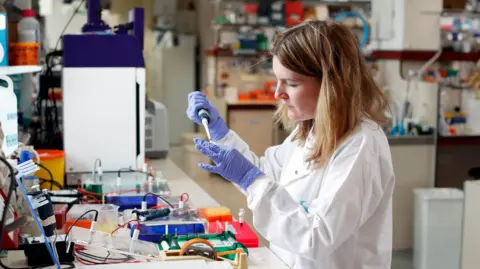
The boss of UK Research and Innovation (UKRI), the public body which spends £8bn of taxpayer money each year on research and innovation in the UK, has warned the organisation faces "hard decisions" on funding future projects.
In an open letter, Ian Chapman said the government had told it to "focus and do fewer things better", which "will result in negative outcomes for some".
It represents a major reorganisation of the way Britain's scientific research and innovation is prioritised and funded with public money, and has angered many in the research community.
Chapman said the changes have not yet been finalised, but he expected them to be fully implemented by April 2027.
In a later briefing, he declined to explain how research projects would be selected in future.
But he said overall, the money available to researchers was set to increase in the future with "more emphasis on commercialisation".
Funding for what UKRI describes as "curiosity driven" research, which Chapman said the UK is "really good at", is to remain at the same level - effectively a decrease in real terms as time goes on.
In the past this has included studying blood clot detection, plastic-eating enzymes and how babies learn.
"When you make choices some will miss out, but if you don't make choices everybody loses out," Chapman said.
'The funding isn't there'
UKRI is made up of eight separate research councils, which have various disciplines including medicine and biotechnology.
One of them is the Science and Technologies Facilities Council (STFC), which is responsible for research into topics such as astronomy, computational science, and nuclear physics.
It currently pays the UK's membership to the Swiss laboratory Cern and the European Space Agency, and it also supports and operates some of the world's biggest telescopes. It has been instructed to find £162m in savings.
"The STFC was extremely ambitious in what it wanted to do and the funding isn't there," said its executive chair Michele Dougherty.
She said there were no plans to withdraw from existing international commitments.
And she added it was too early to say whether the council would fund any new projects in the next couple of years - but did suggest if it did, it would be at the expense of something it is currently supporting.
Other councils have also paused grants for new research.
"The UK punches above its weight in scientific impact and in space-related industry," said Chris Lintott, professor of astrophysics at Oxford University.
"This should be a national success story but instead we are facing the possibility of unsettling and destabilising threats to funding for cutting edge science."
The changes have also impacted Innovate UK, which supports small and medium sized businesses with grants and advice.
The BBC understands local business advisors have been laid off, and those left have been instructed not take on any new "clients" – science and tech businesses seeking funding and guidance.
"In the past we have supported thousands of start-ups with small amounts of money," said Chapman.
"We are now seeking to support fewer companies."
He did not explain how those companies will be selected.
In the commercial sector, around 75% of businesses which receive private funding from venture capitalists fail.
It is notoriously difficult to identify those which will succeed early on.
"Reducing budgets and staffing for small and medium-sized enterprise (SME) support at Innovate UK is the opposite of what our domestic start-up and entrepreneur community needs," said Stephen Tulip, UK manager of the App Association.
"Cutting access to expertise and funding for UK SMEs will harm the UK's growth agenda and force start-ups to look elsewhere for investment and support."
Mike Griffin, who founded a sustainable 3D printing company with the help of Innovate UK, agreed.
"For small companies, early-stage backing is the bridge to market," he said.
"If support shifts toward bigger, later-stage winners, many practical, life-changing innovations won't survive long enough to scale."






 English (US)