
 2 hours ago
1
2 hours ago
1

Every morning, Katelyn Ohashi gets up and makes a smoothie and then walks her four-month-old puppy. She drives to the gym and begins with a moment of gratitude before warming up with gymnasts half her age. She trains four days a week, around four hours per day, while also dabbling in her various hobbies. It’s a routine that maybe a decade ago she didn’t envision but is now undertaking.
When Ohashi left elite gymnastics in 2013, it was no longer a place where she found joy. Although she was seen as an Olympic hopeful (she was the last gymnast to beat Simone Biles in the all-around finals at the American Cup), a back injury took her out of the running for the Games. She slowly found her joy for the sport in NCAA gymnastics at UCLA, where she was known for her perfect 10 floor routines that often went viral, garnering millions of views from around the world.
Now 29, she is chasing a lifelong dream: a spot on the US team for a home Olympics in Los Angeles in 2028.
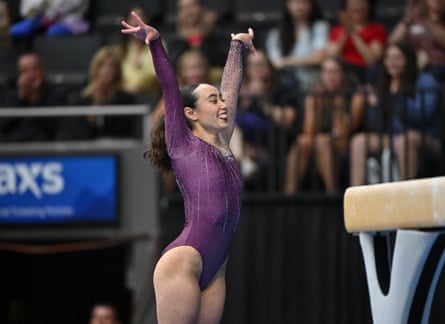
Ohashi first had inklings of a return to elite gymnastics back in 2021. She, along with former Tokyo gymnasts and others, participated in Simone Biles’s Gold Over America tour across the country. With a three-year runway, Ohashi said she started to get into shape but “never really took it seriously”. Paris 2024 came and went. Last year, the conversation shifted.
“This time around, it just felt like: OK, LA, home soil. For gymnastics, I’m definitely getting up there in age,” Ohashi said. The average age on the women’s national team in Paris was about 22 – the oldest since 1952 – with Biles the oldest member at 27. “It just felt like if I really wanted this to be something real, I needed to move out of LA.”
A Seattle native, Ohashi moved repeatedly during her childhood in pursuit of gymnastics, relocating with her mother and one of her brothers from Missouri to Texas before heading to California for college. Finding the right training gym this time was a stroke of luck thanks to her connections at UCLA. Cale Robinson, a friend and former Stanford men’s gymnast, owned Pacific Reign Gymnastics in Woodinville, Washington, where Ohashi would play around some skills when visiting family. Catching up at dinners together over the years, Robinson and Ohashi would joke about how easy her flips still felt. At one point, the conversation about coming back to elite got more serious.
“We, like, loosely mapped things out,” Robinson recalled. Ohashi started working with a personal trainer and lifted weights daily to get stronger and build her muscle strength back.
“Get a team of people around you, like your physical therapist, all of the people that you need to make sure that you’re healthy first and foremost,” Robinson said.
Ohashi gathered her team, including talking to Valorie Kondos Field, the former UCLA head coach known as Miss Val. While there might have been initial doubts about Ohashi getting all of her skills back, Kondos Field said Ohashi has “one of the strongest minds of any athlete that’s ever played sport”.
“At the end of the day, Katelyn is not fixating on a score. Yes, she has a goal. She’d love to make the Olympic team or whatever that is. We don’t even talk about that. It’s like: what is today going to look like for you? How are you going to go home at the end of the day with no regrets?”
Kondos Field flew up to Seattle for three days this summer to help Ohashi refine the last touches on her floor routine before the US Classic competition in July. The two developed a “badass” character for Ohashi to portray. The routine is a two-and-a-half pass floor to jazz-inspired music that marries the “contemporary feel of artistic gymnastics in this era while respecting the classical essence of elite gymnastics”, Kondos Field said. It includes elements such as a split jump into a straddle split, a classic Ohashi if you’ve watched her previous Michael Jackson viral routines. Her athleticism was even praised by the likes of Kobe Bryant, Kondos Field noted.
College taught Ohashi gratitude and gave her the reps in front of crowds every week to know how to be more precise with her practices. Since she is still regaining her full range of skills, she and Robinson tweak routines now to her advantage for the code of points.
The United States’ depth makes Ohashi’s comeback all the more difficult. Jade Carey, Olympic floor champion and vault bronze medalist, and world champion Leanne Wong remain in the mix for 2028, while Tokyo all-around champion Sunisa Lee announced her own comeback last month. Only five gymnasts will make the US Olympic team for Los Angeles.
In June, Ohashi competed in her first senior meet at the American Classic. She walked into the gym and saw the familiar faces of past judges and even some of the fellow competitors. She hopped on to the beam and threw out a standing Arabian.
“When I saluted, it was like, ‘Oh yeah, this is where I’ve always been. This is where I belong,’” Ohashi said.
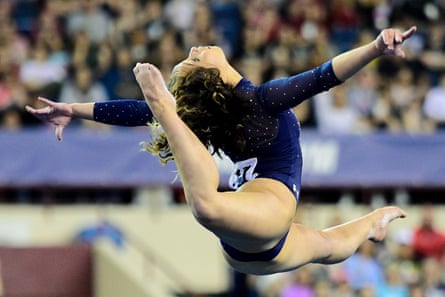
At July’s US Classic, she competed on beam and floor, finishing four-tenths shy of qualifying for this weekend’s US national championships.
For Ohashi, creativity has also returned to other areas of her life. She sews, knits and makes jewellery.
“I’ve found myself writing a lot more, especially just going through so many different life changes. It’s starting to spark the creativity again,” she said.
In January, she moved from Los Angeles back to Seattle in January this year to live and train. As life would have it, it was an important move as her father started struggling with heart conditions.
“This is, I guess, the harsh realities of having parents that are ageing,” she said on Zoom while calling in from the hospital; her mother had also just fractured her hip the day before our call.
Ohashi attributes her strong mind to her Japanese father, an avid bowler and former Seattle City Light employee who died in May. She never told him her goals.
“I’m sure he would be very proud. He always wanted it to be my dream. My mom probably wanted it to be her dream, and he was just along for the ride and supported in any possible way he could, and I’m sure he still is,” she said.
Two years out from Olympic selection, even if she does not make the team, there are no regrets.
“I don’t want to shy away from [LA 2028], but I also want to be realistic with where my body is every day and make sure I’m still doing it for me and for the love of the game,” she said.
The ripple effects are already there.
Intergenerationally, Ohashi’s presence models what can be possible for the young girls and boys who are learning how to understand their bodies and assert themselves.
Simone Rose, 18, another athlete from Pacific Reign and a member of the US national team, remembers being 10 years old and watching Ohashi compete for UCLA. A signed Ohashi autograph meet and greet still hangs on the wall of her room.
Now training alongside her for LA 2028, Rose said that meets are a lot more fun because of Ohashi’s positive energy in the gym and competitions that make experiences “even more special”.
“It’s pretty incredible to go from looking up to her as a young gymnast to now calling her my teammate,” Rose said.
For a sport that has historically been high-pressure and focused on skinny, young athletes, having someone like Ohashi in the gym can make a positive difference in showing that it’s never too late to chase your dreams.
“The energy shifts in any room that Katelyn walks into. I imagine that as the arenas get bigger, that energy is going to just permeate through more people,” Kondos Field said.
Ohashi won’t be at this year’s US nationals. But don’t count her out at the next one.









 English (US) ·