
 2 hours ago
4
2 hours ago
4

On a Wednesday evening in midtown New York, generations X through Z spill out of the Ethel Barrymore Theatre to cluster around the venue’s side stage door. They’re waiting for Taraji P Henson.
“I feel like I’m Cardi B on tour,” Henson jokes. When we talk over a video call this April, the actor is one week out from the opening night of her Broadway debut in the revival of August Wilson’s Joe Turner’s Come and Gone. Throughout the show’s preview period, Henson has made an effort to make it out to street level after performances to shake hands, take pictures and sign playbills. “It’s good to see my fans like this, up close and personal,” she says.
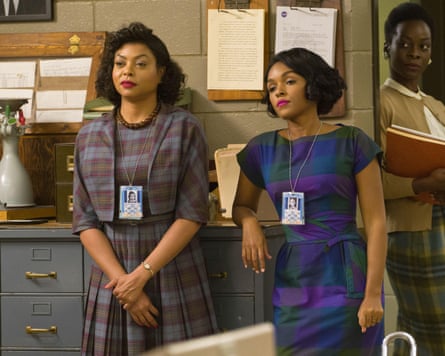
Over the past 30 years, Henson has become a Hollywood mainstay for her thoughtful character work. She’s been a hip-hop soul star in Hustle & Flow, an ardent adoptive mother in The Curious Case of Benjamin Button and a groundbreaking Nasa mathematician in Hidden Figures. She’s also a four-time Emmy-nominated, Golden Globe-winning, Oscar-nominated actor and a Tony-nominated producer. But Henson’s formal training is in theater, and it’s here she truly thrives. “I got that good Howard [University] training,” she says of her alma mater, where she studied drama in the 90s. “[I was] made for the stage.”
It may seem like Henson waited to come to Broadway. But in truth, Broadway was waiting for her – and when it was ready, all it took was a 20-minute phone call from Debbie Allen, the veteran actor, choreographer and film-maker. After Denzel Washington, a steward of August Wilson’s works, tapped Allen to helm the stage and screen revival of Joe Turner’s Come and Gone, she began to assemble her players.
“Joe Turner found me. [My character] Bertha found me,” Henson recalls. She takes a beat, then launches into an eerily spot-on Allen impression, raspy drawl and all. “Debbie called me and was like, ‘Taraji, I got something for you! How do you feel about doing Miss Bertha in Joe Turner’s Come and Gone, honey? We gon’ do the film, but we gotta do this Broadway play first, honey.’ And I said, ‘Well, Debbie, anything for you. All you had to do was say August Wilson, and I’m in.’ It was that easy.”
Joe Turner’s Come and Gone is the fourth play in August Wilson’s classic Century Cycle, set in 1911 Pittsburgh. The original cast included Black luminaries such as Delroy Lindo and Angela Bassett. Today, Henson leads the star-studded cast of the Allen-directed revival alongside Cedric The Entertainer, Ruben Santiago-Hudson, an actor and playwright, and Joshua Boone, a Broadway star. Henson portrays Bertha Holly, the devoted matriarch of a boarding house she runs with her husband Seth. Bertha and Seth care for their boarders with a parental attentiveness that is empowering, loving and protective, fostering an environment ripe for self-discovery: an everlasting practice for descendants of slaves.
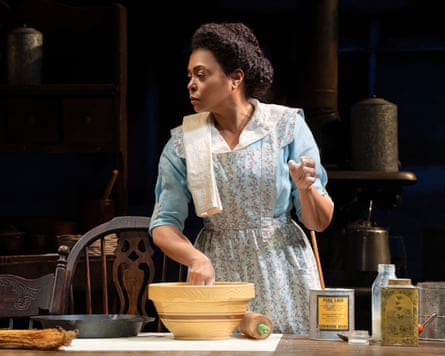
The characters in Joe Turner are, at most, only one generation removed from slavery. Most move up north in urgent pursuit of identity, stability, prosperity and connection, only to find that the afterlife of slavery is ubiquitous: in each intentional scene, Joe Turner’s characters are faced with constant reminders of slavery’s destruction. The foundational matting on which these characters tread is a motley patchwork woven of the free Black migrant’s dreams, faith, grief, integrity, desires, trauma and invincible joy.
There’s countless elements of Joe Turner that, tragically, still apply to our own 2026 setting, like the theme of displacement. “Families are being pulled apart right now as we speak,” Henson says. “Somebody who is being detained by ICE right now just disappeared. Whole families are being wrecked. That’s crazy to me.”
It’s a play also steeped in Black spirituality, both Hoodoo and Christianity, details that Henson says audiences “didn’t understand” when it first opened in 1988 at the same theatre where the 2026 production is staged. But now we’re in a post-Sinners world, one where comprehension of the spectrum of African-American faith has been expanded on a mainstream scale: in 2025, Ryan Coogler’s spiritual thriller invited audiences to engage in a cultural meditation on Black religion outside of the Christian church with its insightful depiction of the sacred practice of Hoodoo.
“That’s Black people, period. That’s just who we are,” Henson says. “You could take us, snatch us from a whole continent, and what you not gon’ do is disconnect us from the creator.”
To Henson, the play’s central message is a call to action. “It is very important in your lifetime to find your purpose, whatever that is. Nobody can give it to you,” she says. “Everybody has a purpose. [The character Bynum] talks about it as a ‘song’. Because once you find your purpose, you’re going to want to sing about it, you’re going to want to tell the world about it, because now you’re going to impregnate somebody else with their purpose. And it’s all connected to God, connecting yourself back to the creator, love and laughter … There’s so much to be learned from [the play], but I think the overall theme is making sure love is in that purpose.”
Henson believes that her Broadway debut was divine timing and a lesson – or reminder – in embracing her own purpose. “I still have a love for the craft. I’m a producer, I have a production company, [so] I’m behind the curtain,” Henson explains. “The wizard doesn’t exist for me anymore. The rose-colored glasses are off. So now I understand the business, and a lot of times the business involves politicking. That takes the artistry out of me. It wears me thin and it makes me question, ‘Why am I doing this?’ Because it doesn’t make me happy, having to fight and scrap and scrape for a dollar and my worth. That’s exhausting.”
In 2023, Henson made headlines by opening up about how the pay disparity for Black women in Hollywood has affected her career. “I’m just tired of working so hard, being gracious at what I do [and] getting paid a fraction of the cost,” Henson said at the time. Henson tells me today that the last time she felt such a high level of burnout was when she left the CBS drama Person of Interest in 2013, feeling “empty”, disillusioned and questioning her career. She walked away from the screen and instead joined the cast of the 1930s-set play Above the Fold at the Pasadena Playhouse, as a test of her devotion to and compatibility with the craft of acting. She was searching for their spark, and theater was her refuge.
“I brought Hollywood to me in Pasadena, that was the difference,” Henson says. “That’s how I got Cookie [in Lee Daniels’ hit TV show Empire], because Fox [executives] kept coming to that play.”
Watching Henson on stage, it makes sense why those execs kept coming back: her magnetism is irresistible. As Bertha she pulls off a hat-trick, showcasing her emotional depth as an actor, her impressive singing skills as well as her natural knack for improv.
“I think the night you came, I dropped flour,” Henson says, referring to a kitchen scene in which Bertha prepares biscuits while talking to her husband. “I came home and beat myself up like crazy. Then I called my friend. [They] was like, ‘Taraji, you are so busy in that kitchen. Why would an audience member not think that dropping the flour is normal?’ I cleaned it up, and no one noticed. No one.”
She laughs breezily, her voice echoing off of the walls. “That’s what’s so beautiful about live theater: you have to stay in it. You can’t say, ‘Oh fuck, I dropped the flour, oh shit!’ [Then] I’m Taraji. I have to stay Bertha and I have to work it out.”
Bertha Holly feels like she was written specifically for Henson, a fit Allen discerned before Henson did. “I understood why [Allen] called on me to be Bertha,” she says. “A lot of characters I’ve portrayed in my career have been the glue, the moral compass [like Bertha].” Allen’s explicit trust in Henson has been reciprocated tenfold, making for an intimate actor-director dynamic and blossoming friendship that Henson calls a “safety net”.
“And whenever I’m safe, I’m uninhibited,” she says. “You want an artist to explore, to feel free and safe enough to go there, to just forget that they’re acting … You just want to make [Allen] proud.”

Henson treats every night like opening night, but is self-aware enough to balance strict discipline with rest and gratitude. “This Broadway moment forced me to really sit down and pat myself on the back … that’s why I’m glad I came now,” she says, getting teary-eyed. “This is years of my hard work and me putting everything I have into all of these characters that I portray and earning the trust of my audience. It is hard out here. People are barely getting by, eggs and gas and groceries and insurance [are expensive]. So when people come out of their pockets to purchase a ticket that has my name on it, I’m going to give them everything I got.”
Since previews began, Henson has met folks by the busload who traveled to New York with their churches or their universities, or flown in from California or Texas, to see her in her Broadway debut (the show’s run has been extended twice). Seeing her tangible impact as an artist through her audiences was not simply re-affirmation, but a new definition of success. She’s no longer placing her value as a performer in a gold-plated statuette.
“I’m very hard on myself,” Henson says. “The industry can play a game with your mind and make you think you’re not worthy because you don’t have ‘the gold’. I don’t care who got that gold. Are they coming to see you like this? I’m so giving of my gift to the world, and the world sees it. That’s why they show up for me. And that’s [worth] more than man-made gold.”
-
Joe Turner’s Come and Gone is at Ethel Barrymore Theatre, New York City, until 26 July









 English (US)