
 2 hours ago
2
2 hours ago
2

The quietest man in the stadium will be the most brilliantly lit when the spotlight falls on him come the end of the match. Mark McCall will hope that his last home fixture in charge of Saracens will have ended with his team back in the top four, just when it matters most, with one round to play.
A win against Harlequins on Saturday in front of a sellout crowd would move Saracens above Exeter into fourth, with the Chiefs due to visit Leicester on Sunday. Saracens are 20-point favourites to beat Quins; Leicester 11-point favourites to beat Exeter. Unless both underdogs rear up to bite their hosts (an outcome the bookies rate as a one-in-50 chance), we are due a straight shootout for that fourth playoff spot on the final weekend of the regular season at Sandy Park, where Exeter will host Saracens.
Which is poignant, because the only other director of rugby, head coach, call it what you will, who rivals McCall for longevity in the English game is Rob Baxter. One would have to extend the gong to Baxter, given his long playing association with the Chiefs, but the contest between the two as Prem supremos is complicated by Baxter’s step away from the first team (to become what Exeter term the director of rugby) for three years from 2022 and Saracens’ season on the naughty step of the Championship for the 2020-21 season after the salary-cap palaver.
Either way, there is no one to touch McCall for silverware accumulated during his 15-year stint as director of rugby. Six English titles and three European is quite the haul. After the prolonged game of musical chairs that preceded his tenure (nine changes of regime at Saracens in a little more than 10 years, involving some of the biggest names in the game) he has presided over English rugby’s most successful club of the past 20 years with an understated dignity.
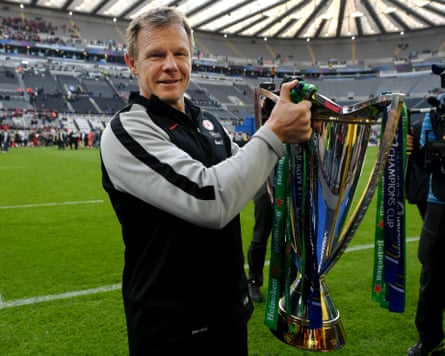
Brought to Saracens by Brendan Venter, his teammate for a season at London Irish, as a first-team coach in 2009 (the year Baxter was made Exeter head coach), he assumed the reins when Venter stepped away himself to be technical director, just as the club were building to their first title, in 2011. If Venter, who will return to take up control of the first team next season, was Saracens’ first nod to stability, he supplied it with a certain flamboyance, never afraid of that spotlight or controversy. Here is to more of the same.
But McCall has been a club executive’s dream, if not a Hollywood executive’s. Modesty and consistency are his watchwords. Which is not to say there is no fire. To sit close to the Saracens’ coaching box is be jolted from one’s reverie by the occasional roar of anger or triumph, the shock of which is surpassed only by the realisation it came from McCall. More often, he will hold court after the match with a soft smile and even softer words, inclining the gaggle of reporters around him to lean in all the closer.
As the generation of players whose careers he oversaw reach coaching age themselves, Saracens’ next era will be intriguing to watch. The man they call Smally will leave a gaping hole. “Saracens has been a huge part of my life for the last 17 years,” he said, “so the final home game will obviously be significant. But until the final whistle, my focus remains purely on the game and what is at stake for us.”
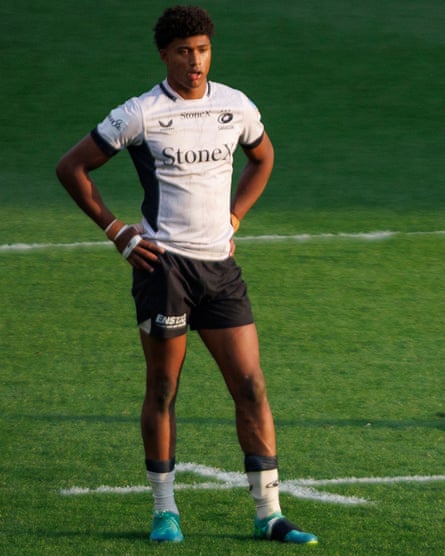
He makes three changes from the side who beat Gloucester last time out. Eroni Mawi, Hugh Tizard and Tobias Elliott come in, while Noah Caluori needs two tries from the last two rounds to equal the record season haul of 20 held by Sam Simmonds of Exeter (obviously).
Harlequins have plenty to play for themselves, currently a point ahead of Gloucester in the last of the qualifying spots for the Champions Cup. They make one change to the side that did much to help Saracens in their quest for the top four by beating Exeter at the big stadium in the last round. Sean Kerr comes in for the injured Luke Northmore.
So much for the detail. Saturday will be about the end of an era. And maybe one last tilt at a seventh English title.




 English (US)