
 3 hours ago
3
3 hours ago
3

25 minutes ago
Chris BaraniukTechnology Reporter

 CreateMe
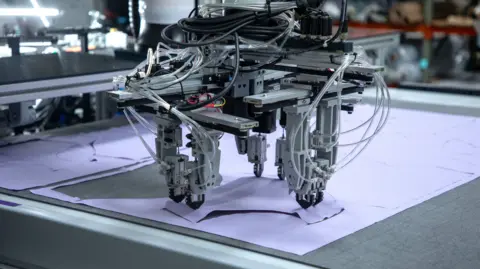
Floppy textiles are hard for robots to manipulate
They assemble cars, they perform surgery, and they even handle cargo at airports. But give most robots a needle and thread, and they would probably come undone.
Those workers may use tools such as sewing machines but fully automating such labour is difficult. "You have a problem if it's sewing," says Cam Myers, founder and chief executive of California-based CreateMe, a robotics company. "You have to keep [two pieces of fabric] in alignment under motion."
His company takes another approach. Forget sewing – glue the pieces of fabric together instead. "Once the adhesive is laid down, you simply line something over it and stamp." CreateMe has designed robots that do this and the firm is already making women's underwear this way. It will begin producing t-shirts, too, in the coming months. Mass production could follow next year.
Roboticists have eyed the garment manufacturing industry for decades. If machines could ever take over such work, clothes-making could come back to countries in the West, and the environmental footprint of garments might be slashed in the process. But millions of textile workers could also be out of a job.
 CreateMe
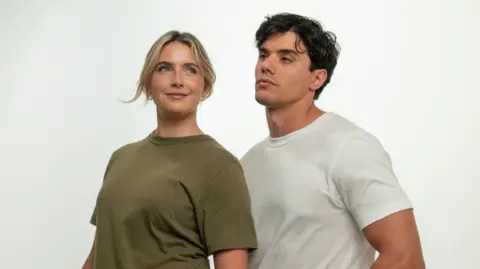
CreateMe robots glue together seams
Just a few percent of clothes sold today in the UK are made here. It's a similar story in the US. Myers says he has customers seeking to market garments as "made in the US", with US-produced cotton, for example.
"We can use cotton, we can use wool, we can use leather," he says, of CreateMe's adhesive-based process. If just 10% of t-shirt manufacturing moved back to the US with the help of automation, that would be a huge industry shift, he adds.
The adhesive CreateMe uses is thermoset, which means that ironing or washing machine temperatures aren't enough to melt it and make the clothes fall apart, insists Myers. He adds that, because these garments lack seams, they are streamlined and can also be manufactured on moulds that capture the contours of the human body.
Even Myers acknowledges that a key challenge in apparel is that it is "high flex" – in other words, you won't get very far if you just make white t-shirts. Customers like choosing from an endless array of garments, with varying form factors, colours and designs. Clothes-producing robots are still a long way from doing all that.
And there remains a debate over the fundamentals.
"We don't believe that sewing is going away," says Palaniswamy Rajan, chairman and chief executive of Softwear Automation, based in the US state of Georgia. He points out that visible stitching is a key component in the design of many fashionable garments, perhaps most famously jeans.
Rajan says that his company will soon announce the third generation of its sewing robots, which he claims will make t-shirts at the same cost as importing them to the US. However, he declines to discuss any details about the technology.
 Getty Images
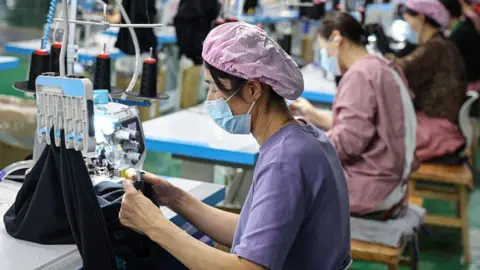
Humans still have major advantages over robots in garment making
Multiple firms that spoke to the BBC for this article were reluctant to share information about how their robots work, such is the competition for a slice of the giant apparel market.
Meanwhile, textile workers are already under pressure, having faced factory closures during the Covid-19 pandemic, and more recently the war in Iran, which has hit polyester supplies. Automation industry representatives often suggest that workers should aim for better-paying, less repetitive jobs – but simply handing t-shirt production to robots won't do that overnight.
"If you can re-shore the manufacturing part, you can just produce there on-demand," says Gerald Feichtinger at the Technical University of Leoben, in Austria.
He recently led a study that analysed whether such on-demand manufacturing could reduce overproduction of garments, and slash the carbon emissions associated with transporting them from Asia to Europe, for example. "We can see a significant reduction in greenhouse gas emissions," he adds.
The paper found that emissions associated with making a t-shirt could fall by roughly 45% when a robot produced the garment in Europe or the US.
 Robotextile
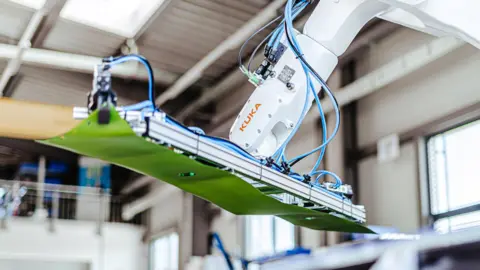
Robotextile has developed grippers that can manipulate fabric
Claims around automation lowering the environmental impact of textiles should be balanced against the fact that other parts of the supply chain, such as dyeing of fabric, or the production of yarn, may not be so easy to re-shore. Feichtinger and his colleagues' study acknowledges these factors and he says re-shoring multiple parts of the garment supply chain remains "challenging".
Michael Fraede is co-founder of German firm Robotextile, which makes gripper devices that enable robots to deftly pick up pieces of fabric. Some of them work by gently blowing air across the fabric, making it flutter and lift, so that it can then be sucked towards a gripper and clamped into place, for example.
Fraede says the market for automating textile production in Europe is likely limited to specialist textiles, such as those used for bicycle bags or airbags in cars – his company's robots have helped to make both such products, among others.
"It will take 10 more years before we see the first actions of re-shoring," he says. "This industry is not used to thinking that way. They are used to saving money wherever they can."
Others are more hopeful. Lauren Junestrand, innovation and sustainability network manager at the UK Fashion and Textile Association says, "The UK has huge potential to incorporate robotics." Garment-makers are using more and more robots for various tasks already, she adds.
But even Junestrand says that countries such as the UK will probably never be able to compete with competitors in Asia, in terms of volume. "I think it's going to be more of a co-existence," she adds.
More Technology of Business








 English (US)