
 2 hours ago
2
2 hours ago
2

The 2026 World Cup has begun in very entertaining fashion. On Wednesday we reached the point at which all 48 nations had played twice, with only four of the matches ending goalless.
Even then, three of the 0-0 draws delivered unexpected points for Cape Verde, Curaçao and Iran against Spain, Ecuador and Belgium respectively. There was a gripping tension and excitement to override the lack of goals each time. England also drew 0-0 with Ghana in a rather more boring match, but you can’t have everything.
There has been an average of 2.94 goals-per-game this summer, making 2026 the most exhilarating World Cup since 1970 by this very simple measure – so far.
While it’s reasonable to think the rate may dip as the tournament progresses and the stakes increase, that wasn’t the case at Qatar 2022 or in Russia in 2018. The goal rate increased after the conclusion of the group stage, albeit extra time played a part. If that pattern continues, we could be set to enjoy one of the all-time great international tournaments.
What could be behind the goal surge?The upswing in goals is a result of multiple factors. The four-way tussle for the Golden Boot could be one of the most influential. In the space of 25 hours during the first round of fixtures, Kylian Mbappé, Lionel Messi, Erling Haaland and Harry Kane all scored at least twice. The first three repeated that feat earlier this week, with Cristiano Ronaldo getting in on the act against Uzbekistan too. The elite forwards are driving each other on.
Lots of other players are trying to keep pace. We have already seen 21 instances of a player scoring at least twice in a match at this edition of the World Cup, passing the total of 20 from 2022. It doesn’t matter which players deliver the goals but when multiple men have red hot days, it inevitably helps things along.
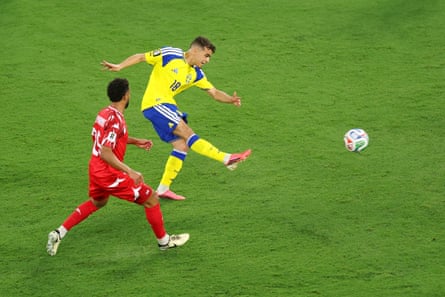
The Brighton midfielder Yasin Ayari highlights this phenomenon and another element of play that is having an impact at this World Cup. He has never scored twice in a match in English league football yet managed this in Sweden’s 5-1 win over Tunisia. To make his double even less likely, both strikes were hit from outside the penalty area.
Long-range rockets have also boosted Mbappé’s Golden Boot credentials. He scored from beyond the 18-yard line against Senegal and Iraq, having done this just once across his first two World Cup campaigns. The tournament has already provided six more goals from outside the box than we saw four years ago.
This goes against the perceived wisdom that data analysis within football has caused low-probability shots to decline in frequency. While there might be truth to that in the club game, international teams don’t have the same amount of training time to learn complex attacking routines.
The expanded World Cup will surely have made a significant difference too. With 50% more teams, 48 compared to 32, it’s likely that relatively weaker nations have qualified who would have struggled to make it to a smaller tournament. And top-tier forwards will at times face defenders and goalkeepers unaccustomed to facing finishers of their quality. It makes sense to try to beat them as soon as a shooting opportunity presents itself.
Other mistakes from goalkeepers are contributing to the goal total too. Not everyone can make 15 saves to keep a clean sheet like Eloy Room did for Curaçao against Ecuador.
Opta has a metric called defensive errors, which occur when a player makes a mistake that leads to a shot. These can take many forms, as the Uruguay goalkeeper Fernando Muslera has proven. He spilled a shot that saw a rebound converted against Saudi Arabia, then raced out of his box unsuccessfully to allow Helio Varela to score a famous equaliser for Cape Verde.
We have also seen two different Iraq goalkeepers present gifts, to Haaland and then Mbappé, as if they need any help in the goals department. There have already been 25 Opta-defined errors by players that led to goals at this World Cup when there were 37 across the previous two editions combined.
Own goals are recorded separately from errors but they have also risen since 2022. The tournament in Qatar had two, the same total from which the USA alone have benefited this time around.
The pressure that backlines are being put under is forcing more goal-costing blunders than ever before, regardless of in which data bucket they belong. The World Cup own goal record of 12, from 2018, is very much under threat.
Supersubs are also making serious impacts. Teams have been allowed up to five subs since Qatar 2022 (until 1998 they wereallowed a maximum of two outfield players, and before 1970 none at all). Deniz Undav has already been directly involved in five goals after coming off the bench, the joint-most at a World Cup since records began in 1966. He and his fellow bench-warmers have contributed 28 goals, just two fewer than their counterparts managed in the entirety of the 2022 World Cup. There have even been eight goals both scored and assisted by substitutes, more than ever before in this competition.
Thomas Tuchel acknowledged the importance of a role that has become viewed as a finisher rather than a second choice after England beat Croatia. “We needed this quality to bring it over the line,” the England head coach said of his substitutes’ contribution. “I know they are all starters. So it is new for them. But they also know it is a period of time that is so special and they buy into this idea that we do it as a team. This is the only way.”
Tuchel was partially referring to Marcus Rashford, who scored in England’s opening game after replacing Anthony Gordon. His goal was relatively routine, in terms of being in the centre of the penalty area in open play, with no defensive howlers making a difference. Extremes in these factors elsewhere are helping to make the 2026 World Cup the highest scoring since England were defending champions.




 English (US) ·