
 1 hour ago
1
1 hour ago
1

Pull. Breathe. Kick. Glide. Three decades since my last swimming lesson, I found myself sitting in a lecture theatre chanting these words with a few dozen strangers, all of us trying not to take anyone’s eye out as we matched them to the actions.
Pull. Breathe. Kick. Glide. I’ve been to enough Edinburgh fringe shows to inure myself to the embarrassment of audience participation. And, to be honest, this one was a pretty euphoric communal experience. It turns out you don’t need to be near water to marvel at a swimming feat, especially one that’s more than 150 years old.
The comedian Adam Riches previously created a one-man show out of Jimmy Connors’ 1991 US Open run, a theatrical effort that involved a lot of leaping, smashing and two-handed backhands. The Captain, which runs through August, evokes a less explosive kind of sporting endurance. It’s named for Matthew Webb, the first man to swim the Channel unaided, although we never meet the hero himself. Instead, Riches narrates his story in the person of Fred Beckwith, the promoter who helped Webb train for his feat at Lambeth Baths.
Pull. Breathe. Kick. Glide. Today, we probably think of breaststroke as the least flashy of all the competitive swimming disciplines. It’s hard to imagine people packing Victorian music halls to watch live demonstrations of it, but then, for the previous millennium, there hadn’t been much of a European tradition of swimming at all. Consider Leonardo da Vinci’s 16th-century notebooks, where, among his thoughts on flying machines, gunpowder, and steam-powered cannon, he mused on “how it is that all other animals which have feet with toes, know by nature how to swim, excepting man” and “in what way man ought to learn to swim”.
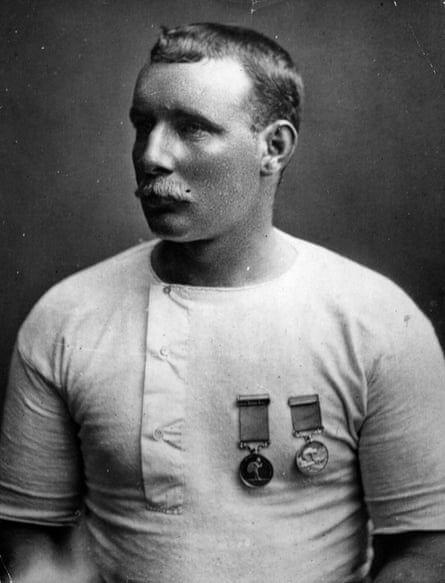
In Riches’ show, Beckwith tells us that “swimming, pre-Captain Webb, wasn’t an act in itself – it was merely a counterpoint to drowning”. Not entirely true, because in 1810 Lord Byron had already channelled his Main Character Energy into crossing the Hellespont – which we know today as the Dardanelles in Turkey – to prove a point. The mad, bad aristocrat managed the dangerous four-mile stretch of straits in just over an hour – with a club foot, no less – and immediately wrote a poem about his achievement. Within a couple of decades, the types of races that had been held in lakes for informal wagers were gradually being organised into something formal by the National Swimming Society, and artificial pools were being opened in London.
Still, Webb’s heroics did significantly popularise the pastime, not least because his aquatic adventure had gone almost fatally wrong. What should have been a 21-mile distance turned into nearly 39 as tides and weather threw him off course. Even then, his actions inspired plenty of others to emulate him, including Agnes Beckwith, Fred’s daughter, who set her own long-distance records, swimming 20 miles of the Thames from Westminster to Richmond and back to Mortlake.
Olympic swimming owes him its own debt: the races at the first modern Games in 1896 were held in the Mediterranean Sea, where athletes contended with frigid temperatures and 13ft waves. (After winning gold in the 1200m, 18-year-old Alfréd Hajós stated that “my will to live completely overcame my desire to win”.) The Channel has had a share in Webb’s glory, too. For decades that treacherous, traffic-lined stretch of water became (and in some ways remains) the ultimate marker of endurance swimming.
Gertrude Ederle’s 1926 crossing – the fastest in its day and the first by a woman – became as well known as Webb’s. And it was Ederle’s memory that inspired the legendary Lynne Cox on her own record-breaking swims: the first woman to cross the Cook Strait between New Zealand’s North and South islands, then the first human to traverse the Bering Strait between the US and the Soviet Union. A cold war effort indeed, in waters that literally froze around her.
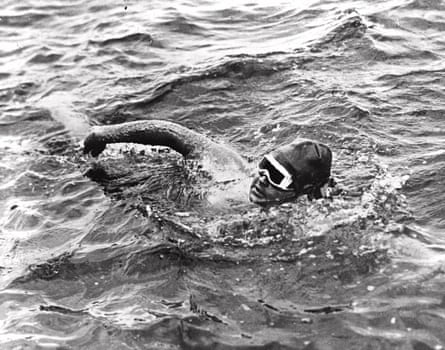
For me, it has been impossible to contemplate Webb without following an imaginary current to a more recent legend of the breaststroke. Admittedly, Adam Ramsay-Peaty doesn’t have to swim further than 100m at a time, and it usually takes him under a minute, as opposed to the 21 hours and 45 minutes that Webb struggled between Dover and Calais. Still, there’s something in the obstinate ambition of each man that echoes down the centuries, that calls across the 30 miles between their Shropshire and Staffordshire birthplaces. Ramsay-Peaty has been, like Webb, the greatest breaststroke swimmer that ever breathed, kicked, glided. He’s also learning that even the lushest of laurel wreaths don’t stay green for ever.
Webb’s own tale was, tragically, a cautionary one: he died at 35, chasing the fame and fortune that never lasted long enough. We’re equally minded, in this content-driven age, to consume sport as any other fleeting entertainment. And perhaps that’s how it should be. It was, after all, conceived and marshalled under its new 19th-century codes as a byproduct of the burgeoning middle classes’ appetite for leisure and recreation.
But there’s something in the nature of sport – its sense of a physical science, a way of measuring human progress – that will always speak to us at a deeper level. Sabastian Sawe and Yomif Kejelcha breaking the two-hour barrier at the London Marathon. Josh Kerr running the fastest ever mile. Katie Ledecky becoming the greatest distance swimmer in history. And Captain Matthew Webb – whose ghost John Betjeman would decades later write a poem about – doing a thing that everyone but him believed humanly impossible.





 English (US) ·