
 3 hours ago
2
3 hours ago
2

Vegetables play a central role in Korean cuisine, and they form the backbone of everyday meals, rather than simply acting as side dishes. They provide balance, nutrition, colour and variety, often through preparations such as kimchi, namul and seasonal banchan. Our vegetable cooking focuses on simplicity and preserving natural flavour, often using techniques such as blanching, light sauteeing, fermenting and pickling, and typically seasoning with garlic, sesame oil, soy sauce and fermented pastes such as doenjang and gochujang. This approach reflects Korea’s long tradition of plant-focused cooking shaped by seasonality, resourcefulness and the need for preserved foods. Together, vegetables create harmony and contrast within a meal.
Asparagus and courgette pajeon with soy-vinegar dip
Prep 5 min
Cook 20 min
Makes 1 pajeon for two to share
2 large asparagus spears (70g)
1 large spring onion (15g), trimmed
¼ medium courgette (35g)
¼ onion (40g), peeled
1 red chilli (optional)
80g standard tempura flour (or Korean savoury pancake mix powder)
Vegetable oil, for frying
For the soy-vinegar dip
40ml Korean jin ganjang soy sauce, or Kikkoman or any light soy sauce
20ml Korean apple vinegar, or rice vinegar
10g caster sugar
1 tbsp finely diced onion
½ red chilli, very finely diced
Put all the ingredients for the soy-vinegar dip in a bowl, mix well to combine, then set aside.
Cut off and discard the hard bases from the asparagus stalks, then slice the spears at an angle into roughly ½cm-thick x 8-10cm-long pieces. Cut the spring onion into similar-sized pieces. Cut the courgette in half lengthways, then cut it into ½cm-thick half-moons. Cut the quarter-onion into ½cm-thick slices. Don’t stress about being too precise with the slicing, though – a little thicker or thinner won’t be a problem.
In a bowl, mix the tempura flour with 90ml water to make a batter, beating it until there are no lumps. Put all the sliced vegetables in the batter and mix well to coat – there’s no need for any seasoning, because tempura flour is ready seasoned.
Pour enough oil into a 22cm nonstick frying pan so the surface is completely coated (or use two smaller pans ). Put the pan on a medium-high heat and, once the oil is hot, tip in the batter mixture – it should sizzle the moment it hits the pan – and spread it out evenly to cover the whole base of the pan. Leave to cook for three minutes, then flip and cook for three minutes on the other side. Flip again, cook for a minute more, then carefully transfer the pajeon to a plate.
Serve the pajeon whole, and cut it up like a pizza (or cut it into 4-5cm squares to make it easier to pick up and eat), with the soy-vinegar sauce on the side for dipping.
Green vegetable and vermicelli japchae
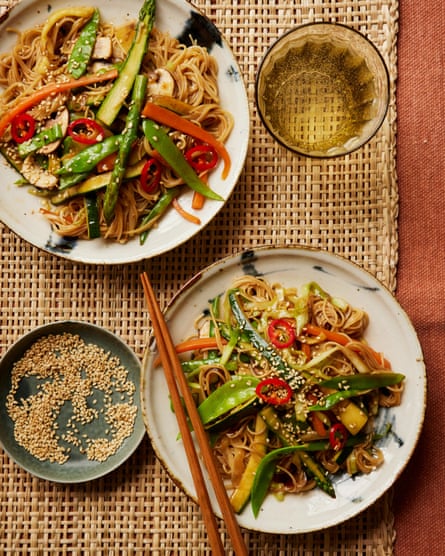
The choice of vegetables here is up to you – those listed are just what I like in my japchae.
Prep 5 min
Cook 20 min
Serves 2 to share as a starter
100g rice vermicelli
30g carrot
50g chestnut mushrooms
80g peeled onion
20g mangetout
40g hispi cabbage
40g courgette
40g asparagus
1 tbsp vegetable oil
20g peeled garlic, finely sliced
For the sauce
35ml Korean jin soy sauce, or Kikkoman or other light soy sauce
50g mushroom stir-fry sauce – I use Lee Kum Kee, which you can get in large supermarkets, specialist stores and online (or, for non-vegetarians, oyster sauce)
15g caster sugar
20ml sesame oil
1 small pinch salt (optional)
1 good pinch ground black pepper
To garnish (optional)
1 pinch white sesame seeds
½ red chilli, very finely sliced
Put the noodles in a large, heat-resistant bowl, pour in enough just-boiled water to cover, then leave to soak for 10 minutes. Drain the noodles, then put them back in the bowl to keep warm.
While the noodles are soaking, cut all the vegetables into ½cm-thin strips and put in a bowl to the side of the hob. Mix all the ingredients for the sauce in a small bowl and put to the side of the hob.
Put the vegetable oil in a large pan on a medium-low heat, add the sliced garlic and cook gently, stirring, for a minute. Turn up the heat to medium-high, tip in all the sliced vegetables, and cook for another minute – at this stage, it’s best to keep them all pretty crunchy. Turn off the heat, add the drained noodles and the sauce, and toss and mix to combine.
Return the pan to a medium heat, then stir and toss for no more than two minutes, just until the noodles and vegetables are heated through and coated in the sauce, and the vegetables still have plenty of crunch; if they start to stick to the pan, add a tablespoon of water, to loosen.
Taste and, if need be, add a pinch of salt (you may not need any, because there should be enough seasoning in the sauce already) and some ground black pepper. Divide between two bowls, garnish with the sesame seeds and sliced red chilli, if using, and serve immediately.
-
Joo Won is chef/co-owner of Calong, London N16








 English (US) ·