
 2 hours ago
3
2 hours ago
3

‘I must admit,” says Raoul Peck from his book-lined Parisian apartment, “George Orwell was not top of my list of authors who I thought would fit my current view of the world.” That view – anti-imperialist, intellectually curious and fiercely independent – has been shaped by an extraordinary life. Born in Haiti, Peck grew up under the notoriously violent Duvalier regimes, before his family fled in 1961. He was variously educated in what is now the Democratic Republic of Congo, then New York and Orléans in France before moving to Berlin, where he studied industrial engineering and economics. He spent a year as a New York taxi driver and five as a journalist and photographer, before getting his film degree in Berlin in 1988. In 2010, he was made chair of the French state film school.
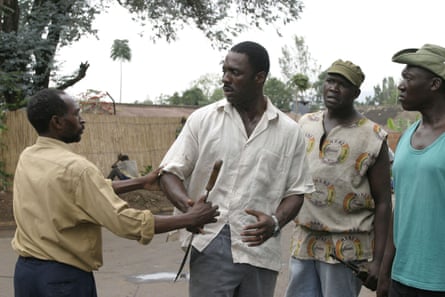
He is best known for his dramas and documentaries, which often zoom in on his intellectual heroes. He has profiled Patrice Lumumba, the DRC’s first leader; shot a drama about the friendship of the young Engels and Marx, the crucible that created communism; created a tender portrait of South African photographer Ernest Cole; and won a Bafta for his 2017 documentary about the writer James Baldwin, I Am Not Your Negro. In 2021, he made Exterminate All the Brutes, a four-part TV series about colonisation and ethnic cleansing. His 2005 film Sometimes in April dramatised and explored the Rwandan genocide. No one – with the possible exception of Adam Curtis – has consistently interrogated big ideas and the structures that shape our world in a more inventive and probing way.
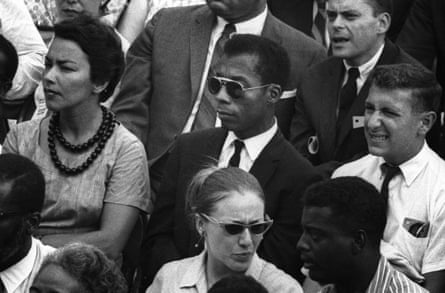
When Peck won the Bafta for I Am Not Your Negro, he paid homage to Baldwin in his acceptance speech, saying, “He left us with words that are today urgently necessary in a world of unapologetic ignorance.” The same could be said for nearly all Peck’s subjects but especially Orwell, whom the director explores in his latest film, 2+2=5, despite having previously dismissed him. “I was always interested in what’s happening right now, wherever I live,” explains Peck, who is as inquisitive as ever at 72, and barely sits still throughout our Zoom call. “Orwell had been sold to me in school and university as a sort of science-fiction writer.”
Peck constructs his portrait of the writer using Orwell’s own words (brought to life by a gravel-voiced Damian Lewis), many of which come from the diary he kept leading up to his death from tuberculosis in 1950. Orwell died six months after his famous novel Nineteen Eighty-Four was published, and Peck splices scenes from the various adaptations, from Rudolph Cartier’s 1954 version for the BBC to Michael Anderson’s 1984 film with a Eurythmics soundtrack and John Hurt as Winston Smith. The famous Apple Super Bowl ad that suggested the year 1984 would not be like Orwell’s vision as the Macintosh personal computer had arrived also makes an appearance.
The euphemistic “newspeak” imposed by Big Brother’s regime in the novel in order to stifle dissent is interspersed with modern political slogans such as Russia’s “special military operation” in Ukraine, while clips from Animal Farm sit next to footage of goose-stepping Chinese troops on parade. Images from the Iraq war, snippets of Narendra Modi’s Hindu nationalist speeches and horrifying clips from Yemen and Gaza flash by. It’s a sensory overload that places Orwell in the here and now. “I grew up with newspeak,” Peck says. “I basically had to deconstruct everything around me. Because Kennedy and the US were supporting the dictatorship in my country, while lecturing us about democracy.”
When Peck began researching Orwell, the author soon felt familiar to him. Rather than an inscrutable Englishman from a different world, he seemed like a fellow traveller. “I discovered an Orwell from the third world,” the director says. “He went back to Burma [now known as Myanmar] as a 20-year-old and discovered colonialism, and then went to fight the Spanish civil war in his 30s. That’s what young people did in the world I come from. We fight for truth, we fight for justice, and we don’t fight through Twitter. Until 1986, there was a dictatorship in Haiti. So most of my young life, I was geared up to go back to my country and fight and probably die. That was the political logic we grew up in. So I totally found myself in Orwell.”
The film came about after Alex Gibney, a fellow documentarian and the film’s producer, was offered unprecedented access to the Orwell archive, and Peck was given carte blanche to make the film he wanted. As the director dug, surprises appeared. He was stunned when he found images of the author with his Indian nanny as a child, which suddenly placed the writer in a new vulnerable context with an intimate connection to the far reaches of the British Empire.
He was further intrigued after discovering the writer’s reflection on his time in Burma as an imperial police officer. Orwell’s most famous work from the period is his story of an officer shooting an elephant, which starts with the line: “In Moulmein, in Lower Burma, I was hated by large numbers of people – the only time in my life that I have been important enough for this to happen to me.” Peck found the writer’s self-loathing and his support for the Burmese people surprising.
“Why would a young British guy go back to Burma as a colonial agent?” asks Peck. “He’s looking for something, but he discovered colonialism – that’s a wakeup call. He wrote about it in a way few people would do in that time. He was denouncing the crimes of his own people and his own crimes. It took courage to do that so candidly.”
In Peck’s film, Orwell doesn’t just take aim at the colonial operation in Burma but also at the British class system, media complicity, and the authoritarian tendencies of populist movements. Peck calls Orwell’s analysis a “toolbox” that can still be used today to diagnose unhealthy societies. “He shows how political systems become authoritarian,” says Peck. “It doesn’t matter if it’s left or right: they both attack language, attack intelligence, attack justice, attack the press or try to dominate it. You must have some sort of cult of personality. We see this in any type of deviant system – any institution can go there if there are no checks and balances.”
Peck has firsthand experience of political failure from inside government. Persuaded that it was the patriotic thing to do, he served as Haiti’s minister of culture from March 1996 until October 1997, when he resigned in protest at what he saw as an anti-democratic takeover by former president Jean-Bertrand Aristide. Peck wrote about the experience in a book whose title loosely translates as Mr Minister … Until Patience Ran Out, and is a chronicle of political incompetence, mendacity and dashed hopes. “I know how weak governments are, how corrupt they can be, how scared they can be,” he says today. “As a society we give them too much power.”
How does he feel about democracies in the west? “They are so fragile,” the director says. “They don’t see that their own democracy is crumbling day by day. Remember Berlusconi in Italy? People were making jokes about it. I never took it as a joke. For me, it was a degradation of democracy in Europe. So I knew at one point it would come to the US.”
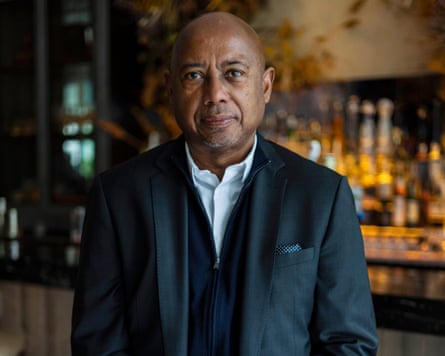
Peck is clear-sighted about America’s slide into authoritarianism. “Look at Donald Trump. He has 40 journalists in front of him and he attacks one, a woman, and calls her ‘piggy’ or says ‘you never smile’. If the whole room doesn’t stand up and leave, you’re giving him the power, because next time he knows that he can attack each one of you. And that’s what he does – he doesn’t attack you collectively, he points to one person and then everybody else backs off. That’s how an authoritarian regime works. He doesn’t attack all law firms, he attacks one, the most powerful one. He attacked the biggest university, Columbia.”
Despite his ordeal in office and his dire assessment of western politics, Peck hasn’t lost faith in all political movements. The last few minutes of 2+2=5 feature footage of protests all over the world, and examples of people power that can cut through the fug caused by newspeak and dishonest leadership. He speaks with friends in Haiti on a nightly basis, getting updates and cooking up ideas to improve the situation on the ground in a country that is dysfunctional and divided.
So are protests the solution? “I wouldn’t call it a solution,” says Peck. “I would say, like Orwell also says, the status quo is also a political position; doing nothing is also a political statement. The question for each one of us, individually and collectively, is what is our decision? Because if you don’t engage, history will be made without you.”






 English (US)