
 8 hours ago
3
8 hours ago
3

Layer two: Nick Woltemade, signed for £69m in the hot madness of summer, has stopped scoring. Anthony Elanga, a £55m winger, has struggled for game time and goals. Malick Thiaw, a £35m centre-half bought from Milan, keeps making basic errors. Last summer’s transfer window, conducted without a sporting director and with an outgoing chief executive, looks increasingly like a disaster. The football seems a little slower and less urgent these days, St James’ Park a little quieter and more anxious. Eddie Howe is basically holding this thing together with hugs and smiles.
Layer three: turns out Alexander Isak lighted the exit path so that others might follow. Sandro Tonali’s agent decided to make a little mischief on transfer deadline day, putting Arsenal on alert. Perhaps Tonali will be the next painful transfer saga, perhaps Bruno Guimarães or Lewis Hall or Tino Livramento. The sporting director, Ross Wilson, is still getting his feet under the table. The chief executive, David Hopkinson, reckons Newcastle can be the best team in the world by 2030. They sit 11th in the Premier League. No signings arrived in January.
Layer four: the new training ground, rumoured to be out near the airport, is yet to materialise. No spades in the dirt, no announcements or architects’ drawings, no timeline. The new stadium in Leazes Park remains a figment of the imagination. During the takeover process, Amanda Staveley claimed that the Public Investment Fund of Saudi Arabia had “massive plans to invest in the city, in housing, everything”. The regeneration of St James’ Park, its community and the wider urban area was a major part of winning public support for the bid. More than four years on, there is little to no evidence that any of these schemes were formalised, let alone enacted.
Layer five: last week, the Public Investment Fund of Saudi Arabia quietly but dramatically downscaled its vast £5.8tn Neom megacity project in the face of rising costs. Unveiled in 2017, the centrepiece of Neom was The Line: a 106-mile row of mirrored skyscrapers, 500 metres high and 200 metres across, with a hidden marina, a 30-storey building hung upside down from a bridge and a World Cup football stadium on its top. Mountains would be levelled, tunnelled under, blown up in order to make room for it.
But quickly the project descended into a kind of wilful farce, as developers ran into massive logistical, physical and technical obstacles that they nonetheless felt unable to relay to the crown prince, Mohammed bin Salman. One senior manager told the Financial Times that staff were “effectively having to lie about the timescales and the cost of delivering the vision”. Aerial imagery reveals much of the tunnelling and excavation has taken place for the high-speed rail link to a new airport that may never be built.
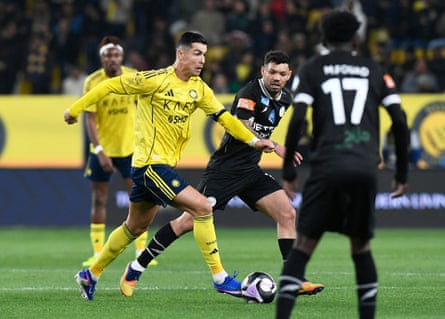
Layer six: across the kingdom, investments are being downsized, downgraded, pared back. Mukaab, an enormous cube‑shaped skyscraper in Riyadh that would have been the world’s largest building by volume, has been scrapped. For months there has been speculation within boxing that Saudi Arabia is beginning to taper down its generous mega-fight budget. Cristiano Ronaldo has reportedly been on strike at Al-Nassr over a lack of investment in the squad.
Layer seven: the crown prince was in a generous mood on his visit to the White House in November, promising investments of $1tn in the US without offering further details. But behind the scenes, the PIF is said to be running low on cash. Falling oil revenues have drilled an enormous hole in its accounts. Its portfolio is littered with expensive investments that have failed to bear fruit: a cruise line that owns one ship, an electric vehicle business yet to sell a car. International investors are being told that there is no new money available as it undergoes what is euphemistically described as a “restructuring”. Where does a lavish commitment to sport fit into this picture of retrenchment, recalibration and slow‑burning chaos? Nobody seems to know.
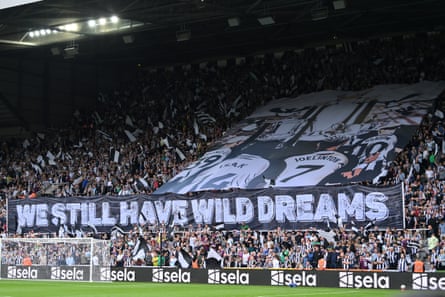
Layer one: the vast majority of Newcastle fans are yet to turn on their club’s Saudi ownership in any meaningful way. The memories of Mike Ashley are still fresh, and they remain in Champions League contention this season and next. All the same a certain cold unease seems to have taken hold of one of England’s great clubs: a bleak suspicion that the vivid dreamscape they were sold in 2021, a vision that caused many of them to swallow down or deflect the many human rights concerns surrounding the takeover, is years away from coming to fruition, if it ever does.
The recent history of PIF is a tale of grand schemes, wild ambition and unfulfilled promises. Promises that have either been deferred or not kept, or maybe were never intended to be kept in the first place, that existed essentially as an incantation, a public show of aspiration in a world bending ever harder towards the spectacle rather than the exercise of power.
Perhaps Woltemade finds his shooting boots. Perhaps a Wembley final or a run of wins gets the city stirring again. Perhaps the training ground eventually gets built. Perhaps at some point in the next decade there is a new stadium on the bones of the old. But of course there are no guarantees, and if none of it happens there will be no recourse, no outlet for buyers’ remorse, no meaningful way of holding to account those responsible.
The decisions affecting their future happiness will be taken without their consent or veto, in rooms they will not be able to access. Layers upon layers of bureaucracy and management, economics and geopolitics, the fate of a club and a city turning on the whims of the global oil market or what a man in a palace might decide to build tomorrow. It is one of the enduring tragedies of English football that those with the greatest interest ultimately have the smallest stake in it.

 English (US)