
 4 hours ago
3
4 hours ago
3

Kimberly Belflower’s revisionist take on Arthur Miller’s classic The Crucible re-spins the witch-hunts for the #MeToo generation. A classroom of teenagers – mostly girls – want to set up a feminist club, which is sparked, you assume, by the news headlines. Set in 2018, it is an original way to deal with adolescent girlhood in the direct fallout of the Harvey Weinstein scandal, although the play takes a while to gather power.
Beth (Holly Howden Gilchrist) is the class swot; Ivy (Clare Hughes) has a father accused of inappropriate behaviour at work; Nell (Lauryn Ajufo) is the new girl; Raelynn (Miya James) is a pastor’s daughter whose ex-boyfriend cheated on her with Shelby (Sadie Soverall). The last of these is key to proceedings but is absent from school – and this play – for quite a while.
This is a small-town Georgia high school and the idea of a feminist club is deemed too hot to handle until a charismatic (and, to several of the girls, sexy) teacher, Carter Smith (Dónal Finn), intervenes with the idea that it could include boys, too.
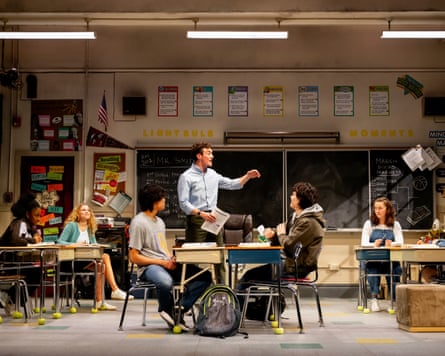
Directed by Danya Taymor and performed straight through at under two hours, the script’s pivot is the play they are studying – The Crucible – under Mr Smith. Alongside it is their growing understanding of intersectional feminism, which sometimes bears adult realisations on sex and power. Flashes of personal drama come with a pointed spotlight on whichever character is under focus and there are exuberantly poppy paeans to Lorde, Taylor Swift and Beyoncé.
It is sweet but slow and slight until the parallel to Miller’s play is revealed with a shock. The initial Dead Poets Society vibe sours and Miller’s play takes on dark contemporary relevance around #MeToo, although this parallel stays hazy: there is a sense that Ivy feels her father is a casualty of the witch-hunt, but there is also a raised consciousness around male predatory behaviour, which has until now remained unspoken by these teenagers. Soverall is a standout in a role originally played by Sadie Sink in Taymor’s Broadway production; she and James have an intimate and awkwardly goofy chemistry as estranged best friends that is tender and convincing.
Belflower’s dialogue captures the way girls talk to each other with humour and pathos, as well as how they internalise the world’s micro-aggressions towards women. But the relationships here are flattened by their cuteness, rather than sharp-edged and gritty, as this cusp of girlhood and adulthood so often tends to be. It more than passes the Bechdel test (the boys here are dolts), which is gratifying, but you do wish for more complexity between the female characters.
There also seems to be something of a false equivalence set up between Miller’s John Proctor, a morally complicated character who betrays his wife but ultimately does not betray his principles, and the predatory male here, who is little more than a repellent serial groomer and abuser.
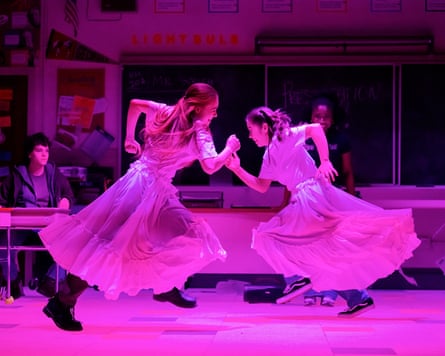
It ends with a surge of emotion as the students enact their liberation in a dance version of the scenes from Miller’s play which show the girls having a fit (two of them perform an interpretative dance that seems like a wilder version of Swift’s Fortnight video in its aesthetic). This brings a high, although nothing has changed, and the predator stays in the room. That is the point but it still feels too neat and easy as an ending.
It is a moving play all the same, and catches the mood of 2018 for a bewildered generation of girls growing into womanhood in the shadow of Weinstein. It feels almost historical in the face of the backlash. Remember #MeToo? What has come of it? And what are these girls thinking now?








 English (US)