
 1 hour ago
3
1 hour ago
3

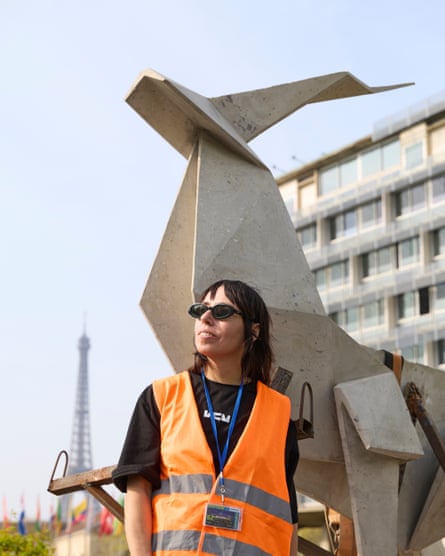
On a perfect spring day in Paris, the deer is first visible in the distance, poised between an avenue of just-budding plane trees in the 7th arrondissement. Its head is raised, its body poised. Seen there among the trees, it really could be a wild animal. In reality, it is a concrete deer, and not even a particularly naturalistic one, since it has the distinct look of origami about it. The sculpture is a play of scale and weight, as if feather-light folded paper has been enlarged and transformed into heavy concrete.
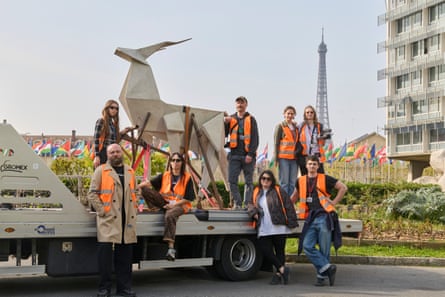
The deer is strapped to a flat-bed truck, and it is being driven into the grand modernist headquarters of Unesco, the UN agency that looks after heritage, culture and education. It will stand there for a day in its gardens, with Alexander Calder’s Spirale for company and the Eiffel Tower as a backdrop. It is the last stop on a long overland journey across eastern, central and western Europe before it crosses the Venetian lagoon and docks in Venice for the 2026 art biennale, where, from this month, it will be the most prominent component of Ukraine’s national pavilion.
The deer sculpture is by Kyiv-based artist Zhanna Kadyrova, who has been making resonant work reflecting the violence of the Russian attack of Ukraine since 2022. The work, however, predates Russia’s full-scale invasion. In 2018, she was commissioned by the city of Pokrovsk, in the Donetsk region, to help regenerate a large park. It was one of a number of efforts to invest in the cities of Ukraine’s east after Russian-backed separatists took over chunks of territory in the Donetsk and Luhansk regions. She and her partner, Denys Ruban, worked in the city for several months. Part of her work was to make a permanent sculpture for an empty plinth that was once the perch of a decommissioned Su-7 fighter-bomber – a Soviet plane capable of carrying tactical nuclear bombs.
Kadyrova submerged most of the plinth in soil and turf – and created her deer to stand atop the peak, as if on a crag. “It wasn’t something too conceptual,” she tells me in Paris. “I wanted to make something for local people that they would love, something understandable, something contemporary.” It wasn’t an immediate hit with everyone. But over time it became a landmark, a well-known feature of the city. It was a peaceable, delicate creature to replace a symbol of military domination and violence.
Fast forward to the summer of 2024. More than two years into Russia’s invasion of Ukraine, Pokrovsk was on the frontline. Kadyrova’s friend Leonid Marushchak – an educator, historian and now co-curator of Ukraine’s Venice pavilion – was at that time organising perilous evacuations of museum collections from frontline towns. In June of that year, as the combat zone inched nearer, and the city was rapidly emptying, Marushchak said: “I saw the deer was still standing there. I called Zhanna to find out if she was not against the evacuation of the sculpture. We went to the local museum – some of the staff were still working. They said they understand that they have to evacuate it, but they had no idea how to do it.”
Marushchak began negotiating with the city authorities – whose first priority, as drone and artillery attacks heightened in their intensity, was not a slightly odd contemporary concrete sculpture in the park. His “trick”, as he called it, was to undertake to evacuate a statue of Mykola Leontovych, too – a beloved Ukrainian composer who wrote the renowned, evocative Carol of the Bells. Eventually, Marushchak succeeded in getting permission and, on 30 August that year, he and Kadyrova oversaw the difficult process – involving angle grinders, a hammer drill and a crane – to get the deer, which had been cast in situ, off its plinth and on to a flat-bed truck.
A moving film, which will also be shown in Venice, documents the process. While the men are at work, Kadyrova asks locals – some about to leave for ever, some determined to tough it out come what may – what they think of the sculpture. Some are nonplussed, but others clearly love it, and the conversation is bound up with the ache of leaving a place, maybe for good. A mother weeps as she speaks of it, and there is a pair of teenage girls, both called Anastasia, who have come to take some last photos of the park, “a place of freedom and a place that reminds us of life before the war”. At the time of writing, Pokrovsk is now under Russian military control, combat raging around it. It will probably end up like Bakhmut, rubble in place of a city, the park with its rolling lawns and willow trees flattened and destroyed.
It was last year that Kadyrova and Marushchak, with fellow curator Ksenia Malykh, proposed a project centring on the sculpture for Ukraine’s Venice Biennale pavilion. “We had this idea to continue this journey as a metaphor,” says Marushchak, “just like so many Ukrainian refugees are wandering around Europe and the world.” The exhibition itself is called Security Guarantees – an ironic remark on the lack of them in Ukraine’s case, the fleeing deer transformed into a symbol of the rupture and violence brought by invasion.
And so, early this spring, the sculpture set out on its journey to Venice – a slow and circuitous one through Warsaw, Prague, Vienna, Brussels and finally Paris. Along the way, it has paused in each city, often in grand imperial architectural settings in which it was never intended to be seen, designed as it was for a park in a small, industrial city. And over the course of its journey, it has accrued more and more meaning and significance. Refugees from Pokrovsk, Kadyrova tells me, regularly come to see the deer, and a new tradition has arisen, of touching it and making a wish.
The deer is a symbol of hope and survival, according to Kateryna Khimei, one of the organisers of the public programme of events that has accompanied the deer on its travels. She is from a satellite town of Pokrovsk and her family has fled their home. “As many are the people who survived, it’s important to speak about those who did not, and about the cultural objects that also did not survive,” she says. She talks about a “new mythology” that has grown up around the deer. “In our context it has become a symbol, something you can come and touch, and have a memory that your city was once beautiful.” For the former citizens of the Pokrovsk, it is the single surviving feature of a city that can be visited, for now, only in the imagination.
This year the Venice Biennale has invited Russia back into its national pavilion after an absence since 2022. This contentious decision by the president of the biennale, which has caused friction with the Italian cultural ministry and provoked fury in the international art world, threatens to overwhelm discussion of the Ukrainian exhibition – and be seen as Ukraine’s problem above all, rather than “a common struggle,” says Khimei. None of the team wants to see their exhibition manoeuvred into the position of merely being seen as the “anti-Russian pavilion”, she says. Her fellow public-programme curator, Ivanna Kozachenko, agrees. “We really hope that the Russian pavilion will not open and Russians will not be present. They destroyed so much cultural heritage in our country, in Syria and Chechnya, and in many, many countries in the past, and now they are sending their culture to Venice. Why should this happen?”
Back in Paris, the sun is shining benignly on the deer as it stands beneath the flags of Unesco. It has been a jittery morning: Russia is a member state of the organisation. The very next day Russia will launch a Shahed drone attack, in full daylight, on central Lviv, which will explode near the city’s Bernardine monastery – a baroque building that is actually illustrated on the Unesco website, the entire city centre being a Unesco world heritage site. Irony abounds, and so does tragedy. When the deer arrives in Venice, it will be installed near the entrance of the Giardini, the public gardens that are the main venue for the biennale. There it will hang suspended from a crane – “a visual game for the viewer,” says Marushchak, that will invite spectators to speculate on whether it is in the process of being removed or put in place – and hinting towards its uncertain, suspended future as a sculpture without a permanent home. But tonight there will be dancing and music in honour of its arrival in Paris – joy salvaged from the darkness.



 English (US)