
 6 hours ago
5
6 hours ago
5

‘It’s magical,” says Loie Hollowell. “It’s such good timing!” The artist, speaking via Zoom from her studio in Queens, New York, is referring to the Artemis II moon mission. Little did she know, when she named her latest painting series Overview Effect, after the term used by astronauts to describe the experience of seeing Earth from space and the profound feelings of awe and interconnectedness it provokes, that she’d be coinciding with this space odyssey. But she is not surprised anyone would want to leave Earth for a while. “We’re having so many problems here,” she says.
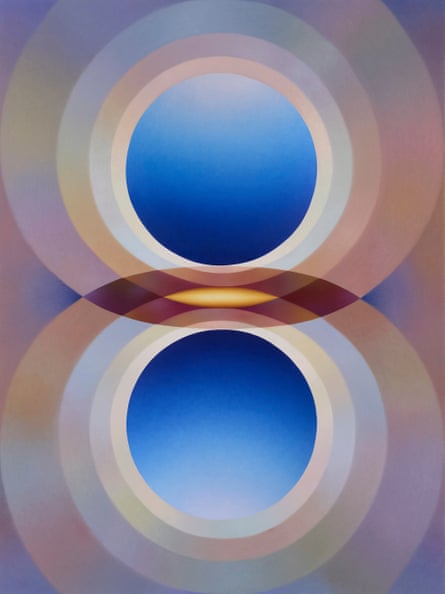
Overview Effect, currently at London’s Pace Gallery, features large-scale canvases combining twin concave and convex sculpted circles. If you folded the canvasses in half vertically, the halves would fit perfectly together. The works, which radiate outwards in rings of glorious colour that are both vibrant and soothing, are a continuation of earlier works focusing on pregnancy and birth through abstraction. Her Split Orb paintings and Dilation Stage series of pastel drawings responded to the difficult birth of her son in a New York hospital. Overview Effect is a result of her daughter’s easier arrival: a “cosmic” home birth that she found far more empowering.
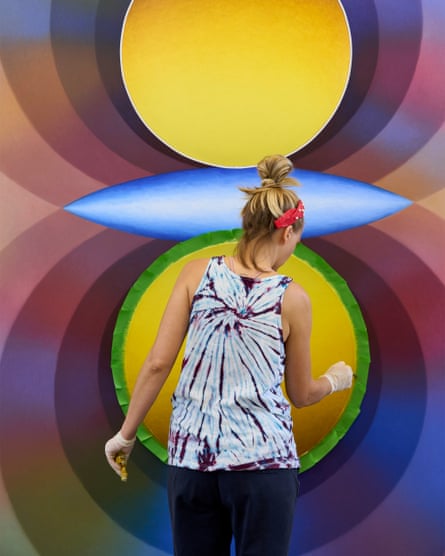
The work that came from the first birth, she says, was more diagrammatic, like a self-portrait: “It’s me from the outside looking at a pregnant body. The second was more internal. I was much more present.” Hollowell is “a sci-fi nerd”, so it’s no surprise she looked to space to capture the out-of-body experience she had during that second labour.
“When I was giving birth, there was a moment in between the contractions where the pain was so deep and so all encompassing that I was probably going to pass out. I kind of came above [myself]. Since I was sitting up, I could look down and see my daughter’s head coming out. And somehow the vision from above was also my head.”
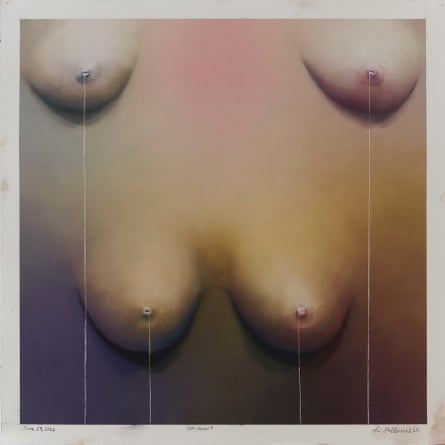
Hence the twin circles of her compositions, so abstract you’d not know what they represented if you weren’t given the rationale. Go downstairs, and her more bodily (and yes, genital) pastel works help you trace the artist’s thought processes. The underpinning is deeply, viscerally corporeal: abortion, conception, pregnancy, birth, breastfeeding.
Hollowell was born in 1983 and raised in Woodland, California. Her father, a painter, worked and her mother, a seamstress and cartoonist, stayed at home with the children. “My mom had four kids and she was just like, ‘Oh, I popped them out. Go and pop them out!’” Hollowell says. “And then she breastfed all of us until we were like five or six. She made it sound very easy. And it’s just not easy. It’s so hard.”
Maybe it’s a form of survival to only remember the good parts, I say. Hollowell is laughing. “I look back and I’m like, I can see the signs of the repressed soul!”
As well as the great American modernists, O’Keeffe included, Hollowell loves Louise Bourgeois, and cites Luchita Hurtado’s birth paintings as a major influence. She wasn’t only looking at other visual artists for inspiration, though. Instagram photographs of home births also fed into her practice, as did the Ina May Gaskin childbirth book she read during pregnancy. She opens it and shows me one of the photographs in it. “It’s funny because all the pictures are kind of symmetrical, you know, there’s like legs spread, vagina in the centre. And that was the kind of compositional structure I was already doing.”
I mention the misogynistic snottiness towards artists such as O’Keeffe, or the feminists of the 1970s: this notion that they’re all just obsessed with their own vaginas. There’s this idea (a patriarchal one, to my mind) that great abstract artists are supposed to transcend the body, so I wonder if she felt a pressure to keep the more corporeal underpinnings under wraps, or “out of the press release” as she puts it. “As people, especially male collectors, have become more comfortable with my image-making, I’m able to speak more openly about what the influences on my practice are or what my inspirations are,” she says. “When I first started showing, I didn’t talk about the works, some of which are at the London show, being influenced by an abortion I had. But over the years, especially with the help of female curators, putting me into museum shows, I’ve been able to highlight that original inspiration.”
The tension between the abstract and the figurative is something Hollowell is still wrestling with. How to “blend” the two, especially when “abstraction sells”? “With the art market being what it is is, we really get pigeonholed into this one thing and it’s hard to break out of that,” she says. As well as her pastel drawings, which more obviously represent vulvas and breasts and have such pleasing titles as Happy Vagina, Boob Wheel, and The Let Down, Hollowell also makes body casts and is collaborating on some paintings with her children. These works would have once felt doomed to be taken less seriously, but I feel optimistic that the constructed barrier between the physical and the abstract that Hollowell is banging her head against can be dismantled.
Isn’t all art created by bodies, anyway? “When I think about making the earlier works, I was super horny,” she says. “I’d think about sex all the time, and [now] I don’t think about sex any more,” she says, of the under-explored role of hormones in the making of visual art. Now is perimenopause, then menopause.
“I feel so in control, in a way that I haven’t felt in the past, and that’s so interesting. The art will change again. My favourite artists really blossomed in their 50s and 60s, and I can see why.”
We talk about the shapeshifting nature of Bourgeois’s practice, how she refused to be hamstrung by one definition of what it meant to be an artist. Thankfully times are continuing to change. “I don’t know if I could have made this work 20 years ago,” Hollowell says. “It would have been really rare to be able to do that and be a mother.”

 English (US)