
 1 hour ago
2
1 hour ago
2

There was a moment outside the door of a recording studio in rural France, staring at a half-eaten apple that he believed possessed psychedelic properties, when James Ford knew things had really got out of hand. He was stood with Klaxons; all of the band members were hypnotised by this rotting fruit which throbbed on the floor with kaleidoscopic intensity. They were convinced that its blooming mould was in fact their spiritual guru.
The band had been riding the wave of their huge, scene-defining debut album, 2007’s Myths of the Near Future – which was produced by Ford – and were now trying to record the interminably difficult follow-up, aided by daily doses of a concoction they’d taken to calling “the five-star general”.
“It was a huge bag, five drugs mixed together, probably ketamine and speed, I don’t know what else, but it was quite a psychedelic powder and they were doing it every morning and throughout the day,” says Ford. He realised he couldn’t rein things back in. “And after a two-and-a-half-week period … things got fucking weird.”
So weird, in fact, that the head of the UK record label came over on the Eurostar carrying a bell jar at the band’s request, only to find out it was to cover an apple that had been chewed up and spat out by a passing dog and was now being called Mr Tabernacle. Klaxons, it’s fair to say, had lost their minds a little bit. The album was aborted.
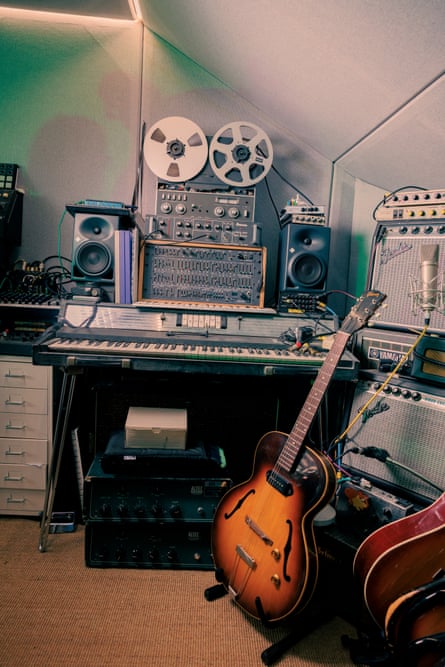
“We thought we were making The Dark Side of the Moon,” says Ford with a giggle, now sitting in the studio in his east London home. Instead, that “ill-fated second record” became the only project that Ford has never finished in a career that has since established him as the music industry’s go-to magic weapon.
It is quite the trajectory. Ford went from tearing up 00s dancefloors as one half, alongside Jas Shaw, of Simian Mobile Disco – musicians and DJs who elevated the electro-rave era of the decade – to becoming the most sought-after ear in music. In the last decade, with little in the way of hype, he has quietly become the pre-eminent producer of his generation.
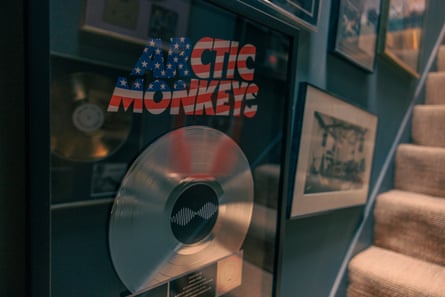
Ford is who you call when you’re trying to make a career-defining album (Arctic Monkeys; Florence + the Machine; Jessie Ware; Fontaines DC), who you trust to realise a stunning comeback (Pulp; Blur; Gorillaz; Depeche Mode) and who you need to help translate critical buzz into commercial success (Geese; The Last Dinner Party; Black Country, New Road).
“It’s a very broad term ‘producer’,” he says, trying to explain his role. “It doesn’t really describe what happens; I’m trying to get to the bottom of someone else’s vision and pull that out there.” Be it Pet Shop Boys or Jessie Ware, artists agree that Ford doesn’t produce in a conventional sense. “I think if you try to imprint your sound, it seems a weird ego-y thing to do, to try to do a Phil Spector on everyone’s record.” And so he doesn’t impose a sound or vibe on to the room so much as mediate, and draw artists in and out of whatever creative pattern they’re in.
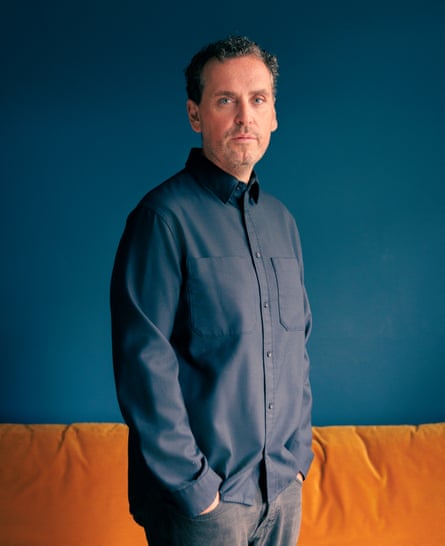
At home, surrounded by synths, guitars and all manner of recording equipment, Ford seems relaxed and is softly spoken, with a light touch of the Staffordshire accent he grew up with. The heyday of his hedonism may be behind him, but it’s obvious that he still loves what he does. It is this and a general sense of ease that has earned Ford a level of trust from artists at their most vulnerable. A gracious, nice guy in an industry famously short of decency, it’s easy to understand why the world’s biggest artists are knocking down his door to work with him.
Still, it’s a minor miracle we’re even meeting today. On Christmas Eve 2024 Ford was with his wife and young son at his in-laws’ in Folkestone when he got “hit like a ton of bricks”. He was laid out on the sofa, unable to get up with a fever that wouldn’t break and a flu-like illness that refused to let up. He had worked flat out all year, and in the weeks running up to December had felt unusually fatigued. He wondered whether he was heading for burnout, but this was something entirely new.
He was admitted to the local A&E; his blood tests were “all over the place”. Having travelled to India with Damon Albarn some weeks earlier, doctors initially suspected he had picked up a tropical disease. “There were a lot of red herrings,” he says. “It took ages to get any kind of diagnosis because my bloods had to get sent to London, so I spent weeks in this horrible state, and just felt I was going to die. It was awful.”
Weeks later, on a Friday night, “someone unceremoniously came in and said: ‘We’ve found leukaemia. You need to go to a cancer ward.’” And that was it. If his life had flashed before him, Ford, who had just turned 46, could admit it had been a good one. A great one, even. “I’ve got a wonderful family with my wife and little boy, I’ve got a great relationship with my parents, a good career, I’ve travelled a lot, done a lot of things with a lot of people that I’ve dreamed of working with,” he says. And he has partied hard, I joke, having borne witness to multiple Simian Mobile Disco sets and afterparties. “I’ve partied really hard,” he says. “I’ve had some great times, I’ve got a lot of good memories and I’ve made some things I’m really proud of. I think I’ve been a generally good person in the world. And so I was almost at the point where I was like, if I die, I’ve had a good innings. I wouldn’t be that scared of it.”
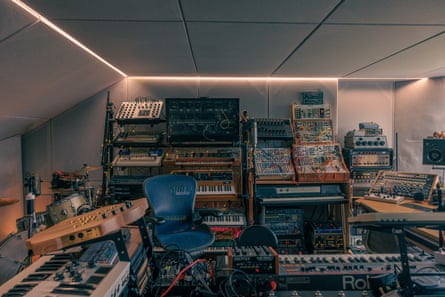
Ford was eventually transferred to St Barts hospital in London and pummelled with rounds of drugs. He spent the early weeks of 2025 obliterated by the illness. Then came the second round of chemotherapy, and something of a breakthrough. He asked his wife Sereen, whom he met as a student at Manchester University, to bring in his laptop, an Ikea fold-up table, some synthesisers, a microphone and a guitar to his hospital room. Supported by staff at the hospital, who could see it cheered him up and got him out of bed, Ford began making music. Nurses got used to administering their daily medical care while Ford messed with drumbeats and sang, locked in his creative flow state. In two weeks, Ford wrote and recorded his new album, Lost in Another World, which would be remarkable enough on its own – were it not for the fact that it is also stunning.
Despite being sung and recorded by Ford in a creative jag while contemplating life and death, the record feels like his signature sound – melodic, electronic, art-pop. It’s joyful where you expect it to be bleak. Over the course of nine months, Ford went through two more rounds of chemotherapy, a stem cell transplant, sepsis – three times – and a stay in intensive care. To say it has been an unremittingly traumatic year sells it short, but he – and the album – wear it lightly.
after newsletter promotion
“I don’t know if nervous is the right word,” he says of Lost in Another World’s impending release. “It’s more odd because it takes me back to that moment of being ill. And I’d intentionally left it, but now I’m having to talk about it. At first, even hearing it back for the first time, I was like ‘Ugh!’” I insist we don’t have to talk about the depths of his illness.
“I always felt pretty invincible, though,” says Ford, reflecting on it. “And then suddenly, you’re like: ‘Oh, I’m not.’ And it was that thing: two or three years before this, I started running. I was going to the gym regularly. I was eating well. I’d lost weight, I’d given up drinking, given up all drugs, blah blah, the full cycle. And then I fucking get leukaemia!”
Despite the toll the cancer took, Ford still somehow managed to produce two more major albums when he was really ill. One for Gorillaz, the other for the Mercury prize-nominated War Child album, Help(2), where he was producing the likes of Olivia Rodrigo and Beth Gibbons from his hospital bed. “Remote producing a session [going on] at Abbey Road while having a blood transfusion was not on my 2025 bingo card,” he posted on Instagram at the time.
Ford was not allowed any visitors for long stretches in hospital, Sereen excepted, because his immunity was so shot. “Funnily enough, Jarvis [Cocker] came in when he wasn’t meant to. But he’s so recognised, they were bamboozled and let him in and he’d very sweetly bought me some of his favourite books and wrote little things in them of what he liked and stuff. It was wonderful but I was a bit: ‘Wow, OK!’”
Mentally at least, music saved him. “It was amazing to have something to focus on that made me feel good, to get into that zone where I shut down everything else on the outside. The lyrics [for Lost in Another World] literally just fell out. Obviously I had a bunch of stuff to process, but it was the easiest music-making process I’ve ever had.”
How is he doing now? “I’m still not fully out of it.” Ford will have his bloods closely monitored for the next few years and attend regular checkups to track whether the cancer comes back. For now, he is gearing up for a number of live shows following the album’s arrival into the world and rehearsals are under way.
“The obvious thing that has come out of all of this is that it does make you recognise what and who the important things in your life are and that life is exceptionally fragile,” he says of his renewed work-life balance. “Not to spend any time with people who aren’t worth spending time with and on projects that aren’t worth spending time on. Just being really selective and intentional about every choice you make. And that can be as simple as ‘spend more time in nature’, ‘spend more time with my family’, ‘maybe not work so hard’.”
He smiles at the last one. “None of that is particularly groundbreaking. It’s stuff you see every day on the internet, but it’s different when you live through it. I definitely had read about the value of gratitude and all of those things, but I could never really take it on board in a way that I have now.”
Lost in Another World by James Ellis Ford is out now; he plays Rough Trade East, London, 17 August; and the Horse Hospital, London, 17 September.





 English (US) ·