
 3 hours ago
4
3 hours ago
4

When Donald Trump returned to office in January last year, one of his first acts was to sign an executive order intended to cut federal funding for any school teaching what the administration defined as “critical race theory”. A raft of other orders mandated the termination of DEI (diversity, equity and inclusion) personnel, offices and training across the federal government. Federal agencies began flagging hundreds of words to avoid or eliminate, including “intersectional” and “intersectionality”. All of which has amounted to 40 years of Kimberlé Crenshaw’s work being literally and deliberately erased.
For decades, the 66-year-old legal scholar has been naming things that powerful people would prefer remain unnamed. In 1989, she coined the term intersectionality to describe the way race and gender overlap to shape lived experience, often in ways the law fails to recognise. Around the same time, she was one of a group of African American scholars who created the framework that came to be known as “critical race theory”, which sought to examine how racism is embedded in legal systems rather than simply enacted through individual prejudice. Now, Crenshaw’s ideas are being contested like never before.
“Unfortunately, I did see this coming,” she tells me over a video call from the California offices of the African American Policy Forum, the thinktank she co-founded. We are calling to discuss Crenshaw’s new memoir, Backtalker, but the conversation soon shifts. “The fact that they are targeting this … it is because they understand the power of these ideas, the power of this history.” Behind her, posters reading “History repeats when we forget” and “The freedom to learn is the freedom to live” hang alongside shelves of critical race theory texts and Black history books the likes of which have, in some states, become politically radioactive.
What makes the intensity of this backlash striking is how recently Crenshaw’s work entered mainstream public consciousness. Until a few years ago, ideas such as intersectionality and critical race theory remained largely within the domain of legal scholarship, academic debate and activist vernacular. It wasn’t until 2020, when a loose coalition of conservative activists, media figures and politicians began elevating them as political flashpoints, that they were thrust into the centre of the culture wars. In the ensuing five years, this snowballed into all-out war against “woke”, with critical race theory as its ultimate bogeyman. It became a byword for liberal overreach, a catch-all for everything that was wrong with the US in the eyes of the conservative right.
“Trump jumped on a bandwagon started by a few rightwing propagandists, claiming that intersectionality and critical race theory were anti-white, anti-male and anti-American,” she says. “Fox News amplified this, and within weeks, these ideas were mentioned more than they had been in the previous four decades.”
Crenshaw, true to form, is not shy about naming what she considers to be the problem. “One of the keys of fascism is control of the nation’s narrative,” she says. “That, alongside creating a group of people that are legitimate targets of exclusion – an us and them – allows for the autocrat to be seen as the embodiment of the essential nation. And in the United States, we come prefabricated for that dimension of fascism to set into our politics.
“Why is it that so many white Americans are willing to continue to vote for a president that is demolishing democracy, so long as he’s willing to affirm them effectively as true Americans?” she continues. “Because of the idea that those over there are different from us. They don’t really belong. That is the way fascism works.”
It is clearly in Crenshaw’s DNA to confront injustice, as is evidenced in Backtalker, which chronicles her journey from witnessing inequality as a child to challenging entrenched power structures in law, academia and politics. “Being a backtalker is like being lactose intolerant,” she writes. “There is BS that I cannot digest. To accept anything close to second‑class status as the price of belonging sickens me.”
Born in Ohio in 1959, on the verge of the civil rights movement, Crenshaw grew up at a time of expanding yet restricted possibilities. She watched that tension unfolding in real time, in the speeches of Malcolm X and Martin Luther King Jr on television, and in discussions around the kitchen table, where her parents, dedicated anti-racist activists, treated politics as a daily practice. “As a Black child, I had early inklings that differences would matter in my life, even if I couldn’t name them,” she says.
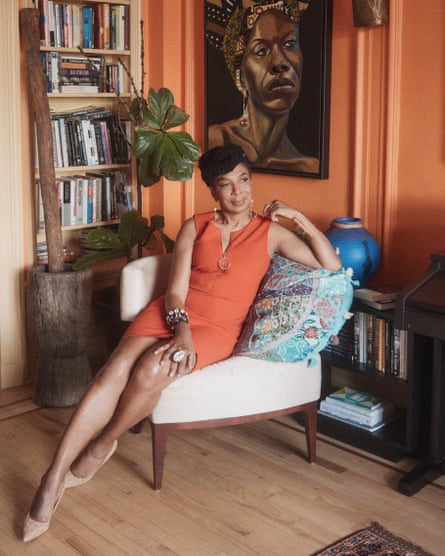
One such inkling came when her family moved to the predominantly white suburb of Canton, Ohio. “When we arrived, there were children playing everywhere,” she remembers. “I was excited.” But almost overnight, the children vanished. Neighbours treated the new family as intruders and shouted slurs when they walked by; an estate agent knocked on their door urging a quick sale.
Perhaps the most formative incident came when she was five years old, and was the only girl in her all‑white class who was not given the opportunity to play the princess, Thorn Rosa, in a school performance. “Thorn Rosa marks the stirring of my nascent awareness that my colour and my girlness were linked,” she writes.
“You push that doubt down until something happens that forces it open,” she tells me. “You realise that how others see you will shape your experiences. And that realisation is traumatic.”
What mattered, she says, was that those moments were not dismissed. “I credit my parents for taking them seriously,” she says. “They refused to minimise what I experienced, even as a young child. That affirmation was freeing, it told me my feelings were grounded in reality and gave me permission to understand them.”
It was tragedy that would, in many ways, become the making of the young Crenshaw. She was eight years old when Martin Luther King Jr was assassinated in 1968 – a before-and-after moment in her life. The following day, young Black activists in Canton directed schoolchildren to the local church for a hastily organised memorial service. Crowded into pews, everyone was silent when the activists asked if anyone had anything to say about Dr King. No one moved. It was Crenshaw who broke the silence, exhorting the crowd not to let his death be the end of the freedom struggle. “We pick up where he left off,” she recalls saying. “We continue to walk in his footsteps. They can’t kill his dream for us – not if we won’t let them.”
Further devastation followed. A year later, her father, an apparently healthy 34-year-old, died suddenly, leaving the family reeling. Not long after, her older brother Mantel was shot and killed while at university. The circumstances were never fully explained, and justice never came. She writes of that period with unflinching candour: “Happiness was dead.” These losses left an indelible mark, sharpening her awareness of the unevenness of justice in a world already structured by racial and social inequities.
Crenshaw arrived at Cornell University in 1978, to a campus shaped by the afterlives of civil rights struggle and Black student organising. It was there that she entered into a relationship with a fellow student that became physically abusive. In one incident, he beat her and tried to throw her from the window of her 10th-floor dorm room.
“We were eye-to-eye when he threw the first punch,” she writes in Backtalker. “Pressed out of denial, I woke to the fact that he was going to beat the daylights out of me.”
What followed unsettled her understanding of community more profoundly than the violence itself. Rather than rallying around her, many of her peers – fellow Black students and friends – closed ranks around him. To involve authorities, they told her, would be to expose a Black man to a system already predisposed against him. The implication was that her suffering as a woman should be subordinated to a broader racial solidarity.
“The way that sexual violence against Black women has long been justified – framing us as unlikely ever to say no to any sexual encounter – you can know this historically, but then when you experience it interpersonally, you have to grapple with the fact that more people in your own community will come to the defence of your abuser than you,” she says. “It really presses the question of ‘what is solidarity supposed to look like?’” she continues. “What does it mean to defend the ‘we’, when that ‘we’ often excludes me?”
Crenshaw returns to that question – of the instability of “we”– again and again. From arriving at Harvard Law School and being called the N-word on her first day, to being directed to enter the university’s exclusive Fly Club through the back door because she was a woman – the Black male friends she was with, rather than challenge the slight, urged her not to make a scene. What she would later call “asymmetrical solidarities” revealed themselves in practice: loyalty expected but not returned. “I cannot bring myself to ride or die for a politics that won’t ride or die for me,” she writes of the incident.
In legal terms, the problem came into focus when Crenshaw came across a 1976 case in which an African American woman was denied the ability to bring a discrimination claim against her employer on the grounds that the law could recognise race or gender, but not both at once. Her experience – specifically of being discriminated against as a Black woman – fell through the cracks and the case was thrown out of court. In 1989, Crenshaw identified this form of compound discrimination and gave it a name: intersectionality. Around the same time, she was part of a group of scholars developing what would become critical race theory, a broader attempt to understand how racism is a structural part of the legal system.
It is a lesson that would resurface, years later, in a very different arena. When Barack Obama was elected president in 2008, the language of “we” returned with renewed force – this time, as a promise. For many, Obama’s election felt like a rupture with the past. But for Crenshaw, it quickly raised a familiar question.
“I didn’t think it would happen in my lifetime,” she says, of that initial hope after Obama’s victory. “It felt like a miracle. My mother and I celebrated together on the phone – I was dancing on a table at Stanford and she was doing the same in her retirement facility. For her especially, it was a dream come true.”
But symbolism, Crenshaw suggests, has limits, particularly when it is used as a substitute for structural change. She found his reticence to address racial injustice head-on frustrating. Very quickly, the terms of Obama’s political viability became clear.
“He had been framed as post-racial, beyond these issues,” she says. “And that framing became a constraint on what he could say and how directly he could address racial injustice.”
Even when Obama did address racial inequality more explicitly in his second term – most notably after the killing of 17-year-old Trayvon Martin in 2012 – the focus, she felt, remained narrow. The White House’s response, My Brother’s Keeper, was launched as a nationwide initiative to expand opportunities for Black boys and young men. Its intentions were widely praised. Crenshaw was not convinced, and she took the administration to task directly.
“What was being discussed – Black boys and boys of colour– while important, came at the expense of girls,” Crenshaw says. “Black girls and girls of colour were suffering many of the same issues.”
Through the African American Policy Forum, she launched the #WhyWeCantWait campaign, calling for the programme to be expanded to include girls and young women of colour. Prominent Black feminist leaders and advocates including Brittney Cooper, Barbara Arnwine, Lisalyn Jacobs and Fatima Goss Graves threw their support behind it. An open letter, signed by more than 1,000 women and girls, urged the administration to realign the initiative with the principles of inclusion and shared fate that had long underpinned struggles for racial justice. The groundswell widened further with a second petition backed by high-profile white feminists including Gloria Steinem, V (formerly Eve Ensler) and Jane Fonda.
Crenshaw was invited to the White House to discuss the initiative, but the encounter only underscored how little space there was for the argument she was making. She recalls being interrupted by Obama’s chief of staff, who, she says, incredibly, told her she perhaps didn’t understand the meaning of intersectionality. Afterwards, she found herself shut out of the administration.
“It was uncomfortable to find myself outside the flow of support,” she says. “I never liked being at odds with my community. But if speaking out means sometimes being at odds with people I love, well, so be it. I still love them. I hope they still love me.”
More recently, though, the backtalking has not been against people she loves. The whiplash between the 44th and 45th presidents – the cautious optimism of Obama and the aggressive rollback under Trump – made that unavoidable.
Since 2020, the backlash has metastasised, Crenshaw argues, into an all-out assault not just on ideas, but on the very existence of Black people and women in positions of authority. “Our very presence in power is treated as preferential treatment,” she says. “This narrative of reverse discrimination has been central to the attack from the start.”
In response, she has not retreated but doubled down on her work with the African American Policy Forum, mobilising coalitions, supporting grassroots activists and amplifying voices that challenge the distortion and erasure of race and gender in public life. She continues to insist that the frameworks she helped build are necessary for understanding how inequality operates today.
This febrile political climate has brought a rising tide of political violence into everyday life in the US. The 2021 Capitol Hill riot, the assassination attempts on Trump, the 2025 targeted killing of Minnesota state representative Melissa Hortman and her husband, the killing of rightwing activist Charlie Kirk. I ask her whether her physical safety is now something she worries about. She demurs.
“There’s a long history in this country of using the threat of violence to keep people under heel,” she says. “The civil rights movement succeeded despite that terror. One cannot ignore that history. One cannot think that those forces that are willing to break this country rather than share it, don’t have descendants who won’t carry forward the same ideas.
“So yes, it’s a reality, and of course I take steps to be safe,” she continues. “But that is the cost of backtalking to the forces of autocracy.”




 English (US)