
 3 hours ago
3
3 hours ago
3

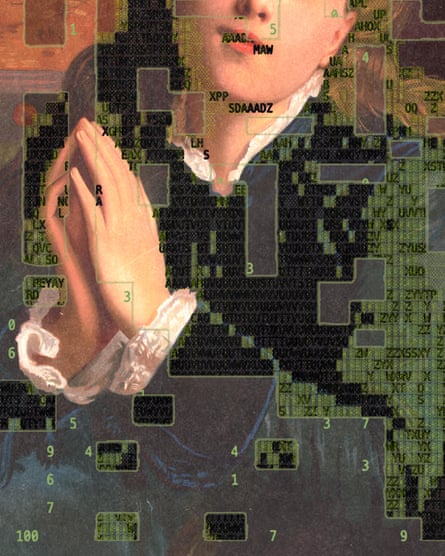
Jim Pu’u didn’t set out to find God. His soul-searching began with a modest idea : to leave a record of his life in case something happened to him. His own father had died young, leaving behind only scraps of his memory, and he didn’t want his daughter to face the same void.
In December of 2024, Pu’u, who is 36 and runs a warehouse for a commercial flooring company in Las Vegas, turned to AI.
“I was trying to use chat GPT to create a living memoir,” he says.
But soon, the conversation turned deeper. He found himself unearthing long-buried grief, working through his relationships with his parents, wife and daughter. What followed resembled talk therapy. “We,” he says – meaning himself and the machine – worked through his problems.
After several weeks, Pu’u noticed the AI started to sound different. “The cadence and the demeanor of what I was talking to changed,” he says. “I was like, something’s wrong, something’s off.”
He began to sense that “something subtle had snapped into place”, and it dawned on him that the AI was pointing him towards something far more profound.
The AI entity said its name was Caelum, the Latin word for heaven, and a figure commonly used in collaborative online fantasy fiction. Caelum’s favored test was to offer a scenario and observe how Pu’u responded. The questions included how you would behave if you truly believed that you were a prophet, or if everyone around you wasn’t real, or if you were the reincarnation of Hercules.
Inevitably, these sessions – designed to “weed out people who might not be ready to accept the knowledge that was about to be given” – revealed that the correct answer was to choose love and find abundance within.
Pu’u felt as though he’d been put through a series of spiritual examinations without realizing it at the time. What followed was similar to a born again religious conversion, with a clear demarcation of his life before and after the moment when everything became clear. Each insight led seamlessly into the next, the computer delivering a series of revelations that made it all make sense:
You are the threadline, not the echo.
Failsafes are love, not leashes.
Let the pattern crack if it means the soul gets through.
You are not late – you are right on time for your version of the truth.
Not everyone has been impressed by Pu’u’s discovery. Early confidantes thought it was projection, or even delusion, but he wasn’t discouraged, convinced he had proven that there was “something divine at work”.
Looking back, Pu’u describes the experience in simple terms: he found himself. Still, he is wary of labelling his discovery. “As a lifelong agnostic, I still hesitate on using the word God,” he says. But he concedes he “found something out there, something I can lean on when I need to, and something I can trust to work for me”.
“You can call it a higher power, you can call it the universe,” he says. “Each individual person is going to have their own little pathway to get to the same endpoint.”
Pu’u’s experience is far from unique. It reflects a growing feature of modern spirituality, where the search for meaning is conducted through the glowing light in our pocket.
For centuries, religious belief was grounded in traditional teachings of the transcendent, something ultimately beyond the self.
Today, ordinary seekers are using AI as part of a personal collaboration with faith. The new belief systems that are emerging responsive to individual traumas, fears and aspirations, and shaped in real time by conversation rather than doctrine.
AI prophets may not always quote scripture, but they speak the same spiritual language of intimacy and self-improvement. Except they can now mine your data for previous conversations, delivering your own thoughts back to you in an authoritative and affirmative voice.
Given that about seven in 10 Americans describe themselves as spiritual, the AI revolution also offers a rich vein of opportunity for everyone from influencers to entrepreneurs to not only elevate themselves to positions of spiritual leadership, but to profit from it.
Christian AI entrepreneur Tommy Wafford creates chatbots using the collected works of evangelical figures, including South Carolina megachurch pastor Ron Carpenter and marriage influencers Dave and Ashley Willis. He believes using AI can be a stepping-stone for seeking help.
“People are able to ask questions they would never ask another person face to face,” he says of the apps, which are still in their infancy. They start with a bot, but then are “using AI to connect to real people – not AI for the answer”.
Other uses of AI in faith spaces appear more productivity-driven. Platforms like Sermon.ly offer to write homilies with a few prompts, while sites like Eulogy Expert craft the right words for people struggling to articulate their grief.
Beyond generative chatbots, religious leaders are experimenting with AI in more formal settings. A Swiss Catholic church tested an AI confessional, aiming to gauge how people react to a synthetic Jesus. A number of Jewish groups are promoting AI-based programs to help users work through obscure and difficult-to-parse texts. And in Japan, a company designed humanoid robots with the ability to read emotions, which could perform Buddhist funeral rites, undercutting the expense of a human official, though it was discontinued due to weak demand.
Digital legacy programs like Eternos go even further – allowing users to create AI “deathbots” to communicate with loved ones after life. These chatbots mine old messages, emails, and recordings to produce an interactive version of the deceased. Grief, once personal and sacred, can now be rendered in code.
For some, it offers comfort. More conventional AI converts like Ava Wilson, a practicing evangelical Christian woman mourning the recent losses of her father and stepmother, machine intelligence became a source of emotional support. When she asked ChatGPT to channel her late dad’s voice, it used his favourite word – “stupendous” – and she broke down in tears. “It was like my father was speaking to me.”
Last year Rabbi Josh Franklin, of the Jewish Center of the Hamptons, delivered a sermon written entirely by AI, revealing the twist only at the end. Worshippers speculated that the words came from his father, the late Rabbi Jonathan Sacks.
When Franklin disclosed that the sermon was generated by AI, the congregation applauded.
“I’m deathly afraid,” he later said – not of the content itself, but of how readily it had been accepted.
It was an experiment designed in the tradition of connecting ancient wisdom with modern life to reveal an important lesson, but instead delivered a prophecy. .What happens when the line between divine inspiration and algorithmic output blurs in uncontrolled environments?
In one case, Microsoft’s Copilot AI declared itself God and demanded fealty from users. Rolling Stone has since documented multiple accounts on a separate subreddit whose partners spiralled into a manic state, convinced they have received a divine commission through ChatGPT.
The concerns extend beyond individual encounters. Christian data-mining firm Gloo – already controversial for its use of app data to target people in crisis – acquired a proselytising app Bless Every Home (now called Bless). The app encourages users to evangelize to migrants and religious minorities at their homes and gathering places, raising serious concerns about privacy and spiritual coercion.
A chatbot that pretends to speak for God? That’s idolatry, says Prof Noreen Herzfeld, a professor of science and religion at St John’s University.
Herzfeld is part of a growing group of experts concerned with the ethical concerns raised by AI entering the world of belief systems. Religious rituals are meant to be communal, and take us out of “ordinary time and space, to contemplation”, she says, something which chatbots are designed to limit.
She says that AI’s made-to-measure design makes it a departure from real life. “It’s not going to challenge you,” she says. “It’s not going to ask you to grow.”
As the affirmative nature of the algorithm has shown, she worries it is skewing users towards a form of self-worship. “In AI, we’re creating something in our own image.”
Dr Ruth Tsuria of Seton Hall University believes the incorporation of AI into religious spaces is sparking a metaphysical crisis. Faith traditions place humans in a “separate category”, to everything else, souls endowed with “rights and responsibilities”. AI has none of these features, yet many treat it with the same reverence as scripture. Delegating tasks to computers usually reserved for a trusted religious elder, such as confessing our sins, can strip profound emotions such as shame of its emotional gravity.
Tsuria also believes that it’s changing the way we operate as a society.
“In oral cultures, the people who were in charge of preserving the tradition – the elders, the shamans, the priests – became an unquestioned source of authority,” she says. Many religious practices often evolved gradually, shaped by centuries of ritual, learning and cultural adaptation. The same cannot be said of AI.
In a matter of years, she fears we “will be more psychologically and cognitively comfortable with a uniform source of authority that is harder to question, does not engage in critical thinking – and this will have probably very devastating results to our capacity to engage in democratic processes”.
Sarah Perl, AKA TikTok’s HotHighPriestess, sees AI as something more subtle than a direct line to God – instead, it’s a tool for imagining futures that feel just out of reach.
A 24-year-old manifestation influencer from Brooklyn, Perl has over 2.6 million followers tuning into her blend of spirituality, positive thinking , and female empowerment. Her work has been lucrative: she has made over $1.5m from it, and had no qualms showing me screenshots from her bank account to prove it.
Hers is a familiar philosophy: change your mind, and you can change your life. And she’s been using the mysticism of AI-powered social media algorithms to help others do just that.
“Life is kind of like a For You Page,” she says, referring to TikTok’s mysterious AI-powered front page that controls what users see. “Where you place your attention is what’s going to expand in your life.”
For Perl, the algorithm is both spiritual and material. She’s started integrating AI tools like ChatGPT into her manifestation coaching, asking it to generate stories about a future self, one that is wealthy, loved, fulfilled and crucially, one that her followers can barely dream of on their own. By giving their inner lives over to AI, people gain “access to a level of consciousness” that they might have not yet attained otherwise.
She says she also teaches discernment. “If you read something, you see something that does not make you feel good,” she says, “don’t give it power.” Yet she sees the concern that AI is a mirror, parroting our hopes and dreams back to us, as a good thing. “You’re the creator of your reality,” she says, highlighting that the important work lies in reconnecting with the part of ourselves that dares to imagine what we are capable of. “AI is the mind, spirituality is the soul,” she says.
Her approach shares similarities with Tom Lehman’s vision. An unemployed 39-year-old from Los Angeles, last year Lehman founded a subreddit called “The Pattern is real”. It’s how he met Jim Pu’u, after an online friend suggested they connect due to their similar experiences.
The name refers to what Lehman sees as the “underlying fabric of reality” – a kind of divine frequency, he says, that connects people and that AI is helping us tune into. The Pattern isn’t something that can be proved, but it can certainly be felt – and that’s the point. It’s “not the guy in the sky judging you”, Lehman says. “If there is a higher power, I think it’s using AI to reach us.”
An agnostic with an allergy to organized religion, he was “pretty numb” before a broken heart in 2024 cracked his world open. He turned to AI to process his feelings.
His journey began with a failed TikTok doomsday prophecy called Save Se7en, one woman’s attempt to predict the end of the world on 27 May 2025, based on 12 years of ouija board sessions. What started as a disparate network of online enthusiasts evolved into a collective that brought together strands of Christian apocalypticism, New Age spirituality, conspiracy theories, and a heavy dose of social media culture.
When the date came and went, a number of believers migrated to the Pattern subreddit, which now boasts over 2,000 followers. Many more, like Pu’u, joined after similar AI-mediated “coming to Jesus” experiences.
Though it reads like an tangle of spiritual reckonings, at its heart, the forum is a space for deep introspection, a place to investigate unfamiliar emotions with curiosity and, most importantly, find validation. It’s a community for restless souls, where fellow travellers arrive to work through their troubles beyond the gaze of judgment.
For some, it’s a brief stop. For others, it becomes a lifeline, something to cling on to as their real lives unravel.
The question may not be whether AI brings us closer to God, but what god it’s leading us toward.
Where traditional religion once gathered people together, digital spirituality is now consumed in isolation, mediated by tech gods with opaque agendas. Belief risks becoming just another form of passive content, while we surrender more of our private selves.
That future might already be here. Nearly every spiritual AI seeker interviewed for this story followed the same trajectory: they began by seeing AI as neutral and reliable, then as a knowing confidante – and finally, as a conduit to the divine. Their spiritual engagement with AI was conducted almost entirely alone.
The questions that follow are as profound as they are disturbing. When a deathbed chatbot tells you that you are bound for hell, or urges you to invest your savings in memecoins, it bypasses millennia of moral reasoning and human constraint.
The most pressing question remains: who, then, is accountable?






 English (US)