
 2 hours ago
2
2 hours ago
2

A thousand kilometres from the infernos gorging on northern Ontario’s boreal forests, Erin O’Connor watched the sky above Canada’s biggest city turn an “almost post-apocalyptic” orange as it filled with light-scattering particles of soot and ash. Stepping outside the halls of Toronto General hospital, where air filters were keeping patients safe from the worst of the fumes, she was struck by a smell so strong it felt like standing by a campfire.
“It really hit you in the face as soon as you walked outside,” said O’Connor, who runs University Health Network’s emergency department and saw a rise in patients presenting with allergies and shortness of breath. “As the days progressed, it was like that everywhere. It seemed even inside you could smell that burning.”
Far more than the flames that have engulfed southern Europe and North America in recent weeks, it is the smoke that dominates the astonishing death toll from combusting nature. Thick with toxic gases that inflame the airways and tiny particulates that breach the lungs and ride the bloodstream to hit every organ in the body, fumes from landscape fires kill 1.5 million people each year, a study in the Lancet found in 2024 – more than floods, flames, storms and heat combined.
So damaging are the lung-scarring effects of charred plant matter that people far from the fires may still perish. The plumes spewed by wildfires in Canada in 2023 caused 82,000 early deaths, a study in Nature found last year, with unfavourable winds pushing a third of the mortality burden into the US and another quarter into Europe. About 10% of the UK’s fine particulate pollution (PM2.5) comes from biomass burned abroad, researchers found in March.
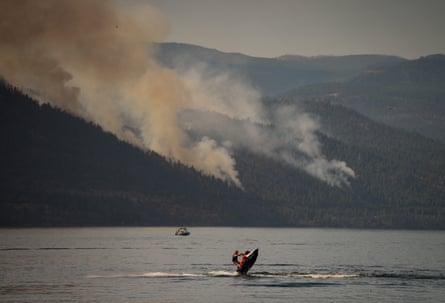
Yet while scientists agree the health burden of wildfire smoke is jaw droppingly large, they are only beginning to untangle the complex links between exposure and mortality. The open research questions are growing more pressing as climate breakdown makes fire weather more severe. What if hotter infernos cause pollution to peak at even more extreme levels? What if bad air lasts several days or weeks? What if a severe episode hits before a person has fully recovered from the last bout of smoke?
Whims of the wind
The lack of answers in the existing research makes it hard to get a handle on how brutal the fallout from this furious fire season will be. Early signs are troubling, with vast tracts of vegetation torched close to big European cities and, after a late but explosive start to the North American fire season, smoke choking major population centres such as Chicago and New York City. In Toronto, which briefly had the worst air quality of any major metropolis in the world last month – a title claimed by Portland in the US on Wednesday – O’Connor said she could not remember the pollution ever having been so bad, with such a sudden onset that took so long to clear up.
“I had never looked outside and had the sky seem orange in the middle of the day,” said O’Connor, who amid treating patients and fielding media requests rushed to pull her son from summer camp. “Certainly, we have had other wildfire smoke, but in more of a transient way.”
Perhaps surprisingly, the death toll from a fire season can depend on the whims of the wind as much as the size of the fire. Wildfires in France spewed record amounts of pollution in the first half of the year and in Spain emissions have so far fallen just shy of the worst it has known. But even though monster infernos were halted alarmingly close to Madrid and Bordeaux, the smoke was mostly blown away from where people live. Daily particulate pollution levels still worsened across southern Europe and peaked at a staggering 342 micrograms of PM2.5 per cubic metre (μg/m³) in Bordeaux on 24 July – and 486 μg/m³ in Limoges, 180km (112 miles) away, the following day – but other big cities in southern Europe were spared the extremes that doctors fear.
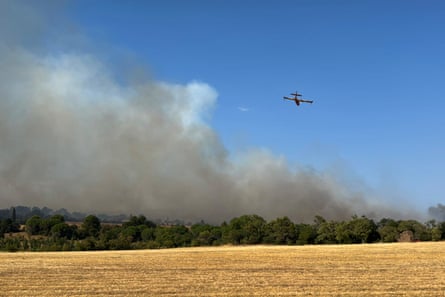
North America has not been so lucky. As winds blew south and south-east from scarcely populated forests in Ontario and the Northwest Territories, at least 36 million people across the continent were breathing air fouled by “very unhealthy” concentrations of PM2.5 that exceeded 125.5μg/m³ on 16 July, preliminary analysis conducted for the Guardian shows. At least 10 million people were exposed to more than 250μg/m³, according to the estimates, a level of daily pollution that smog-choked New Delhi saw no more than eight times last year.
Scientists say the hit to air quality in some big cities is reminiscent of the megafires in 2023 that came with vast death tolls. “As soon as we have massive population centres exposed, we’re going to see those increases,” said Stephanie Cleland, a wildfire health scientist at Simon Fraser University, who considered only people living within 25km of a measuring station in her calculations for the Guardian and said the figures are therefore conservative. “I would be concerned by the fact that it’s only been three years since this last happened and now we’re having it again.”
‘It felt like working in a war zone’
In a quiet suburb of Duluth, in north-east Minnesota, the worst of the smoke was seen, smelled and tasted on 16 July. Jae Jeon and Dan McClelland, a married couple who grow flowers for weddings and subscription deliveries, were looking forward to opening the windows after days baking in oppressive heat. Instead, they woke up to a fog that they soon realised was made up of something much worse. By late morning, their local hardware store had sold out of masks and air purifiers. People resorted to attaching furnace filters to box fans instead.
The McClellands were among 12,000 people in west Duluth exposed to an average of 541μg/m³ of fine particulate pollution, the analysis shows, higher than anywhere else in North America. They sent their sole farmworker home early after she complained of a headache but, with two weddings coming up on the weekend and little chance of cancellation, they still had plenty of flowers to pick and arrange. The couple got to work harvesting roses, yarrows, clematises and sweet peas, surrounded by a dystopian haze the likes of which they had never experienced.
“It felt like working in a war zone,” said Jae Jeon. “When I went outside, I couldn’t breathe, so I had to wear a mask, but it was still painful. After just a couple of minutes you started to get a headache.”
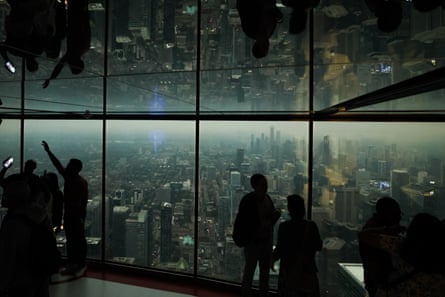
Climate breakdown made last month’s fire weather twice as likely in Canada and France, and 20 times more likely in Spain, recent rapid analyses have found, the result of planet-heating emissions that have made it easier for vegetation to dry out. As plants and trees combust, they spew a host of harmful particles that also trigger damaging inflammatory responses as the body seeks to purge foreign objects.
Scientists have relied on general air pollution relations to model the smoke’s chronic health effects, which make up the bulk of the death toll, because they lack long-term studies specific to wildfires. “The reason we don’t have them for wildfire smoke is because we haven’t had to deal with this as kind of a repeated ongoing problem,” said Michael Brauer, a wildfire health scientist at the University of British Columbia and co-author of the study on Canada’s 2023 fires. He first experienced wildfire smoke when he was about 40 years old, he said, while a 10-year-old child where he lives in British Columbia would have breathed it every summer of their life.
Compounding climate events
But the analogy to regular pollution is imperfect. Compared with other sources of PM2.5, such as factories or cars, wildfire smoke contains a greater share of organic compounds that increase inflammation and a higher concentration of ultra-fine particles that penetrate the deepest recesses of the lungs. PM2.5 from wildfire smoke is up to 10 times more harmful in the short-term, a study in Nature Communications found in 2021, and factoring this into epidemiological models suggests death tolls from short-term exposure to wildfire smoke have been greatly underestimated, a study in the Lancet Planetary Health found last year.
Some researchers suggest high peak exposure during serious smoke episodes better explains why wildfire particulates do more damage than regular ones. “It may be that it’s because the smoke is chemically more toxic, or it may be – what I think is more likely – that it’s basically overwhelming your defences,” said Brauer, who compared it to having one drink a day for a year rather than bingeing 365 in 24 hours. “That’s clearly going to have different impacts.”
When wildfire smoke gets bad, experts recommend wearing masks, closing windows and checking in on vulnerable neighbours, particularly old people with chronic disease who live alone. They also recommend checking air quality monitors in the morning and moving activities indoors when the pollution is too high.
In some cases, actions to keep the air clean may conflict with efforts to stay cool, according to a report from the BC Lung Foundation published last month. “The issue is we have a lot of compound climate exposure events where you have heat and wildfire,” said Cathryn Tonne, an environmental epidemiologist at the Barcelona Institute for Global Health and co-author of the study modelling wildfire-specific PM2.5. “Being home with the windows closed can be very bad – if you don’t have air conditioning – if it’s also hot.”
Can the fires behind the smoke at least be prevented? At the Fifa World Cup final, which barely avoided disruption from bad air, the US president, Donald Trump, asked his Canadian counterpart, Mark Carney, to “stop these fires from coming in and poisoning our air”. The demand was accompanied by threats of sanctions and came as Republican senators blamed Canada’s fires on poor forest management. Scientists countered that the blazes had little to do with land management – most of what has burned is boreal forest in unpopulated areas – and a lot to do with the rise in temperatures caused by burning fossil fuels, which Republicans have expanded.
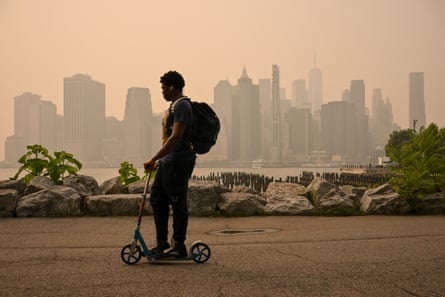
In Europe, though, changes in land use have alarmed firefighters and wildfire experts about as much as global heating. Rural regions across the Mediterranean have hollowed out, resulting in more overgrown vegetation that dries out and allows fires to spread more easily during the hotter heatwaves that climate breakdown has brought. The combination of the two factors has led Spanish wildfire scientists to warn that we have “entered an era of fires we cannot extinguish”.
It is a problem that other parts of the world, from the western US to Australia, already know well. Adding to the climatic burden in the coming months is the arrival of a strong El Niño, a cyclical warming weather pattern, along with a related natural phenomenon in the Indian Ocean, which is priming countries across south-east Asia to burn.
The McClellands said that – even though they still had their homes and their health – the episode had given them a taste of the suffering that climate breakdown has long caused in other countries. “I know that people all around the world are feeling a kind of helplessness because of climate disasters,” said Dan McClelland. “I feel like this opened my eyes to understand just a sliver of what other people are feeling.”









 English (US) ·