
 9 hours ago
2
9 hours ago
2

For nearly two decades, Hilary Knight has been the heartbeat of USA women’s ice hockey – the constant through gold-medal ecstasy and silver-medal heartbreaks, coaching changes, domestic league collapses and the sport’s long, uneven push toward professional stability. Now, at 36, she’s arrived in Milan chasing one more Olympic gold before bringing down the curtain on one of the most influential careers the game has known.
The Olympic women’s hockey tournament opens on Thursday with the United States bringing one of their youngest and fastest teams in years – and their longest-tenured player in the captain’s sweater. Only 11 players return from the team that won silver in Beijing four years ago. Seven are still in college. Many developed inside a professional structure that did not exist for most of Knight’s career, shaped by the emergence of the Professional Women’s Hockey League and the broader surge in investment across women’s sports.
2026 US Olympic women's hockey team
ShowSchedule
All times Eastern.
Thu 5 Feb USA v Czechia, 10.40am (USA Network)
Sat 7 Feb USA v Finland, 10.40am (USA Network)
Mon 9 Feb Switzerland v USA, 2.40pm (USA Network)
Tue 10 Feb Canada v USA, 2.10pm (USA Network)
Fri 13 Feb Quarter-final v TBD, 3.10pm (TBD)*
Mon 16 Feb Semi-final v TBD, 10.40am (TBD)*
Thu 19 Feb Bronze-medal game v TBD, 8.40am (TBD)*
Thu 19 Feb Gold-medal game v TBD, 1.10pm (TBD)*
*-if necessary
Roster breakdown
The 2026 US Olympic women's ice hockey team features 23 players, 13 forwards, seven defenders and three goaltenders, and boasts 21 returnees from the 2025 US women's national team that took home gold at the 2025 IIHF Women's World Championship in April. Eleven of the 23 have prior Olympic experience.
Captain America
Hilary Knight (Sun Valley, Idaho) is the captain of Team USA for the 2026 Olympic Winter Games. Forward Alex Carpenter (North Reading, Massachusetts) and defender Megan Keller (Farmington Hills, Michigan) are alternate captains.
Behind the bench
John Wroblewski is the head coach of the 2026 US Olympic women's ice hockey team. Shari Dickerman, Brent Hill and Josh Sciba are serving as assistant coaches, while Alli Altmann is the team's goaltending coach.
Complete squad
Forwards Hannah Bilka, Alex Carpenter, Kendall Coyne Schofield, Britta Curl-Salemme, Joy Dunne, Taylor Heise, Tessa Janecke, Hilary Knight, Abbey Murphy, Kelly Pannek, Hayley Scamurra, Kirsten Simms, Grace Zumwinkle
Defense Cayla Barnes, Laila Edwards, Rory Guilday, Caroline Harvey, Megan Keller, Lee Stecklein, Haley Winn
Goaltenders Aerin Frankel, Ava McNaughton, Gwyneth Philips
The competitive landscape remains brutally familiar. Canada return much of the core that dominated the 2022 Olympics, led by point-gobbling captain Marie-Philip Poulin, widely considered the best player on the planet. The two countries have traded world titles often enough in recent years that neither side is comfortable claiming control of the rivalry for long. The Americans arrive after sweeping four games against their border rivals late last year, outscoring them 24-7, but inside the US program those results are treated as temporary data points, not verdicts. Rivalry Series defeats from earlier cycles – stretches when, as coach John Wroblewski once put it, the Americans “weren’t even getting the puck” – remain part of the program’s collective memory.
Around Milan, the Games themselves are still snapping into place. Workers were finishing sections of the main Santa Giulia hockey arena less than 24 hours before fans were due to arrive. On the opposite side of the city center, the secondary Rho rink stands as a temporary structure of walkways, scaffolding and curtains, a reminder that the Olympic machine is designed to assemble quickly and disappear just as fast.
For Knight, that volatility feels familiar. Olympic tournaments, she has learned, reset everything. “It’s a clean slate every time you get to a tournament,” she said after Tuesday’s practice at the Rho arena. “You have to work hard.”
If there is a moment when Knight allows herself to step back and consider what five Olympics means, she has not admitted to it yet.
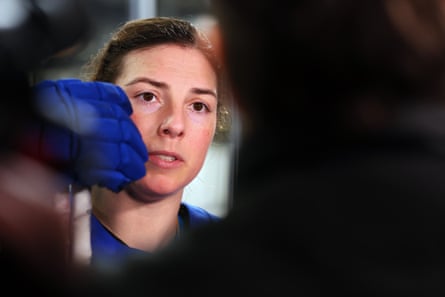
To understand why Knight still matters to this team – and why she has mattered to American hockey for nearly 20 years – requires stepping outside statistics.
On paper, the résumé is overwhelming. Ten world championship gold medals. Four Olympic medals, including gold at the 2018 Pyeongchang Games. Records for goals, assists and points at the IIHF Women’s World Championship. The first player ever to surpass 100 career points in the tournament. The inaugural IIHF Female Player of the Year.
But inside the dressing room, those numbers are rarely the first thing teammates mention. Instead, they talk about presence. About steadiness. About knowing the emotional rhythm of an Olympic tournament and how quickly it can shift.
She spent much of her life in Sun Valley, Idaho, before a prolific collegiate career at the University of Wisconsin, and her family still lives in the mountain town a few hours east of Boise, a place she has often returned to between Olympic cycles and seasons scattered across North America and Europe.
Her path to the sport would never be described as conventional. As a child, she played on boys’ teams, developing in environments where size, pace and physicality were non-negotiable. Later, at Choate Rosemary Hall in Connecticut, she trained in one of the country’s strongest prep hockey programs, sharpening a competitive edge that would carry into the national team.
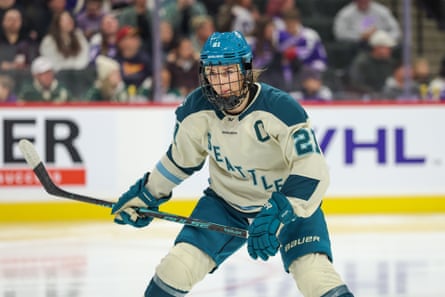
Knight has never framed leadership as dominance or authority. She talks about it instead as accumulated experience – years of trial and error, of learning how to communicate with different personalities, of recognizing when to stay quiet and when to push a room forward. She has often described her role less as leading from the front than making sure the next generation does not have to learn every lesson the hard way.
That approach reflects the environment she came up in. When Knight entered the national team program, women’s hockey existed largely along the quadrennial rhythm of the Olympic cycle. Professional leagues appeared and disappeared. Players trained for world championships and the Winter Games, then scattered across semi-professional teams, overseas contracts and short-term opportunities.
For years, pushing for structural investment felt like, as Knight describes it, “yelling into a void”. The infrastructure that now exists – youth development pipelines, stable professional leagues, broadcast visibility – is the result of years of pressure from players who were competing at the highest level while simultaneously trying to convince the sports world they deserved a permanent place inside it.
The launch of the PWHL three years ago marked a turning point. For Knight and many of her peers, it felt less like the birth of something new than proof that something viable had always existed. She tends to describe women’s sports growth as interconnected – success in one league expanding possibility across others – part of a broader shift in how women’s sport is consumed, marketed and funded globally.
If her generation fought to create space, the generation now entering the Olympic roster is growing up inside it. That difference is visible in the players surrounding her in Milan: faster, more creative, more willing to experiment stylistically, less constrained by the scarcity mindset that shaped earlier eras of the sport.
Knight talks about watching them with something closer to excitement than nostalgia. The evolution, she believes, is exactly what women’s hockey needed. “I’m so excited for them to just take the helm and steer this ship forward,” she said.
Her own career has mirrored that transition. Early Olympic cycles were about validation – proving the sport belonged. Later cycles became about growth – proving it could sustain itself professionally. Now, for the first time, she is entering an Olympic tournament knowing that a full professional ecosystem will still be there when the Games end. That shift has changed how she thinks about legacy and success.
Her definition of accomplishment has expanded beyond medals. It now includes the people who helped make those moments possible: teammates, families, coaches, trainers, the network of support that exists behind every Olympic performance.
That perspective, in some ways, traces back to her first memory of the Games. In 1998, when women’s hockey debuted at the Olympics at Nagano, Knight was a little girl jumping on a friend’s couch celebrating the US gold medal. She does not remember the game itself. She remembers the feeling – the sense that something enormous and shared was happening all at once. The moment helped shape how she understands Olympic sport now: not just as competition, but as something capable of reaching people who may never step on a rink.
Years later, that understanding deepened again in Beijing in 2022, when strict Covid protocols isolated athletes from families and support systems. The experience sharpened her sense of how many people share Olympic moments behind the scenes – and how different the Games can feel when that connection is removed.
Privately, she has begun to process what this Olympic cycle represents. Not as a dramatic farewell, but as a recognition of completeness. She has described reaching a place where her “heart feels really whole”, where the focus shifts from chasing achievements to absorbing the experience itself.
That’s given shape to how she approaches Milan. Less like a final chapter, more like a final opportunity to experience something she has spent most of her life pursuing.
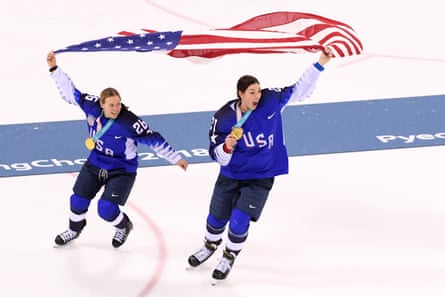
The United States open group-stage play on Thursday against Czechia ahead of a date with the Canadians on Tuesday – and what many expect will be another date with their northern neighbors in the knockout stage.
The rivalry has shaped Knight’s career as much as any single championship, defined by infinitesimal margins, momentum swings, white-knuckle tension and the knowledge that neither side remains on top for very long. Most likely, at some point over the next two weeks, it will come down to their most familiar foes again. It almost always does. “When the puck drops, your heart is beating out of your chest,” Knight said of facing Canada. “You’re like, ‘Am I human? This is insane. This is awesome.’”
In the coming days, she will take faceoffs in buildings that were still being finished this week, skating alongside teammates young enough to have grown up watching her Olympic runs. But the significance of the tournament runs deeper than standings or podiums. It is also a marker of how far the sport has moved during the span of her career and how much further it may still go.
For nearly two decades, she has been the connective tissue between generations of American players. In Milan, she becomes something else as well: a living transition point between what the sport was and what it is becoming.
And somewhere, she knows, another kid is watching – maybe not understanding the systems or rivalries or history, maybe not remembering the game itself – but feeling the scale of the moment. For Knight, that has always been the part that endures.



 English (US)