
 6 hours ago
2
6 hours ago
2

In 1988, the actor Cary Elwes’s career had taken a nosedive. His latest film, a fantasy in which he played a farm boy turned swashbuckling hero, had bombed at the box office and the actor had been out of work for a year. One day he was in a New York restaurant when he spotted Al Pacino, so he went over and introduced himself. “He asked me if I was working and I said no,” Elwes recalls. “He said: ‘You need to exercise your [acting] muscles,’ and told me to go back to school and train.” Pacino put him in touch with the Lee Strasberg Institute, where he had studied with his friend and mentor Charlie Laughton. “I auditioned, I got in and ended up working with Al’s mentor, and it changed my life.”
The meeting with Pacino wasn’t the only life-changing event for Elwes that year, however. The “dud” movie in which he played the handsome farmhand, Westley? That was The Princess Bride, a fairytale spoof that was also an adventure story aimed at adults and children alike, and that its director Rob Reiner later said was a nightmare to market. A year after its theatrical release, it came out on VHS and suddenly took on a life of its own.
Now, nearly 40 years later, The Princess Bride is one of the most beloved movies of all time, celebrated for its stellar cast – Billy Crystal, Mandy Patinkin, Wallace Shawn, Robin Wright, Peter Cook – and its string of catchphrases: “As you wish”, “Inconceivable!”, “Hello. My name is Inigo Montoya. You killed my father. Prepare to die.” They are, Elwes says, “testament to [famed novelist and screenwriter] William Goldman’s brilliance. He put more memorable lines in one movie than any other in cinema history.”
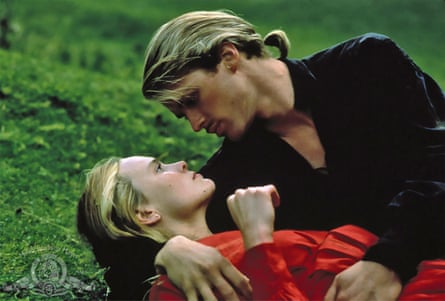
In the decades that followed, Elwes stayed in touch with Reiner who also directed This Is Spinal Tap and When Harry Met Sally – and who was found dead in his home last December along with his wife, the producer and photographer Michele Singer. The couple’s son Nick Reiner was later charged with their murder and is set to stand trial later this year. Elwes and Rob Reiner would often appear together at anniversary events for The Princess Bride where they would regale audiences about the non-stop silliness and laughter on set. “He was a very dear friend and I miss him terribly,” he says now. “It’s a tragedy, an absolute tragedy.”
On Sunday, Elwes was on stage at the Oscars alongside a number of Reiner’s friends and collaborators including Billy Crystal, Carol Kane, Meg Ryan, Kiefer Sutherland, Demi Moore, Kathy Bates and John Cusack to pay a warmly received tribute to the late director and his wife, Michele Singer Reiner.
Elwes, 63, is talking from his home in Los Angeles where it is early morning and where he has declined to turn on his camera: “I haven’t shaved. Is it OK if we do audio? I just prefer it,” he says in his transatlantic accent (Elwes grew up in London but has lived in the US since he was 18). He keeps his answers short but is courteous, calling me by my name at intervals in the way that celebrities do to signal they are paying attention.
We are here to talk about his latest film, Gus Van Sant’s Dead Man’s Wire, which tells the real-life story of Tony Kiritsis (Bill Skarsgård), an Indianapolis businessman who visited his mortgage brokers in 1977 and took one of their executives Richard O Hall (Dacre Montgomery) hostage. Kiritsis attached a sawn-off shotgun to Hall’s neck using a piece of wire and took him to his apartment. There he invited the media to camp outside while he publicly delivered his demands to the company he said had short-changed him over a piece of real estate; those demands included cancelling his debt and an apology from the company boss.
That boss is played by none other than Pacino, with whom Elwes has been friends ever since that first meeting. It’s a smart bit of casting that nods to Dog Day Afternoon, the Sidney Lumet classic from 1975 in which Pacino’s small-time crook tries to rob a bank and soon finds himself in over his head. Both Dog Day Afternoon and Dead Man’s Wire feature working-class men struggling to make ends meet and who commit crimes out of desperation.
Elwes had no recollection of the case when he read the script but says the moral “grey area” around Kiritsis’s actions caught his attention. The film shows what happens “when people feel pushed to the edge and sometimes make decisions they regret later. More people [today] are feeling as if they’ve been marginalised or put in a corner. We’re not advocating resorting to violence but just trying to show that this is what can happen.”
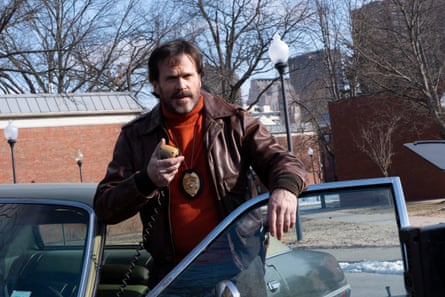
Elwes plays local cop Mike Grable, who also worked as an undercover narcotics detective. Grable, who died in 2016, was a master of disguise, which seems apt because Elwes is barely recognisable in the role, sporting a beard, long brown hair and looking ineffably cool in a terracotta roll neck and brown leather jacket. “That sweater is what Mike wore. Not the actual one, but I met his kids who showed me pictures, so we just tried to recreate it. We wanted to give it that authenticity, you know?”
Dead Man’s Wire is visibly in thrall to many of Elwes’s favourite directors from the 70s, the ones he was reared on as a child growing up in London. “Billy Friedkin, Scorsese and Sidney Lumet, obviously. The plan was to try to make a film that evoked that era in cinema.” And how does a boy from Paddington make it all the way to Hollywood? “I dreamed big, Fiona!” Elwes replies. “Even when I was a kid, from the moment I discovered television, I wanted to be in the entertainment industry. And I just manifested it. I really believe in that. I read a bunch of autobiographies of my favourite actors: Laurence Olivier, Ralph Richardson, Richard Burton, Peter Sellers, Peter O’Toole. I was absolutely focused on doing everything I could to get into the business.”
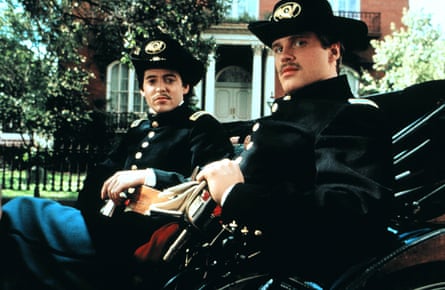
It didn’t hurt that Elwes’s stepfather, Elliott Kastner, was a hotshot film producer from America whose credits included Where Eagles Dare and The Long Goodbye. It was through Kastner that the 15-year-old Elwes spent a week working as Marlon Brando’s personal assistant, after the actor’s regular PA called in sick. Brando was shooting Superman: The Movie at Shepperton Studios and Elwes had to “answer his trailer door, get his meals, get his new pages for him – and make sure he got on set on time”. That sounds terrifying for a teenager, I say. “I was a little nervous,” Elwes replies, serenely. “He was a legend and I looked up to him.” He pauses and adds: “So I had two godfathers influence me in my life, which is pretty strange.”
When Elwes decamped to the US he studied acting at Sarah Lawrence College in Yonkers, New York. Not long after graduating, he auditioned for the 1984 movie Another Country, starring Rupert Everett and Colin Firth, and got the job. “So I got it from my first audition, which I don’t recommend because after that I thought it was too easy.” Next, he played the chiselled Lord Dudley, opposite Helena Bonham Carter’s queen, in Lady Jane, a role that set him up nicely for the part of the heart-throb in The Princess Bride. When the latter flopped, it was a wake-up call for Elwes. A new approach was needed.
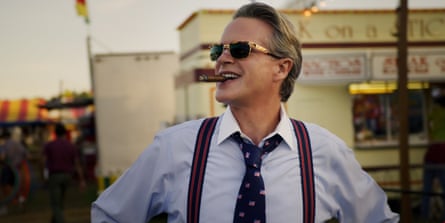
Of the scant job offers that came in during his year of unemployment in New York, he says, all involved swords and princesses. “So even though The Princess Bride was not a success at this point, casting directors wanted to pigeonhole me [as the romantic lead] and I didn’t want that. I wanted to play character roles.” His stint at the Lee Strasberg Institute solved the problem, allowing him to show off his versatility as an actor. Since then, he has appeared in war films (Glory), horror movies (the Saw franchise), thrillers (Twister, Kiss The Girls, Mission: Impossible), comedies (Robin Hood: Men in Tights, Liar Liar) and in popular TV shows including The Marvelous Mrs Maisel and Stranger Things.
When choosing the next job, he says, if he comes across “something I’m a little bit scared of, then that’s usually the thing I gravitate towards”. Yet it is his role as the floppy-haired hero of The Princess Bride for which he remains most recognised and celebrated. Rare is the day when Elwes steps out and isn’t asked to repeat Westley’s immortal line: “As you wish.” If he finds that tiresome, he is too savvy to say so. “This film brings people and families together,” he says. “I feel I have a responsibility to it, but it’s a wonderful responsibility. You’re lucky as an actor to have your work resonate with anyone, so I don’t take that for granted.”
Dead Man’s Wire is in cinemas on 20 March.



 English (US)