
 2 hours ago
2
2 hours ago
2

After six days in which a former player was held accountable in court for sexist comments and a current manager was charged by the Football Association with using sexist language, are we seeing a change in how that behaviour is tackled?
For years, talk of so-called “banter” has been used to silence complaints and it has been a struggle to convince football that sexism and misogyny even exist, but there are signs the sport is finally waking up.
Last week, Joey Barton received a criminal sentence for harmful social media posts targeting the pundits Lucy Ward and Eni Aluko for doing their jobs. Aluko was targeted by racially charged posts, too.
A few days earlier, Barnet’s Dean Brennan had become the first EFL manager to be charged with sexist abuse towards a female referee. He has denied the charge. That comes after cases in non-league in the past two months where where Hemel Hempstead Town were fined and a match at Coventry Sphinx was abandoned because of abuse towards female officials.
This type of abuse is vile and nothing new, but the visibility of those outcomes is. It starts to send a message that this behaviour won’t be tolerated any more, which is hugely important in the context of the Kick Sexism Out campaign we at Kick It Out launched at the start of last season.
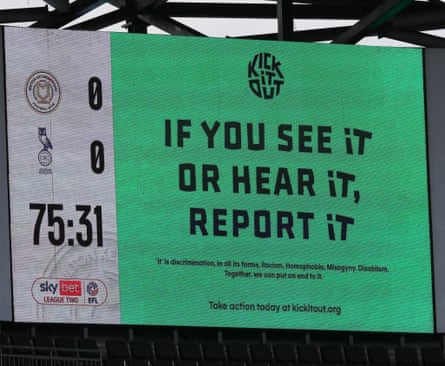
Research we commissioned found that 85% of female fans who had experienced sexism in football settings never reported it. They felt nothing would be done or it wouldn’t be taken seriously, which is understandable.
But when more positive outcomes are visible, as we’ve seen in the past month, it can help break the cycle, and perhaps encourage more women to report sexism when they witness it.
This season, we have received 86 reports of sexism, helped by our new reporting relationship with Her Game Too. That’s nearly four times the number at this stage last year, including a record 19 involving mass chanting, and comes after setting records for professional, grassroots and online reports in each of the past three seasons.
It may sound strange to say that an increase in sexism reports is positive, but we know it’s happening and now we are starting to see more people willing to call it out. We can use that to drive further outcomes, including clubs being charged for sexist chanting.
We see this as recognition that women have had enough and are desperate for change. The reasons are staring us in the face. Sexism has become one of the fastest-rising forms of abuse in football, with female fans, referees, officials, physios and club staff regularly targeted.
Chants reported to us have included “Get your tits out for the lads” and “She’s got chlamydia”. Fans have been subjected to comments such as: “Get back in the kitchen, you slag.” Officials have faced a barrage of lewd and abusive language when they take the field.
It is a consistent narrative of women being told they don’t belong in football. It begs the question: where exactly does football want women to show up?
This behaviour seeps into grassroots, too. I manage a girls’ academy side and we play in a boys’ league. We are the only girls’ team in the league and I’m the only female manager. Most teams are desperate to beat us, for fear of losing to girls – a sad insecurity more from the male managers than the young boys on the pitch, in my opinion.
Playing against a team recently, we faced constant sexist remarks from spectators about girls not being “man enough” to play against boys and shouts of: “Don’t play against boys if you can’t act like boys.” All types of comments were shouted at me and my 12- and 13-year-old players, simply for us being present, by a pair of grown men – one of whom told me he had a daughter when I challenged him, so how could he possibly be sexist. Fair to say, I didn’t let that go.
The behaviour in football environments feels unique to the sport at times. People often appear entitled and emboldened to say whatever they like to whoever they like, without fear of consequence. That’s the part we really have to change.
So when we see more people calling it out and more accountability, it gives us more hope. There’s a long way to go, and reports will continue to rise, but momentum can build and everyone can play their part in standing up to sexism and misogyny.
Hollie Varney is the chief operating officer at football’s anti-discrimination organisation Kick It Out.





 English (US)