
 2 hours ago
2
2 hours ago
2

Two things will strike you when you pick up the Dyson HushJet Mini Cool fan for the first time. The first is that flesh-pink (stone/blush) is a bold colour choice for a product that already looks like it’s escaped from a certain NSFW section of the Filter.
However, once you’ve retrieved your mind from the gutter, you’ll notice that the different form of pleasure the HushJet Mini offers – impressively powerful wind speeds to keep you cool in heatwaves – comes at a price. This thing is loud with a capital L, and becomes even more so as you progress through its five settings. More “jet” than “hush”.
Still, if you’re feeling the heat and are willing to pay £100 to make things a little more bearable, the HushJet Mini Cool has plenty of positives. It’s just a question of whether anyone will hear you saying them over the din of its mighty motor. (If you’re not willing to pay £100, read to the bottom for my roundup of the best alternatives.)
How I tested

As the author of the Filter’s guide to the best handheld fans, I have a pretty straightforward way of assessing their strengths and weaknesses. In terms of objective measures, I use a digital anemometer to measure wind speeds, a sound measurement app held 15cm away from the device to gauge noise levels, and a set of kitchen scales for weight. Battery life is also timed at the highest and lowest settings to test manufacturers’ claims.
Then there are more subjective measures. Is it nice to hold? Is it easy to use? Does it look stylish? And, finally, there’s pricing. With the cheapest fan in my roundup coming in at just £6, do you really get more for an extra £93.99? Well, yes, but that still doesn’t necessarily mean you should spend that much.
What you need to know
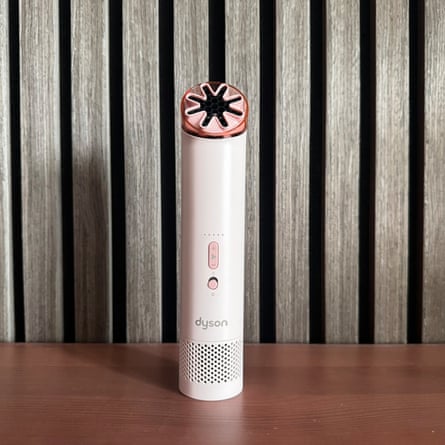
The £99.99 HushJet Mini Cool is Dyson’s first handheld fan, although the company has some history with larger cooling units. Dyson has been making bladeless fans since 2009, and the press release promises that “17 years of airflow expertise” is packed into a cylindrical frame that’s just 38mm across.
The company says that the HushJet Mini Cool can force through wind speeds of 55mph because of a DC motor that can run at up to 65,000 rpm. The HushJet technology promises “reduced turbulence and smoother, quieter acoustics”. Though, again, “quieter” definitely isn’t the same as “quiet”. Bournemouth’s Vitality Stadium is quieter than Anfield on matchday, but you still wouldn’t go there to meditate.
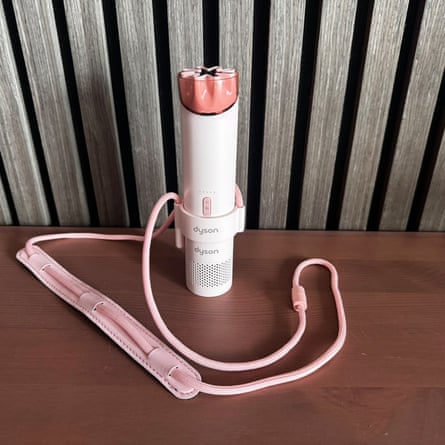
That said, it’s impressive that this kind of power can come from something so compact, and the company’s engineers have thought carefully about different use cases. As well as holding it, you can keep it round your neck blasting up cool air with an included lanyard, and a charging stand allows for use on a desk.
As well as the stone/blush colour, the HushJet is available in carnelian/sky, a red unit with a light blue head, and ink/cobalt, which is a striking mix of dark blue and black.
Dyson HushJet Mini Cool specifications
Power levels: five, plus boost mode
Measured air speed: 2.0-6.1 metres a second (7.5 metres a second in boost mode)
Measured volume: 61.5-76.2dB (80.3dB in boost mode)
Tested battery life: 50mins 45secs to 6hrs 9mins 30secs
Measured weight: 220g
What we love

Despite my earlier smutty misgivings about the shape of the fan, Dyson’s design is impressive as ever. As with Apple, there are reasons that Dyson products are popular despite their high price: they’re thoughtfully designed, aesthetically pleasing, and instantly intuitive.
The HushJet Mini Cool hits all three. The design is simple, comfortable to hold for extended periods and – aside from the fan opening that looks alarmingly like a lamprey’s mouth – minimalist. There’s just one button to turn it on and off, and a speed rocker for upping and lowering the fan speed; five lights above it indicate the level at which the fan is set.
The bundled accessories are equally well thought out. The charging stand offers added stability for use on a desk, with a neat cut-out to allow a USB-C cable through (the fan is capped at its lowest speed while charging).
The adjustable lanyard is more of a design challenge, but one that Dyson handles with panache: there’s a perfectly cut-out grip that slides past the buttons to allow easy control on the go (the head rotates so it’s blasting air at you, and not the person opposite). A universal mount for attaching to strollers and a grip clip for bag straps and jackets is promised for release later this summer, although you’ll have to buy them separately.
The power this thing can put out is amazing. At its lowest setting, I measured wind speeds of 2 metres a second (m/s), which is similar to other fans I tested, although it feels stronger as the size of the head delivers a more concentrated blast.
At its top level, however, it delivered a consistent 6.1m/s, and in boost mode – a temporary setting achieved by holding down the “+” rocker – it hit 7.5m/s. That’s the second-highest speed I measured in my group test. The one fan I used that beat it (the JisuLife Handheld Fan Ultra2, which reaches 9.8m/s) is bulkier, weighing around a third more at 294g.
What we don’t love
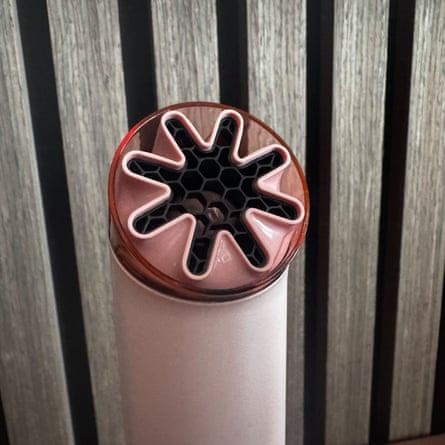
There’s an elephant in the room, though. Scratch that, it’s closer to a howler monkey: this thing is enormously loud.
Don’t get me wrong: I’m sure Dyson’s engineers have done incredible things to quieten it down, given its power and size. This is, after all, an intractable physics problem: a motor of this size has to spin incredibly fast to create any meaningful airflow. Quiet, small or powerful: you can only pick two. And yet, if you’re going to call a product HushJet, you’re inviting disappointment when the results are uncomfortably loud.
At its lowest setting, it’s not too bad: 61.5dB, when measured 15cm away. At this level, it makes the kind of background whirr that would make you prepare electronic last rites if they were coming from your laptop, but are OK from a fan. While performing the battery test, I could still clearly hear it while walking between rooms.
But level 2 is already getting uncomfortable at 69.4dB, and by the time you hit level 5, it’s reaching 76.2dB. According to the Hearing Health Foundation’s helpful chart, that’s about the level of landscaping equipment heard from inside a house: enough to make it embarrassing to use in public. The aforementioned boost mode hits a ludicrous 80.3dB, though this is, of course, only intended to be temporary – which is just as well, as my cats were not, uh, fans.
I’m aware of how grating this kind of volume can become with extended use, as I had to keep the fan on at its lowest and highest settings to test the battery. The fan packs a 5,000mAh capacity cell, which is similar to what you’d get in a large Android smartphone. Yet powering the moving parts takes its toll, with the fan giving up after 6hrs 9mins 30secs at its lowest setting, or just 50mins 45secs at level 5. If you routinely use boost mode, expect that to drop further.
For comparison, the other handheld fans I tested lasted around three to four hours at top speed, or 10 at their lowest. Admittedly, these top speeds were also lower, but it’s still important to bear in mind if you have a full day of outdoor fun planned.
Sustainability
For a company with a dedicated sustainability magazine about its product development, Dyson is oddly quiet about the HushJet Mini Cool’s ecological credentials. There’s no mention of recycled materials, nor lip service to sustainability on the product page or in the accompanying press release.
There are obvious small wins, but nothing groundbreaking or even particularly unusual. It charges via USB-C cable, meaning no bespoke charging connector, and it uses a rechargeable lithium-ion battery, rather than requiring disposables. However, there is no obvious way for users to replace the battery themselves.
after newsletter promotion
Dyson HushJet Mini Cool: should I buy it?
There’s no question that the Dyson HushJet Mini Cool will make hot days more manageable. It outputs an impressive amount of air for a device that you can hold like a microphone and weighs barely more than a smartphone.
There are two main drawbacks, though. The first is how loud it gets. Push it higher than level 3 and it strays into obnoxious territory. Unless you’re using it somewhere noisy like a gig, expect annoyed looks when you’re using it in public. Granted, that’s less of a problem in the privacy of your own home, but in that case you’d be better off with a more powerful (and quieter) desk fan.
The second is the price. One penny shy of £100 is a lot for a handheld fan, even one as powerful as this. Other options mostly won’t cool you down as effectively, but you’ll have £80 to £90 more in your all-important ice-lolly kitty.
Dyson HushJet Mini Cool vs …
Shark ChillPill
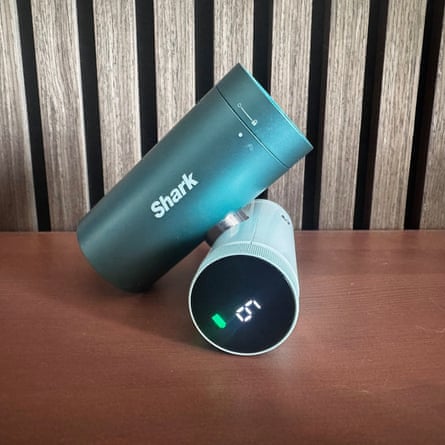
I’ve been testing Dyson’s arch rival, the Shark ChillPill, at the same time (a full review is incoming), and there are pros and cons to each. On the negative side of the ledger, the ChillPill has a less intuitive and comfortable design, is nowhere near as powerful (maxing out at 4.6m/s in my tests), and is £30 more expensive.
I still prefer it overall, though, because of its three-in-one design that offers three different kinds of cooling via a set of bundled interchangeable heads. As well as the regular wind fan, one head sprays a refreshing mist of water alongside the air so you feel physically cooler, and one has a cold plate that you can apply to warm areas like the neck and wrist to feel instantly cooler. While this makes it undoubtedly more fiddly, the versatility is welcome.
John Lewis handheld and foldable desk fan
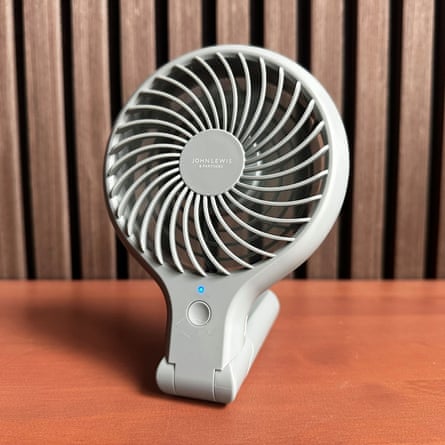
The overall winner of my roundup of the best handheld fans, John Lewis’s entry is a well-made, inexpensive option, with a clever folding design that allows it to double up as a mini desk fan. It doesn’t get anywhere near the power of the Dyson HushJet, maxing out at a measured 3.7m/s, but nor does it get as loud, only reaching 62.4dB at its top speed. It also goes longer between USB-C charges, lasting more than four hours on its highest setting, and nearly 10 on its lowest.
Diveblues Jetforce
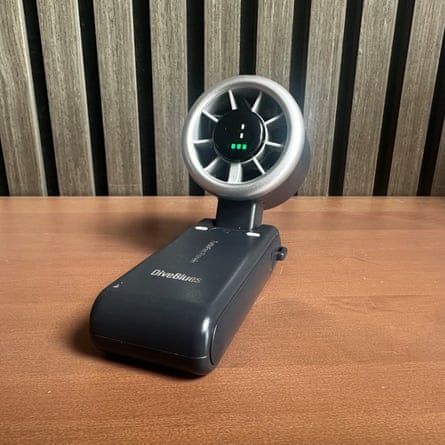
If you want similar levels of power to Dyson at a fraction of the cost, then look at the Diveblues Jetforce. Even at its lowest setting, in my tests, it hit a breezy 3.8m/s before maxing out at an impressive 6.6m/s. But as with Dyson’s offering, a tiny fan blasting out that much air will be noisy, and the Jetforce starts at an intrusive 66dB before hitting 74.3dB at its top setting. That’s about the level of a vacuum cleaner, which typically isn’t held so close to your ears. On the bright side, the battery life is stellar, running for more than 11 hours at its lowest speed, and almost three at its highest.
JisuLife Ultra2
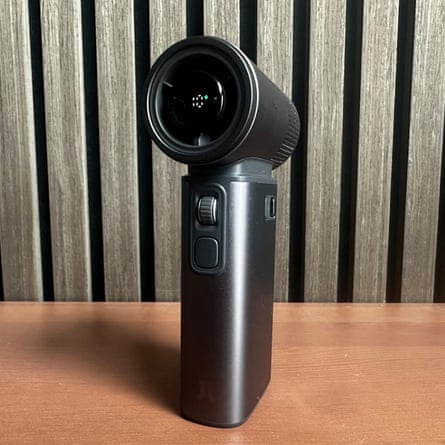
The only model that beat the Dyson HushJet Mini Cool for power in my testing, the JisuLife Ultra2 has 100 speed adjustments ranging from a gentle 2.8m/s to a massive 9.8m/s at full blast. Even at that level, its battery lasted more than 90 minutes in my tests, although I wasn’t grateful to endure a volume of 88.8dB for all that time. The fan isn’t just for cooling, with adapters in the box to turn it into an air cushion inflater, a fire-maker, and a duster to fire out gunk from tough-to-reach places. There’s even a torch on the back, making it worth its 294g packing weight for campers.
For more ways to keep cool with the Filter, read our guide to the best fans, the best evaporative air coolers and top tips for coping in a heatwave
Alan Martin is a writer who has been putting products – including phones, gaming devices and wearables – through their paces for more than a decade. While little of this actively increases body temperature, a poorly ventilated south London home has ensured he’s become something of a fan enthusiast, too








 English (US) ·