
 1 hour ago
3
1 hour ago
3

Back in 1993, Bora Milutinović offered a succinct diagnosis of the American men’s soccer player: “This is the problem with these people: they don’t have a problem.”
What the then-US men’s national team head coach meant, presumably, is that making it in soccer wasn’t existential for American players, as it is for many others worldwide. Milutinović and his two brothers had been orphaned by the second world war and clawed their way to the Yugoslav national team and gainful professional careers. The players in the Serb’s care at that time, by contrast, never had to worry about feeding themselves.
Landon Donovan and Clint Dempsey didn’t come along until long after Milutinović was gone. But they had problems, running the gamut from “American poverty”, as Donovan puts it, to depression, grief, crushing pressure or, conversely, a long-running underappreciation.
The co-holders of the USMNT’s all-time scoring record at 57 goals apiece tell their stories, with every last wart, in a pair of editorial projects fittingly released just a few weeks apart.
Donovan’s memoir – titled Landon – is astonishingly honest, even by the standards of his habitual indiscretion about his own life. (Like that time in 2010 when he confounded dozens of reporters in a pre-World Cup press conference by speaking at length, and practically unprompted, about the collapse of his first marriage.)
It contains long passages that may as well have been taken from his therapist’s notebook during the years she treated him; ruminations on the ways in which his first wife, the actor Bianca Kajlich, walked all over him; confessions about his difficulty socializing; painful recollections of his father’s abandonment.
“I’m a feeler,” Donovan writes at one point. “Maybe that’s complicated for many men to admit.”
Later on, he offers: “Depression doesn’t care if you’re rich and famous and popular. Depression is selfish. It never asks for permission to show up, and it comes and goes as it pleases.”
Dempsey, meanwhile, is the protagonist of a new Paramount+ docuseries titled You Don’t Know Where I’m From, Dawg. This clunky deep-cut moniker – a reference to his taunting of fellow CBS pundit Micah Richards during a scuffle in a long-ago Premier League match – runs at a fatty 231 minutes over five episodes stuffed with interviews and trips to the seminal spaces along his path. Those are padded with an awful lot of old highlights, but it nevertheless makes for an engaging and nostalgic watch, a time capsule of some vintage MLS and long-ago USMNT campaigns. Also: fishing. Lots of fishing.
The different approaches to telling their story are fitting inasmuch as Dempsey always preferred to show you rather than tell you, and Donovan liked to do both.
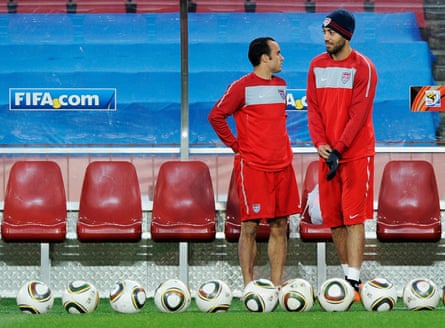
Like Donovan’s emergence from nowhere – or unglamorous inland California, rather – Dempsey’s story is equally deserving of expansive treatment. It has always had something of a fairytale quality, except with a sentient east Texas tornado as the protagonist.
The two men had more in common than they realized as Donovan, the prodigy, and Dempsey, the late bloomer, eventually became rivals for USMNT supremacy. Neither man spawned from the upper-middle class that has produced so much of the professional game stateside. After his father left the family early on, a shared Happy Meal from McDonald’s represented a splurge for Landon, his mother and his twin sister, Tristan. The Dempseys lived in a trailer on Clint’s grandmother’s pasture for a time in Nacogdoches, Texas. His father had to sell a few heads of cattle, his little fishing boat and some guns to keep bankrolling Clint’s budding soccer career. And it wasn’t really until his older sister Jennifer, a promising tennis player, died of an aneurysm at 16 that there was enough money for Clint to resume his soccer training three hours away in Dallas.
Donovan suffered loss, too, in the form of a flakey father who only really took a sustained interest once Landon was already well on his way to stardom.
Yet the two documents are most interesting in the study they offer on the men’s varied and ever-evolving approaches to ambition, masculinity and their implicit debt to a public that suddenly feels entitled to them. The contrast underscores the unseriousness of ascribing a single personality type to The Professional Footballer. Donovan was as ill-suited to the sport’s Darwinian nature as Dempsey seemed to have been designed expressly to thrive in it. Both built enviable careers.
Dempsey, fueled by a kind of primordial rage, weaponized his yearning for betterment in the locker room and on the field. So driven was Dempsey that his Fulham teammates remembered him only greeting them at practice on Monday morning if he’d scored on the weekend. He scraped every last ounce of success from his career, touching the outer bounds of his talent.
Donovan swung the other way. Whereas Dempsey scrapped his way through college soccer and the MLS SuperDraft, where he was an afterthought amid the Freddy Adu hullabaloo, Donovan was American soccer’s golden child from the moment he starred at the under-17 World Cup in 1999. From there, he went on a meandering journey with three spells in Germany and two in England, all separated by returns to California. He alternated between seeking out the best competition and the most comfortable environment between bouts of burnout and depression.
Dempsey hungered for the goals and the money they promised. Donovan guarded his mental health, which ebbed and flowed along with his interest in being a professional athlete.
Every serious soccer nation has a pantheon of great players who haunt their successors. As some of the first real stars of American men’s soccer, Donovan and Dempsey had no such role models – and no near-impossible burdens either. It left them clear to chart their own course, to make it up as they went. There was nobody for them to chase, nothing to keep them going once their bank balances had enough digits in them.
Instead, Donovan and Dempsey lived up to one another, their only comparable contemporaries. After years of competition, they wound up tied with those 57 USMNT goals. They both say they’re at peace with that. They also both say they would have preferred to have the record to themselves.
Today, Donovan and Dempsey, middle-aged family men, are amiable and compelling company. In person as on TV, playing their part in soccer’s ecosystem as pundits, they share a disarming candor. While Donovan was always like this, Dempsey only recently became this way. They say the time they have spent together as broadcasters has drawn them much closer than they ever were as players. They seem to have become more like each other, too: Donovan growing in comfort and confidence, and Dempsey friendlier and more self-aware.
They share something else now: the full-length treatment that their winding tales deserve.
-
Landon is out now. You Don’t Know Where I’m From, Dawg can be streamed on Paramount+ in the United States.
-
Leander Schaerlaeckens’ book on the United States men’s national soccer team, The Long Game, is out on 12 May. You can preorder it here. He teaches at Marist University.





 English (US)