
 2 hours ago
3
2 hours ago
3

Earlier today I set these four chess puzzles. Here they are again with solutions.
1. Oddities
1. A chess tournament is taking place with several participants. Not every player played against every other player, and some players may have played many more games than others.
Some of the players played an odd number of games. Prove that the number of such players must be even.
Solution:
The total number of games played by everyone must be even, since every game has two players. When you add up odd and even numbers to make an even number, there must be an even number of odd ones, because if you have an odd number of odd numbers the total will be odd.
2. L of a trip
A knight in chess moves in an “L” pattern - two squares in one direction and one square in a perpendicular direction. Starting in the bottom right corner of a regular 8×8 chessboard, is it possible for a knight to visit every square on the chessboard exactly once and end up in the top left corner?
Solution: No.
A knight move goes from a white to a black square, or vice versa. To visit every square on the board exactly once requires 63 moves. If you start on white, you will end on black, or vice versa. You cannot start on one corner and end on the opposite corner, since opposite corners of a chess board are the same colour.
3. Pawn return
Take a chessboard with the standard initial setup of pieces. What’s the fewest number of moves needed for a pawn to leave its initial place, get promoted/queened, and then return to its original position?
(Assuming the two players are collaborating to achieve this, not that the one is scuppering the other).
Solution: 6
Here’s one way. The pawn begins on B2. (second column, second row.)
White: B2-4. Pawn moves two in knight column.
Black: A7-5. Pawn moves two in adjacent rook column.
White: B4-A5. Pawn takes pawn.
Black: B7-6. Pawn moves one in knight column
White: A5-B6. Pawn takes pawn
Black: B8 – A6. Knight moves out of way.
For the next three moves, white’s pawn advances one by one in the B column, queens and then returns to B2 in the sixth move.
4. Four knights
Show how to swap the two pairs of knights on the following strangely-shaped grid.
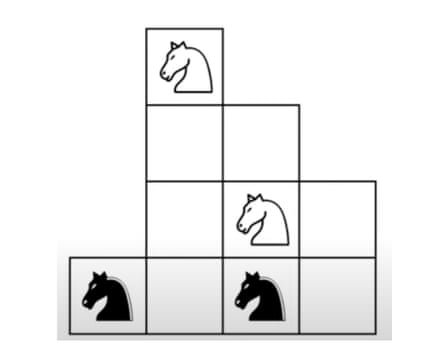
The knights make one move at a time. You’re trying to get the black nights to where the white knights are, and the white knights to where the black knights are.
If you try to solve this problem using knights on a physical grid, you will get very confused. Try to think abstractly. With one simple(ish) insight, the problem is quickly solvable.
Solution:
The positions that the knights can move to are very constrained. Here are all possible moves and positions;
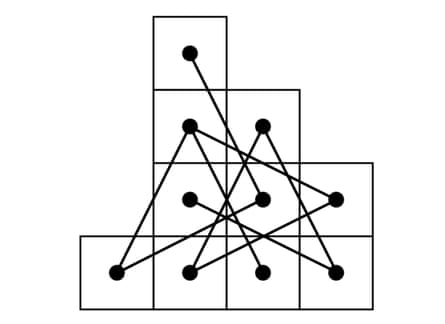
This looks like a mess! However, if we untangle it, we can see the pattern. If we number boxes from the top row, and from left to right, so the white knights are on positions 1 and 5, and the black knights on 7 and 9, the board now looks like this:
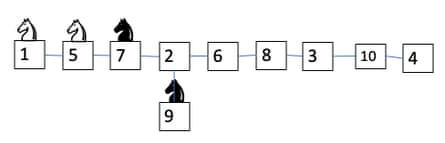
To exchange the positions of the knghts is now a train shunting problem.
-
Move the black knights to 8 and 6
-
Move the white knight at 5 into the ‘“side track” at 9
-
Move the black knights back to 5 and 7.
-
Move the white knight at 9 to 3
-
Move the black knights back to 6 and 8
-
Tuck away the white knight at 1 to square 9
-
Move the black knights to 1 and 5, which is where we want them.
-
Finally, move the white knight at 3 to 7, and we’re done.
Thanks to We Solve Problems for these puzzles. They are a charity that runs free maths circles for secondary school pupils (years 7 to 11) between September and May in more than a dozen cities across the UK.
The final problem is discussed in this YouTube clip.
I’ve been setting a puzzle here on alternate Mondays since 2015. I’m always on the look-out for great puzzles. If you would like to suggest one, email me.






 English (US)