
 8 hours ago
4
8 hours ago
4

It was the architect of London 2012 Olympics who said it best, shortly after Britain’s Keely Hodgkinson, Georgia Hunter Bell and Molly Caudery had lit up the World Indoor Championships with three gold medals in 29 minutes.
“That was a towering moment, not just for UK Athletics but for British sport,” said Sebastian Coe, now the president of World Athletics. “It was very exciting, hugely inspirational. I really do hope they cause a stampede to local athletics clubs, particularly among young girls.”
Soon afterwards, Trevor Painter and Jenny Meadows, the husband and wife coaching team who have guided Hodgkinson and Hunter Bell to glory, were explaining the secrets behind their success – ranging from cycling to crystals to cutting-edge science – before predicting the best was yet to come.
Painter says Hodgkinson was feeling so good she felt she might break her world indoor 800m record again in Sunday’s final, despite having raced twice in two days. “Warming up she said, ‘I feel amazing. I won’t be surprised if I get a PB here’,” says Painter. “I went, ‘OK, your PB is a world record’. Afterwards she had no lactic [acid]. And she was like: ‘I’m just going to do the 4x400m relay,’ and an hour later she ran 50.1sec.”
No one in the field of specialist 400m runners ran quicker, which makes Painter believe that even greater peaks are around the corner, including Hodgkinson possibly taking down the 800m outdoor world record, set in 1983.
What has changed? “It’s the first time since Budapest in 2023 where she’s turned up to a championship 100% healthy,” says Painter. “Even at the Paris Olympics she had a bit of a niggle and missed some of the winter. But this year she’s not missed a session. So we’re seeing times she normally does in summer already.”
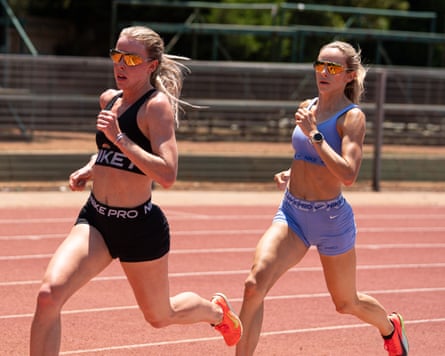
Painter says it helps that Nike has given them a budget for a physiotherapist, Alison Rose, who has kept Hodgkinson’s hamstring problems under control and a physiologist, Rachel McCormick, who formerly worked at the Australian Institute of Sport.
“Keely’s just in a very happy place at the moment relationships-wise,” says Painter. “She’s moving house, so that’s exciting, when you have all those things coming together.”
Hodgkinson believes Himalayan salt crystals have helped calm her. “It’s about making the human happy,” says Painter. “If they’re in a happy place they’re going to perform well.”
Meadows stresses how Hodgkinson and Hunter Bell push each other in training, with the former having more speed and the latter more speed endurance. Despite often going head-to-head they remain great friends. “They’re a dynamic duo,” she says. “They elevate each other,” says Painter.
They are very different personalities, however. Shortly after she broke the world indoor 800m in February, Hodgkinson had a night on the town with her friends to celebrate her birthday when she bumped into Coe and Manchester United’s CEO, Collette Roche. “We thought it was quite funny,” says Meadows. “But we do keep reminding ourselves that Keely can’t be a robot.
“Georgia’s like me. I was a robot and I’m very analytical. Georgia’s exactly the same. But Keely’s a free spirit. You have to keep things flexible for her.”
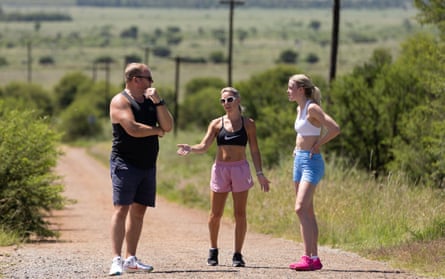
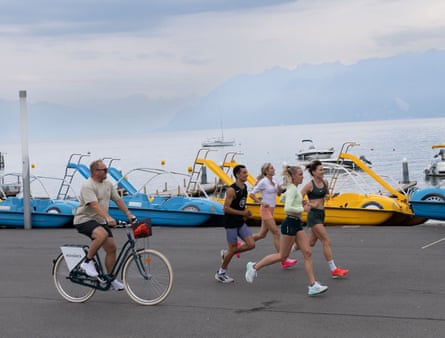
One big shift over the winter is that Hodgkinson has started cycling on her easy endurance days and she enjoys it so much that one-hour sessions sometimes turn into 90 minutes. “We’ve had to rein her back,” says Meadows. “It’s just great though. She finds it so boring on a static bike or the elliptical [machine] in the gym. If she wants to carry on in this sport for a decade or more, we have to let her enjoy life.”
It is that approach to coaching – art, science and the arm around the shoulder – that make Painter and Meadows among the best in the world. “Trevor does all the programming and he’s absolutely brilliant,” says Meadows. “There can be seven different training sessions going on within the same session because everyone’s so bespoke. Keely needs a little bit more of this, Georgia needs that, somebody else needs something else. I don’t know how he does it.”
Painter says a key part of his philosophy is that he does not want athletes doing too much long slow running for the aerobic content of the training. “We have to have speed work, lactate work, threshold work and then long slow volume, so we do as much of the long slow stuff on bikes, in swimming pools, on cross trainers, or ellipticals,” he says.
“It’s up to each individual. Some girls love swimming, some like cycling. As long as they’re giving me, say, 45 minutes on a bike, it’s as good as 30-35 minutes on the running, but without the impact. Then when we run on the track and we’re doing sessions we feel sharper and the sessions are better.”
Painter says that even with her science background, McCormick has been surprised with how quickly Hodgkinson and Hunter Bell recover between sessions. “A lot of the science has been done on 5k, 10k and marathon runners,” he says. “You look at Jakob Ingebrigtsen and it’s all double threshold work and keeping your blood lactate down sub-four, things like that.
“She’s testing us and we’re up in the 20s And then she’s like: ‘Oh they’re going to be screwed for like a week here’. Then two days later we’re up in 20s again and she’s blown away by how we’ve worked like that and then come back and do it again. It’s down to a steady buildup of work over the years.”
Painter believes McCormick’s work is just getting started. “In the long term, she’s going to be of massive help in terms of how we get even better.”





 English (US)