
 4 hours ago
3
4 hours ago
3

1. Special players trump special measures
Rather unexpectedly, Sussex are the only team in Division One with two wins. Less unexpected is the fact they still find themselves five points off the pace and in third. Ah, bonus points and administrative sanctions – two old friends back to make a complicated game still more complicated.
The home side did it the hard way on the field at Hove, 137 runs behind and eight down in their first innings, then conceding 78 runs to Warwickshire’s last two wickets in their second dig. There are teams who might look at a target of 328, which would be the highest innings of the match, think about the 12-point handicap imposed for matters concerning the boardroom not the players, and walk into the April chill with shoulders slightly slumped, somewhat sorry for themselves.
Not Sussex. Three recent recruits made the runs required, Daniel Hughes with 83 providing the foundation for Jack Leaning (120) and Tom Price (70) to bring home the spoils with an unbroken stand of 144.
Though the game must have some means to deter risky financial decisions, it’s on the field that trophies should be won and lost, a case being made rather well so far by Ollie Robinson’s fighters.
2. Overton goes from a panning to a praising
After Essex had won their opener with ease, they were brought down to earth, receiving a dose of their own medicine from Somerset.
It was always likely that two highly effective seam attacks would balance the game in such a way that, if a batter could get in and make a ton, that might be decisive. What no one expected was for that batter to be a bowler.
Craig Overton, who must be wondering if this captaincy lark will continue to be such a rollercoaster ride after last week’s criticism in this column, took guard with his team 114 for 5, still behind the home team’s 149, neither side with much of an advantage. He left 216 runs later, his own share a career-best 141. The match was not quite won but it more or less was when Essex swiftly lost three top-order batters before reaching 50.
Unlike his twin brother Jamie, Craig’s international and franchise career never really got off the ground, his loyalty lying with Somerset. There have been controversial moments for sure, but no fans enjoy the successes of their own like Taunton’s – and good on them for it. There is still a long way to go, but if I were a West Country sculptor, I’d be checking my chisels were in good order and that I have access to a bloody big chunk of stone. Just in case the call comes in September.
After Overton’s declaration rather killed the opening of their defence of the pennant last week at Taunton, Nottinghamshire’s home campaign was ignited by a win from the front against a Glamorgan side who could be looking down the barrel of a long season.
Haseeb Hameed, the Notts captain, was out to the first ball of the match and then the sixth of the second innings, the old pro Timm van der Gugten his tormentor on both occasions. But having a Championship on your CV gives you confidence that, if it’s not your day, there are teammates with good reason for thinking it might well be theirs.
Jack Haynes made a round hundred in the first innings and Joe Clark scored 136 in the second. Usually scores of 279 and 311 for 9 declared would barely merit the description of giving the bowlers plenty to work with, but Hameed had the high pace of Josh Tongue and Dillon Pennington, supported by the nous of Fergus O’Neill and Brett Hutton, with Liam Patterson-White’s spin on hand if required.
And, more importantly, he had an opposition batting lineup for whom only the promising Asa Tribe and budding all-rounder Mason Crane could muster a score of more than 30 in both efforts.
The reigning champions, Nottinghamshire, returned to winning ways against Glamorgan. Photograph: Steve Poole/ProSports/Shutterstock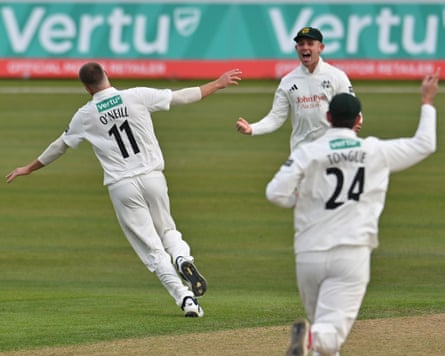
4. Baker cooks up easy win
Hampshire bounced back from a mauling last week to inflict one on Yorkshire at Headingley. Even the use of two substitutes did not help Yorkshire, who lost Jhye Richardson and Jack White to a sickness bug midway through the match.
Sonny Baker was flavour of the month this time last year, earning himself a couple of white-ball appearances for England that might be charitably described as coming too soon. Showing the value of raw pace, he shot out Sam Whiteman lbw, then disturbed the timber of the nightwatchman Ben Coad, and cleaned up James Wharton in a single over, 4 for 45 his eventual haul.
At the other end Kyle Abbott, a couple of months off his 39th birthday, was on his way to a 10-wicket haul in a first-class career in which he has paid fewer than 21 runs for each of his 720 victims. Whether an ageing South African taking a place that might go to a young English bowler is a good or bad thing is a matter on which I’m torn. But Baker is in an ideal spot to listen and learn from a man 16 years his senior. If he does, he will do much better should England come calling again.
5. Anderson and Andersson
To no one’s shock, Durham top Division Two, but pessimistic Lancashire fans (me and the rest of them) are surprised to see Lanky second after their win against Derbyshire.
It was a great game of cricket at Old Trafford in which the two near neighbours traded blows in a tight affair that turned the home side’s way with the contributions of two old Ashes adversaries.
Marcus Harris (125 and 66) was the top scorer for the Red Rose in both innings, his return to the colours shoring up a top order that had collapsed to 40 for 5 last time out. But the visitors were 77 for 4 in pursuit of 138 and firmish favourites when James Anderson had Martin Andersson (228 and 54 this season) caught by Michael Jones (in a nice redemptive moment) for 15. Cue three more for the old hoofer as Derbyshire’s last five wickets went in a clatter to leave them 30 short of their target.
Anderson had figures of 9.5-3-18-4 after getting through 23 overs in the first innings. And those of us saying, “Sure, he’s still got it, but can he maintain it in the second innings?” had our answer. You don’t take 1,157 wickets, and counting, if you can’t come back and close out a win.
6. Pitching for pitch data
Leicestershire, Northamptonshire and Durham made more than 600, and Surrey more than 500, without any help from freak heatwaves or depleted attacks (see substitutes rule above). Luke Procter might still be batting now had he not declared on himself on 261. I’ll admit to a frisson of excitement every time a score climbs but does anyone enjoy these one-sided affairs?
At The Oval on Friday, a seasoned fan remarked that he had seldom seen such a green pitch – I replied, saying it would be very flat by the afternoon. It was, as Jamie Smith and Ollie Pope can attest – and it stayed flat, as Rishi Patel, Steve Eskanazi and Ben Cox will be equally pleased to confirm, all five cashing in their chips for a ton.
But why so? As I often find myself saying at this time of year, other sports are drowning in data (so is cricket, if bowler-batter match-ups and most runs scored through midwicket off left-arm wrist spin is your thing) but we still measure pitches like they did in the 1890s, never mind the 1990s. Why can’t we know how much moisture there is in the wicket at the start of each day, how much grass is left for the bowlers, and exactly how fast or slow a pitch is?
Only when we can measure a pitch can we reliably improve it. And we all know what a good pitch plays like, so why can’t we have more of them? It might avoid us barely bothering to look up from our phones when Smith flat pulls a six to raise his 150.
This article is from The 99.94 Cricket Blog






 English (US)