
 8 hours ago
5
8 hours ago
5

Angela Hartnett’s home kitchen isn’t a place you could recreate, however much Le Creuset you bought. A basement in east London, it has the relaxed timelessness of a villa in a Sally Rooney novel, but the embedded knowledge of a Michelin-starred chef who’s been cooking since she worked in her family’s chippy 40 and a bit years ago (she’s now 57) – every utensil exactly where your hand would be looking for it, everything mysteriously the right size.
Today she’s making a poached chicken with spring vegetables. It sounds simple, and it’s maybe the fundamental paradox of food that the simpler a dish – the fewer the ingredients, the less fussing about – the easier it is to screw up. Poached chicken can come out the colour of over-washed underpants, although, to be fair, still taste delicious. Cook it too fast, and the skin wrinkles away from the meat eerily, so now it’s like underpants wearing tights. Listing errors from my own back catalogue is so unappetising that I’m going to stop, even though I’m nothing like done. The question is, how does a chef make this dish look so elegant, so vivid, so sharply delineated but perfectly harmonious, so appealing, so cheffy?
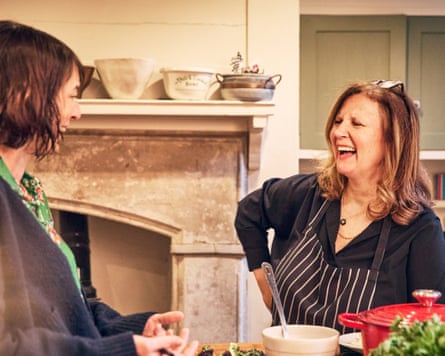
The first big difference is neither tools nor food: it’s tempo. Angela Hartnett is always moving but never rushing, her evenness and fluidity, as if by magic, produce vegetables in very even shapes, and no splashing or mishap of any kind. She’s not a shouty chef – you’ll know that from her earliest TV work, Hell’s Kitchen in the late 00s, when she was almost a rogue element, with the rest of them shouting the entire time. “People associate Michelin with machismo,” she says. “It might have been once, but not any more, and I certainly don’t think that just because you run an aggressive kitchen, you’re a better chef.”
“Look, the key is buying a good chicken,” Hartnett says. How many times, dummy? There’s nowhere to hide in a poaching operation. You can also forget jointing it properly without an incredibly sharp knife, and that’s how they judge a new chef across Hartnett’s kitchens – Murano, the ritzy one near the Ritz, and her four, less formal Café Muranos – by the state of their steel, and how swiftly they could remove one of their own fingers. Recipes never tell you to joint the bird – it won’t change the taste and it sounds daunting – but it means it fits more snugly in the pan, it means you can do the drumsticks separately in less time, and it prevents that splayed effect that looks a bit amateurish.
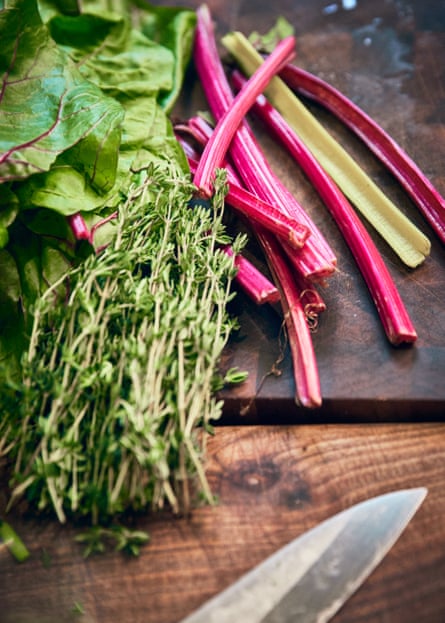
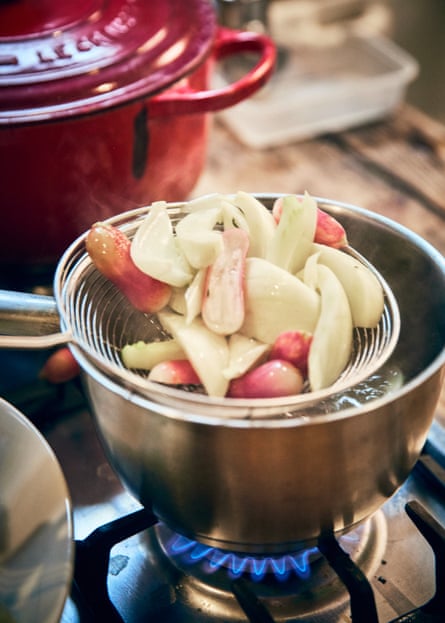
The spring vegetables are going in a separate pan: only the sturdy ones – carrots, onions, celery, garlic – are going in with the chicken. Her first thought, again, is sourcing. “Neil [Borthwick, her husband, also a chef, they met in a kitchen] gets really upset if I ever bring anything home that isn’t grown in Britain.” We cycle through why that matters – food miles, sustainability, the fact that British farmers do a really good job and deserve support – but it’s basically that they taste better.
Carrots should be cut on a slant; they just look classier that way, can’t explain why. Celery chunks should be smaller, because it can be stringy, “so you could probably fit that all in your mouth in one piece”, she says. That way, the string is your mouth’s problem, not your knife and fork’s. Grelot onions – they look like giant, idealised spring onions and are sometimes purple, like a Beatrix Potter fever dream – are mild and sweet and extremely chic. Thyme can be introduced in your own cack-handed fashion.
The important next bit is salting the water. However many pinches of salt you would normally use, multiply that by five, having first reimagined a “pinch” as “by a giant, using his thumb and all of his fingers.” Hartnett is soothing about this. “That’s a lot of water in there” (fair – it’s covering the chicken by an inch).
I don’t know why I’m acting all prim; I love salt: my dad saw an episode of Floyd on Fish in the 80s, in which the mighty Keith said you should stand well back from a pan of poaching water and hurl salt in until it tastes like the sea. There was salt everywhere after that: on the shelves, in his ears, and everything tasted delicious.
Years ago, when Borthwick was a nipper, working in France under the tutelage of the genius Michel Bras, Angela used to go to see him – although they weren’t dating then – and encountered Bras’s signature salad, the gargouillou. “They basically get 10 herbs, 20 vegetables, prep the veg in ham stock and just put them on a plate with herbs on top,” she says, laughing. I say I’d be so disappointed if I went all the way to a three-starred restaurant in France and accidentally ordered that, and she explains that all the vegetables come from Bras’ own garden. Whoever in the kitchen made the worst mistake the night before would have to get up at 6am and fetch them. Salt, seasonality, terroir, genius; the rest is detail.
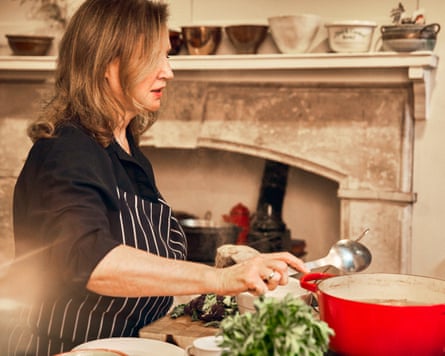
As the pan, on a high heat, comes to a boil, the froth will start to surface and you’ll have to skim it – an operation I hate, because, just in the act of skimming, you push the impurities back in: it’s like asking a child to peel a quail’s egg. The chef’s trick here is to be less uptight: “It’s not going to kill you, a little bit of impurity,” Hartnett says. And when you come to drain it, it’ll sink to the bottom anyway.” Her kitchen distinction is whether you’re a natural cook or a precision cook: “Some people weigh everything to within an inch of its life; they want everything in little boxes, and I’m not even like that when I’m at work. I would never weigh out the vegetables for a stock.”
Being an instinctive cook when you’re writing a recipe has its pitfalls, and she runs through her greatest hits of blunders, of which the funniest was “a famous stuffing at Christmas – spinach, ricotta, parmesan – and you put in an egg yolk to set it. I said something like “five kilos of spinach”. They even double-checked it with me, and I said: “It wilts, it wilts, it wilts” … and people were writing to me afterwards saying, ‘Oh my god, Angela, we honestly had a trolley just for spinach.’”
OK, now that your chicken has come to a boil, check in with yourself that you understand what a simmer is: it’s not a rolling boil, but nor is it that subtle, one-tiny-bubble-every-10-seconds state of near inertia. The pace is stately, the bubbles significant, as if there’s a swamp monster in there, breathing in and out. Learn to understand what’s going on by feel; when the chicken’s been going for about 50 minutes, Hartnett gives the thighs a little squeeze and decides they’re still too soft. The stock, by now, tastes incredible.
This is a total aside, because it won’t affect your cooking, but there’s an art to talking about food in a way that makes people want to eat it. For the past four years, Hartnett has co-hosted the Dish podcast with Nick Grimshaw, in which they interview famous people while she cooks for them. It started as a Waitrose promo and became “easily the biggest branded podcast in Europe, if not the world”, the chief exec of its production company once said. What’s funny about it is that they don’t tend to wang on about the food, and yet most of your brain is taken up with wanting to try it. “I love my job, I love cooking, I love food, and I love eating out and I love eating in, but I don’t need to talk about it 24/7. You go out with other chefs and they want to spend an evening on the virtues of a carrot, and I’m like: give me strength.”
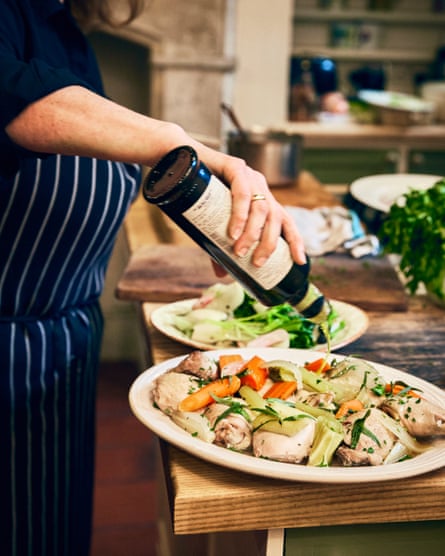
To the matter of the spring vegetables: be ready to adapt. This recipe originally calls for peas, broad beans and asparagus, but it’s too early in the year for those, “though we can probably get away with a few asparagus”, Harnett says, pragmatically. “I just chose stuff that’s seasonal today: chard, leeks, carrots, sprouting broccoli, radishes.
“When you’re blanching the veg, that’s just a three-minute job. Then I’ll mix them all with a touch of olive oil, put some herbs through it, maybe a bit of lemon, then that will be the base.” Don’t overdo the vegetables, obviously, but don’t make that student mistake where you think it’s classy to be way too al dente; vegetables don’t taste of themselves when they’re undercooked.
Arrange the chicken artfully on top, although there are only so many mistakes you can make with a simply jointed chicken. In terms of looking pretty, more vegetables over the top can do that work on their own. You can reduce the stock and add butter, but don’t be tempted to make a floury gravy, because that would jar: the look you’re going for is “timeless Italian elegance” not “hearty pub roast” (though those are good, too). Add parsley, a bit more finishing oil.
“If I was comparing what I do at Murano with what I’d do at home, it’s a bit more technical, there’s a bit more finesse, for want of a better word, but the flavours are the same,” Hartnett says. “Even at Murano, we don’t have dishes that have 15 ingredients in them. You just want a beautiful, finished plate of food.”
Her favourite utensil: the spider

Somewhere between a slotted spoon and a little sieve is the spider (I feel like Homer Simpson discovering a meal between brunch and lunch). So you wouldn’t use it for skimming or for draining, but for everything in between – the “fishing things out of a pan” space: vegetables out of poaching water, or bouquet garni and bay leaves. The shallowness makes it easy to manoeuvre, and the concentric circles of the cage mean you don’t pick up anything tiny, like a peppercorn, by accident. It is also a pleasing object to have around the place, especially if you get it in both sizes.
The recipe: poached chicken with vegetables
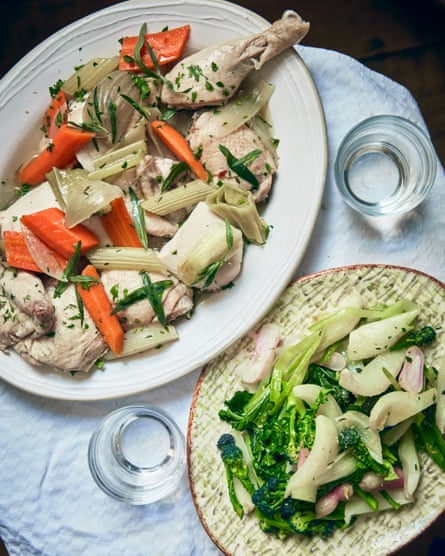
When entertaining, you often just want brilliant flavours from a simple recipe and this poached chicken fits the bill perfectly. Buy the best chicken you can and poach it in water – no other liquid – along with fresh vegetables, allowing the wonderful fat of the chicken to flavour the finished dish. Simple.
Serves 6
1 whole chicken (about 1.5–2kg)
2 carrots, peeled and cut into large chunks
2 celery sticks, cut into large chunks
1 white onion, quartered
1 small garlic bulb, halved horizontally
2 thyme sprigs
15g salted butter
A handful of flat-leaf parsley, chopped
For the vegetables
1 bunch (about 400g) asparagus
200g peas in their pods
200g broad beans in their pods
Extra-virgin olive oil
A few mint leaves
Sea salt
Put the chicken in a large pan, cover with cold water, and put on a medium heat. Bring the liquid to a slow boil, then immediately reduce the liquid to a simmer. Skim any foam off the top.
Add the poaching vegetables and thyme and cook for 50–60 minutes at a low simmer, until the chicken is cooked through.
Shortly before the chicken is ready, prepare the vegetables. Snap the wooden stalks from the asparagus stems and pod the peas and broad beans. Put the asparagus in a pan of boiling salted water and cook for one minute, then add the broad beans and peas and cook for three minutes more, until it is all tender.
Remove the vegetables from the pan using a slotted spoon and set aside in a bowl. Add a drizzle of olive oil, some picked mint leaves and a touch of sea salt.
When the chicken is ready, drain the chicken and vegetables with a slotted spoon and transfer to a serving dish.
Pour a few ladlefuls of the stock into a small pan (freeze any leftover stock to use in soups and risottos). Put the pan over a medium heat and leave the stock to reduce for three minutes, until slightly thickened. Add the butter and the flat-leaf parsley, stir to combine to a sauce, then pour the sauce over the poached chicken and vegetables and serve.
Extracted from The Weekend Cook by Angela Hartnett (Bloomsbury, £26)






 English (US)