
 5 hours ago
1
5 hours ago
1

Anonymous was often a woman: so said Virginia Woolf. And so thought Cynthia Osiecki one day in 2022, when she chanced on an unattributed still life in the storage area of the National Museum of Norway in Oslo.
Osiecki had been studying the work of a renowned 17th-century Flemish artist, Clara Peeters, one of the earliest practitioners of still life painting. Works by Peeters hang in the Prado in Madrid, the Ashmolean Museum in Oxford and the Metropolitan Museum in New York.
The Oslo painting, Still Life with Small Game and Grapes on a Gilded Tazza, was created around 1620 and features nine freshly dead birds, hazelnuts, apricots and a fly perched on a bunch of grapes. It had once been regarded as the work of a member of a famous family of Antwerp artists, Ambrosius Brueghel. But in the early 20th century the attribution was reassessed, and the work reclassified as being by “anonymous”. Since then it had mostly been consigned to storage.
Osiecki began to wonder whether the work – some details of which have been obscured by many layers of varnish – could be by Peeters, an enigmatic but prolific artist who pushed the boundaries of still life painting in the Northern European baroque period. Osiecki began to compare the work with other pieces by the painter, who is thought to have been born in Antwerp around 1594. “I looked at the panel the Oslo work is painted on, and discovered it was from a supplier Peeters often used,” she says. “Then I looked at other paintings by Peeters, and I noticed some of them had a tazza [a saucer-like dish on a pedestal] very similar to the one in the Oslo painting.” Osiecki noticed, too, similarities in the way the dead birds, the grapes and the hazelnuts were positioned in the composition.
One problem, though, was that Peeters was well known for signing her works, and the Oslo piece had no signature. But the panel had been damaged by woodworm, and the area eaten away was the bottom edge of the work – the very area where Peeters usually signed her pieces.
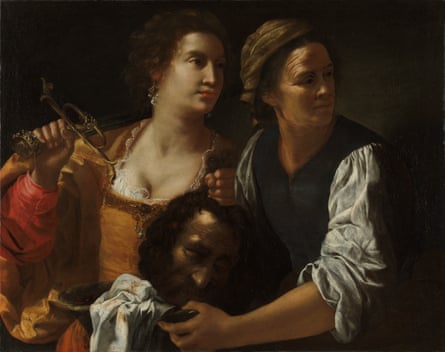
Artemisia Gentileschi, c1640. Photograph: Børre Høstland Annar Bjørgli/Kunstner: Gentileschi Artemisia
It seemed more and more likely that the painting was a work by Peeters – but a piece of the jigsaw was missing. Peeters is famous for including miniature self-portraits in her work, often reflections of herself in pewter or glass objects, or on shiny fruit or vegetables. “I could see a shape on some of the grapes, and on closer examination I realised they look like outlines of human figures,” says Osiecki. These might be the artist herself, and it could be that the image has been lost during conservation work.
Earlier this year the painting was officially reattributed to Peeters, and it will be one of the star exhibits in Woman Painter at the National Museum of Norway opening 8 October, curated by Osiecki. The show features the work of female artists working across northern Europe and Italy between 1550 and 1650, with paintings by 19 artists including Artemisia Gentileschi, Lavinia Fontana and Judith Leyster, as well as Clara Peeters.
Peeters was known for intimate still lifes reflecting the transience of this world, says Osiecki. “Her paintings, including the newly attributed work, are all about the brevity of life. We see recently dead birds, who will be part of a feast for humans, and grapes that will soon either be eaten or will decay. And though the work includes luxurious objects such as the tazza, Peeters is making the point that you can’t take anything with you when you die. In the end we’re all equal.”
after newsletter promotion
The reattributed work demonstrates how art history is expanding to include women whose work has been lost or ignored, says Nora Ceciliedatter Nerdrum, director of exhibitions and collections at the National Museum of Norway. Over recent years, Europe’s major museums have been opening up to shows of women’s work – in 2016, Peeters became the first woman ever to be given a solo show at the Prado.
Nerdrum agrees that the quest to correct the omission of women from the canon of art history began by retrieving known works by women from storage; now, the search is on for women whose work has been labelled “anonymous”. “Watch this space, because there will be lots more of these finds in the future,” says Osiecki. “The more we look, the more archival research we do, the more women we’re going to find.”








 English (US) ·