
 2 hours ago
3
2 hours ago
3

By the time Flight PTN27B started its descent into El Prat a bit before 8pm on Monday evening, a small crowd had gathered by the terminal doors, waiting for it to land. A few people stood and watched the sky, cameras out to capture its arrival. A lot more watched on their phones. In the two hours it had taken to get there from Manchester, taking off at 5.11pm, 101 minutes behind schedule, the Pilatus PC-24 had become the most tracked plane on the planet. Everyone knew that Rodrigo Hernández was on board. Unless, of course, he had been sneaked away in a catering cart.
Five days earlier, Rodri had been seen, and recorded, at Barajas airport waiting to get on a flight back to Manchester from Madrid. He wheeled a small RFEF (Spanish football federation) case with his name on, stood alone in the queue, the World Cup winning-captain just a bloke in shorts and T-shirt, and his stay in the UK was supposed to be brief, just long enough to say goodbye. The plane he was boarding was a Ryanair one: that was the detail everyone homed in on, something extraordinary in the ordinariness. This time, though, he came on a private jet, one way. His family travelled with him. He came to sign for FC Barcelona.
Rodri was late: an agreement between Manchester City and Barcelona had taken a little longer than expected, long enough for concern to creep in, and his flight landed 70 minutes behind schedule. Maybe he is late-late, too: at 30, and three years after the departure of Sergio Busquets – the man to whom he had always been likened and whose natural successor he has always been … this transfer could perhaps have come sooner. Yet it was rarely even contemplated, virtually up until the moment it happened. In that sense, it had actually been quick. A fortnight ago, few thought of this.
Now here he was, heading out in jeans and a white T-shirt. There was expectation, a hint still of disbelief that they had got him. A touch of relief, too, after the delay. They had been “intense days” Rodri said, but now it was done. Barcelona’s third bid had been accepted: €60m plus a further €15m in add-ons, €11m of which are virtually guaranteed. He will earn around €15m a year, an increase on his salary at City, and has signed a four-year deal.
Rodri seals Barcelona transfer
Show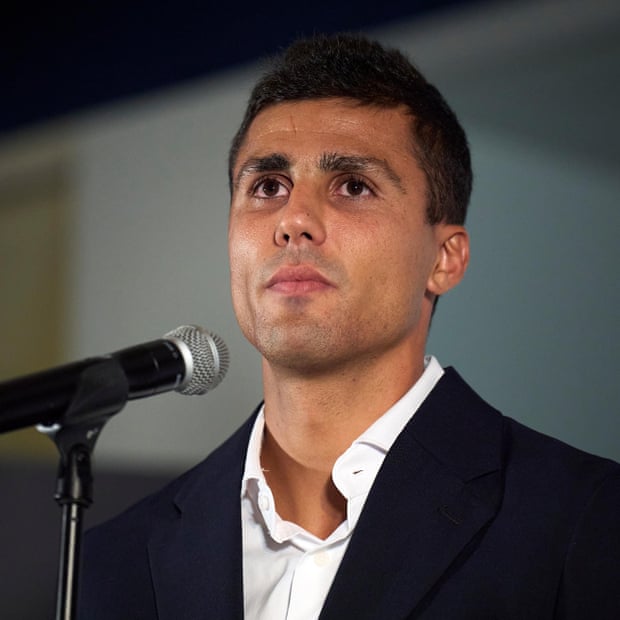
The Spain midfielder Rodri has completed his £65.4m move from Manchester City, signing a four-year contract after undergoing a medical on Tuesday.
'Barcelona and Manchester City have reached an agreement for Rodri, who is committing to the Catalan club until 30 June 2030,' read a club statement.
Barça added that the 30-year-old is 'considered one of the best players in the world in his position', and 'stands out for his tactical intelligence, composure on the ball, ability to regain possession and precision in his passing'.
Rodri (pictured) was named the best player of the World Cup after Spain’s triumph this summer. He spent seven seasons at the Etihad Stadium, winning the Premier League four times and scoring the winner in the 2023 Champions League final against Internazionale. The 2024 Ballon d'Or winner joined from Atlético Madrid in July 2019, and was in the final year of his contract.
In a message to City fans on the club’s website, Rodri wrote: 'I found that saying goodbye is one of the most difficult things in life but I am going to try. I knew I came into a top team but I never thought we could be able to create the legacy we made – winning trophies, fans around the world, love and respect.'
'We made an example to inspire the next generations not only because the success, also because the way we did it,' he added. 'And the fans were with us every step of the way. City didn’t just make me grow as a player. They made me grow as a human ... Manchester shaped my whole life. It’s time to say goodbye, thanks to the club, the fans, the staff and my teammates. This journey couldn’t be the same without you, my heart will always be blue.'
Barcelona saw an initial £40m offer and an increased bid turned down before an agreement was struck on Sunday. Rodri flew to Barcelona’s El Prat airport on Monday and told reporters: 'Playing for Barcelona is a dream come true for me.'
The new City manager, Enzo Maresca, faces a race to rebuild his midfield, with Rodri joining Bernardo Silva in departing the club, Tijjani Reijnders poised to join Saudi Pro League side Al Qadsiah, and Newcastle reportedly interested in Nico González. Elliot Anderson has joined from Nottingham Forest for £116m and City have been linked with Lille’s Ayyoub Bouaddi and Chelsea’s Enzo Fernandez.
Photograph: Quality Sport Images/Getty Images Europe
“I’m happy to be here,” Rodri said, and they were happy to have him. The following morning he arrived at the club’s Joan Despí training ground to complete his medical, everything signed off. As he left the terminal building, Rodri had been asked if this was a dream come true. He of course said yes it was, which he had to say. The question had been direct, leading. It had been loaded too.
A Ballon d’Or winner and the embodiment of a style, an identity, that is theirs too, Rodri is the perfect fit. The time was right for him too. Voted the best player at the World Cup, the culmination of his recovery from injury, there was just one year left on his contract at City. He had won it all in England and Pep Guardiola had gone. After seven years away, home called. But home didn’t mean Barcelona; in fact, it had seemed more likely to mean Real Madrid.
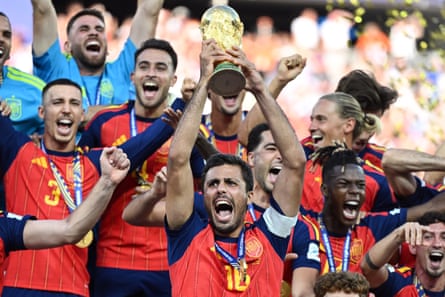
Rodri grew up to the north-west of the capital and even Real’s refusal to turn up the night he won the Ballon d’Or, an act of grubbiness and disrespect, didn’t mean closing the door. Instead, he was increasingly open about his willingness – his apparent desire – to go. “Obviously, when the best club in history, the most successful with everything that brings, call you it is an honour and you always have to pay attention,” he said not long after the ceremony. In the spring, Rodri admitted he would like to return to Spain and that he would not rule out going to Real, even if he had been in the academy at Atlético. When Real held presidential elections in May, the pretender, Enrique Riquelme, announced that his signing would be Rodri. For his part, Rodri kept his counsel and come the end of the World Cup he had three offers: Paris Saint-Germain, who he ruled out because he wanted a return to Spain, Barcelona and Real.
Real, ambivalent before, appeared convinced by his status as the World Cup’s best player, president Florentino Pérez’s reticence seemingly overcome. He was exactly the footballer they needed, someone to get them to actually play, and Real were confident that he would come, that theirs was the only real offer. One headline summed it up: “Rodri is next”. This was done, which is when things tend to get undone. Rodri had an offer that was impossible to turn down. Only the terms of the negotiation shifted, doubts growing about Real’s commitment, frustration growing.
Barcelona, seeing an opportunity, pushed at an unexpectedly opening door. Rodri might not have been the player they needed most – a forward was their priority – but, well, he’s Rodri. This was undeniably a step up in quality, even for a midfield like theirs. Meanwhile, doubts over Frenkie de Jong’s fitness brought a reframing: maybe he was more necessary than they had believed. Likewise, that slight nagging doubt about his fit with Pedri in the seleccion feels like a small one, easily overcome, certainly no obstacle to bringing together arguably the best two midfielders in the world. Good luck getting the ball off them.
On the day that Real announced Vinícius Júnior had renewed his contract at the club and that they had made Yan Diomande the most expensive signing in their history, they also briefed that Rodri wasn’t coming after all. The excitement among fans at the Santiago Bernabéu turned to disappointment, a kind of lingering doom. That huge hole in the middle of Madrid’s midfield was still not plugged, their issues still not addressed.
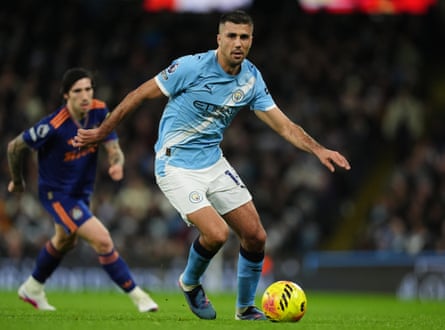
For Barcelona this was the signing of the summer. The World Cup winning-captain, perhaps the best player on the planet, was coming to Catalonia. There was a kind of gleeful disbelief, the expectation huge. Rodri thanked Madrid, but he had made his decision. As usual, Jorge Valdano put it best when the €75m deal had been done. “Rodri’s deal is worth €35m for what it gives Barcelona and €40m for what it takes away from Madrid,” he said. “At Real Madrid he would have revolutionised their play and improved everything.”
Valdano added he will not have the impact on Barcelona’s style that he would have had on Real’s, but that was because it is already his. “I always try to learn from Busquets,” said Rodri. “I watched him especially closely: he, and others, lay down a model of playing I knew I had to follow.” When Rodri joined City, Guardiola had found his other Busquets, or so it goes. Waiting patiently for his moment, when Busquets finally left the national team, it was always going to be Rodri who stepped in. A “perfect computer”, Luis de la Fuente called him. Doing so with Barcelona would seem natural, maybe even overdue, his signing a no-brainer.
Rodri’s World Cup overcame any doubts that it was too late, that his time had gone, and brought an extra dimension too, a shift in his role which he didn’t just embrace but consciously sought. He had the maturity, the leadership, the ascendancy over Spain’s young players – Barcelona’s young players – that they needed. And he needed too: there is something almost paternal about him and they had the youth that he wanted to lead, to guide. And, of course, the talent too. He knows how good it is to play with them: he had done so all summer, wining the ultimate award. And so it was done.
Now all that was needed was for City and Barcelona to reach an agreement. Eventually, they did, so Rodrigo Hernández had another plane to catch.

 English (US) ·