
 2 hours ago
3
2 hours ago
3

Was ever a musical so eager to be liked, so anxious not to exclude? It is not just the patronising pre-show introduction, which assumes we have never been in a theatre and insists we all hate bankers. It is also the pathological number of pop-culture references in Rob Madge’s book. “We’re on your side,” it seems to say, “because we too have heard of Coronation Street, EastEnders, Cher, The Legend of Zelda, Jeremy Beadle, Mamma Mia!, Dirty Dancing, Wonderwall …” The list goes on.
The level of insecurity is strange because Bank of Dave: The Musical is a tremendously likable show. The source material is the feelgood true-life story of Dave Fishwick (Sam Lupton), the Burnley businessman whose egalitarian conscience led him to step in where others had failed. Seeing his fellow townsfolk being held back for want of money, he determined to set up a non-profit bank that would treat them with trust and respect.
Presented as a David and Goliath battle between an impoverished former mill town and a self-serving banking sector, it is an underdog tale with a happy ending. Following the fictionalised outline of the 2023 Netflix film, starring Rory Kinnear, it has two big plus-points for a musical: a community that pulls together and a romantic subplot between a buttoned-up London lawyer (Lucca Chadwick-Patel) and a no-nonsense local doctor (a star performance by Lauryn Redding).
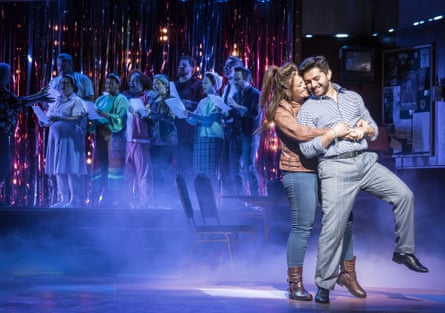
Director Nikolai Foster fashions an ebullient, if a tad overheated show, forever erupting into big chorus numbers on Amy Jane Cook’s amorphous bar-room set with its backdrop of Lancashire chimneys and neat integration of Duncan McLean’s video designs. Pippa Cleary’s songs are bright and engaging, drawing on gospel, soul, hip-hop and Broadway golden age. A couple of romantic numbers slow the pace, but generally, the songs propel the story forward and add to the cheeriness.
Like the film, the north-south divide is overegged – there is even an apology for the “southern saviour narrative” – and the honest-to-goodness characters flirt with cliche. Unlike the film, it comes clean about the story’s fabrications. Such honesty is consistent with a determinedly down-to-earth show that rails against inequality while championing the possibility of change.








 English (US)