
 1 hour ago
5
1 hour ago
5

There are two ways to win a final. You can win it by the odd goal, amid a frenzy of anxiety so the final whistle comes as a relief. Or you can win it as a procession, flexing your superiority, so the final whistle is almost resented for spoiling the fun. For Aston Villa, this was very much the latter. If their fans had dreamed the previous night of how they might win the game, they could barely have come up with something so satisfying and emphatic.
It’s true that Villa have a budget around 2.8 times that of Freiburg, and that they have been strong favourites in almost every game in the Europa League this season. But then in the Premier League they’re often fighting against sides with far greater resources. The poles of European and domestic football may have flipped, but that is not their fault nor, at least for now, their concern. They have not been a successful enough club – at least in the past 100 years – to decline to fully celebrate any trophy that comes their way. A second European success, 44 years after the first, is history.
Almost all football in its way echoes through the shadows of its past. For Villa, the parallels with the fabled 1-0 win over Bayern Munich in Rotterdam were unavoidable. Then, too, they wore white against a German side in red. Then, too, they suffered an early scare with their goalkeeper, although on this occasion Emiliano Martínez was able to carry on after taking a blow to the hand in the warm-up whereas in 1982 Jimmy Rimmer was forced off with a neck problem. And then too, the game in its early stages was a scrappy and nervous mess, not helped by a punctilious French referee; for Georges Konrath then, read François Letexier in 2026.
But there the similarities ended. There was a notable contrast, for instance, in the quality of the strikes that gave Villa the win. At De Kuip, Peter Withe converted Tony Morley’s low cross with his shin, making such dreadful contact that, even though he was in the middle of the box and six yards out with most of the goal to aim at, the ball squirted in off a post. Here, the strike from Youri Tielemans that put Villa ahead four minutes before the break could hardly have been truer.
It came from a set play, naturally enough – however redolent this may have been of glories past, this is 2026 – and so Austin MacPhee, Villa’s set-piece coach, must take credit. His long greying hair gives him the aura of some great magus, Trismegistus in a tracksuit, but there really is something remarkable about the way MacPhee conjures space. Who knows what skaldic wisdom facilitates his acts of misdirection, but somehow Freiburg were persuaded to leave a vast acreage at the top of their box untenanted, and into it Tielemans arced his run before belting home a scudding volley.

But if that goal was both fitting and pleasing in the sheer power of the shot, the second is the strike that will be replayed for its aesthetic quality. Emi Buendía has at times divided Villa fans, but his place in history is assured now. If there is to be a mural of this final in the environs of Villa Park as there is of 1982, it is his shot, whipped into the top corner, that will take centre stage.
The third may not have been so spectacular but even it felt a little like a souped-up version of the Withe goal, with Lucas Digne in the Gary Shaw role, and Buendía playing Morley to Morgan Rogers as the scorer, though his dart across the near post and poked finish was rather defter than the original.
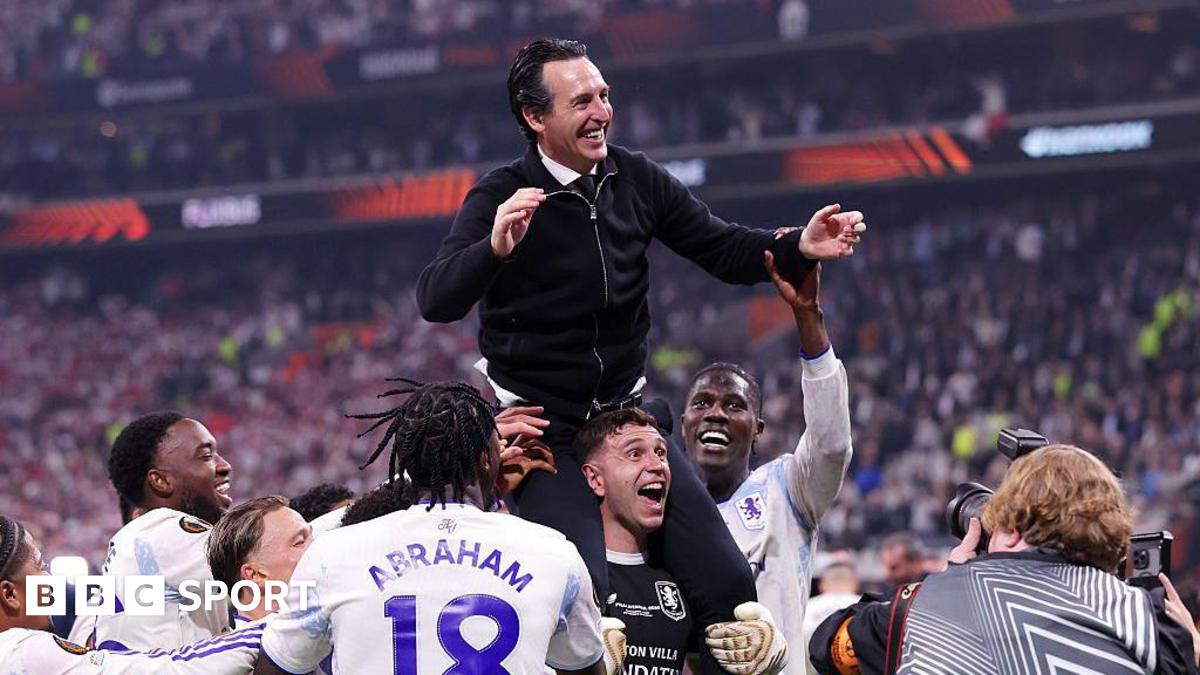
The other major difference was in the manager. In 1982, Villa were led by Tony Barton who had only been a manager for three months. This time they were led by Unai Emery, who has dominated the Europa League like no manager has ever dominated any European trophy. He may have rejected the title of “king of the Europa League” on Tuesday, insisting only on looking forward, but he has been in six of the last 13 finals with four different teams and won it five times. Whatever doubts may remain about his capacity to manage a giant of modern football after his disappointments at Paris Saint-Germain and Arsenal, nobody can doubt how good he has been for Villa, or how good Villa have been for him.
Race for Europe: what does Villa's victory mean?
ShowAston Villa's victory in the Europa League final means that six Premier League teams could play in next season's Champions League – but only if Villa finish fifth in the table. Villa would qualify as Europa League winners, with the extra league phase place awarded to the team in sixth (currently Bournemouth).
Liverpool have all but secured fifth place, but could climb to fourth with a win over Brentford on the final day, if Villa are beaten at Manchester City (who, like Arsenal and Manchester United, have secured a top-four finish). That would open up a sixth Champions League spot for Bournemouth or Brighton.
If Villa stay above fifth, the team who finishes sixth will go into the Europa League. The side in seventh place will do so either way, with eighth spot earning a Conference League berth, after City won the FA and League Cups and finished in the top four.
Chelsea are currently in eighth place but travel to Sunderland – one point back in 10th place – on the final day in what looks likely to be a European eliminator. Crystal Palace can also claim a Europa League spot if they win the Conference League final.
Key final-day fixtures: Brighton v Man Utd, Liverpool v Brentford, Man City v Aston Villa, Nottingham Forest v Bournemouth, Sunderland v Chelsea.
It’s an oddity of the change in tournament structure, that for Villa or Emery to have the chance of winning the Europa League again would require a measure of failure. The sense is that one stage of their evolution is complete; the challenge now is to sustain the next phase, that of being a regular Champions League club.


 English (US)