
 2 hours ago
3
2 hours ago
3

And then there were two. As the clock ticked down at St Mary’s Stadium on Saturday night even the stray yellow balloons on the pitch had begun to take on a weirdly mocking quality.
The balloons were almost too much, like metaphors-for-hire in an arthouse film, popping up in shot every time Arsenal tried to transform another spell of mechanical pressure into creative, incisive football. Your dreams? Your dreams are just air inside a polymer shell. Your dreams are a squeaky veneer. Even when you try to take agency over your dreams, or at least stamp on them before a set piece, they will scoot away and bobble about annoyingly near the corner flag.
If it is any consolation in defeat, Arsenal can still achieve something unprecedented this season. No English side has won a quadruple. But nobody has surely ever blown a quadruple quite like this, either. Six games to lose them all. Carabao Cup final. Check. FA Cup exit at Southampton. Got it. We’re two from two right now.
Lose at home against Bournemouth on Saturday. Lose against Manchester City at the Etihad Stadium a week later. That’s the nine-point lead in the league all but gone. Chuck in a stumble against Sporting Lisbon (past three games: three wins, 13 goals scored) and this is pretty much your lot in 16 days of active club football. From quadruple to nonruple. From quadruple to quadlapse. This, this is football heritage.
Take a breath, resist the doomer-ism, and it is also unlikely Arsenal’s season will play out like that. Winning everything never really happens. Losing everything probably won’t either. Good teams have setbacks, even while they’re winning trophies. Channel the fury, get the first 11 out there and the league title in particular is well within reach.
More to the point, it is already a significant achievement just to get so close. This is not a team of ready‑made galacticos clumped together in a rule-busting splurge, or an all-time head coach bolted on as a trophy guarantee. It’s a coherent attempt to build something. Southampton are a good team. The message here is that it is still brutally difficult to win, and this can only ever be a good thing.
The question remains, though. Why is the prospect of Arsenal not winning things so much more of a story than a shot at a first league title in 22 years? Why is there so much hunger for this? Why does it feel like watching one of those disaster-juggernaut moments in a Hollywood movie, where the Rock or similar stares at the horizon and sees the wall of water rising, the tsunami about to break?
In part this is because we live in a banter-verse where every stumble must be played out in peeled-eyeball super slow-mo. So much of football is consumed now as schadenfreude (literally: harm-pleasure) that we don’t really need a special German word for this any more, as though it’s an obscure subset of actual pleasure. Joy in your own achievements? That’s the minority act now. We need to start talking about the weird niche pleasure of plain old freude, those rare moments where public enjoyment does not involve mockery, gloating, the taunt reflex.
There is already something iconic about Mikel Arteta’s weekly rictus of pain, the faded gardening coat, the look of a brave, sad, highly intelligent hamster watching his burrow being washed into the brook. By late Saturday night the key imagery from Arsenal TV had already begun to do the social media rounds, a clip of a man so angry he can barely un-grit his teeth, shouting things like HE HAS TO WIN THE CHAMPIONS LEAGUE BECAUSE HE’S THROWN THIS AWAY (narrator’s voice: Arsenal have never done this in their history).
But harm-joy isn’t the whole story. It is the nature of Arsenal’s struggles that makes them so gripping. The way this team has won, and the way it has now wobbled: both of these feel like a model that expresses something not just about modern football but also, if we may go down the balloons of hope route, about modern life too.
This is not about Bottling It, which is a description of an outcome, not an analysis of why it has happened. Cowardice, fraudery and moral collapse are attractive ideas. But there is no such thing as a pure bottling at this level. Being part of a properly balanced team doesn’t make you brave. Winners are not innately wiser or more noble. They’re just better at sport, for complex reasons.
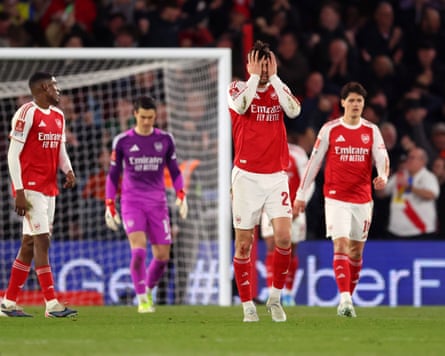
And the current Arsenal is an unusual team. Across his five seasons Arteta has built an extreme model of systems play and controlled movement. Sequences in and out of possession are minutely planned and grooved. The ideal is sustained intensity, constant positional cover, attacks that follow an overwhelming pattern.
But there is also a natural fascination in seeing those formulas interrupted, the way pressure in key moments and the countermeasures of other managers can throw a system. At times like these Arsenal can look like a team that has been aggressively overcoached, that has taken the post-Guardiola, data‑heavy method of breaking the game down into moves and moments, and lost, or suppressed, or forgotten something along the way.
The key flaw right now is obvious enough: an inability to create chances in open play when an opponent has neutralised your usual avenues of attack. Despite the nine-point lead at the top of the league, Arsenal are fourth on chances created from open play across 31 games, and probably further down that table in recent weeks.
Even the most basic attacking numbers tell a tale of creative entropy. Gabriel Martinelli has not scored in the Premier League since September 2025. Noni Madueke has one since January, Gabriel Jesus and Declan Rice none. Leandro Trossard and Martin Ødegaard: none since December. Kai Havertz has zero league goals all season. Bukayo Saka, Arsenal’s best creative player, has three since the start of November.
This is not a surprising outcome when you watch the games. The problem against Southampton wasn’t so much a chop-and-change team. The same attacking patterns were in evidence, but these are predictable: lateral passing, pre‑programmed overloads against a deep defence, an absence of disorientating angles or movements that react to the moment. Without Saka and Eberechi Eze they have no real spontaneity in this team, nothing to rescue the off days, their most inventive attacker a 16‑year‑old who hasn’t been turned into a Dalek yet, and who played with verve late on as a No 10.
Manchester City enter the picture here. Pep Guardiola may be the godfather of possession football and positional control freakery. But the team he is rebuilding on the hoof, expensively supplemented, is still full of notes of controlled self-expression. This is also part of the formula, just as the success of Paris Saint-Germain is built around integrating elements of invention, dribbling and attacking speed into a controlled midfield and defence.
Whereas with Arteta there can be a feeling of watching an apprentice at work who has learned the systems, the outlines, the blueprint, but not the elements between the cracks, a ChatGPT version of Guardiola-ism: logical and expertly glued together, but lacking in edge, like a robot doing a really convincing Jackson Pollock, where all the paint splatters are in just the right place, but it’s still somehow not really Jackson Pollock.
This is not to make light of the spirit and the talent in the team, or the stellar progress of a winning season so far. Those qualities should still see Arsenal home in the league. City were thrillingly fluent against Liverpool on Saturday, but they are still well capable of losing games.
If not then Rayan Cherki’s act of ball-juggling at Wembley two weekends ago could still end up a laser‑targeted taunt; a case of Guardiola’s more refined, more authentic model of positional play saying here is an echo of what you lack, the elements this Arsenal team still needs to embrace to reach its ultimate level.



 English (US)