
 4 hours ago
3
4 hours ago
3

It was an incident that sparked a furore: during Sunday’s Bafta ceremony Tourette syndrome (TS) activist John Davidson made several outbursts, including shouting the N-word as actors Delroy Lindo and Michael B Jordan were presenting a prize on stage.
Among others to comment on the incident were actors including Oscar winner Jamie Foxx and Wendell Pierce, who starred alongside Jordan in The Wire.
Writing in a post about the incident on Instagram, Foxx said Davidson’s use of the N-word was “Unacceptable” and “Nah he meant that shit”, while Pierce wrote on the platform X: “It’s infuriating that the first reaction wasn’t complete and full throatted [sic] apologies to Delroy Lindo and Michael B Jordan. The insult to them takes priority. It doesn’t matter the reasoning for the racist slur.”
Journalist Jemele Hill also commented on X, writing: “Black people are just supposed to be ok with being disrespected and dehumanised so that other people don’t feel bad”.
However, it was Davidson’s experience of TS that inspired the film I Swear, which scooped multiple awards at the ceremony.
“How ironic then to invite the guy and then not expect him to be himself,” said David Whitlam, who also has the disorder.
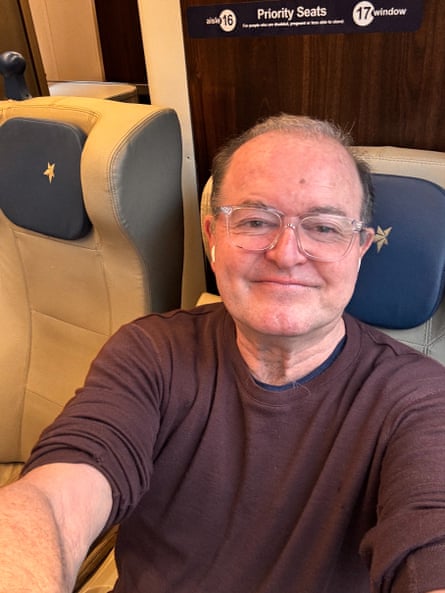
Whitlam, 66, who has TS with coprolalia, vocal tics that involve swearing, stressed Davidson’s outbursts were not deliberate.
“The film pulled no punches and, in an environment where [Ricky] Gervais [former host of the Baftas] can be as rude as he likes, a person whose movie is winning a Bafta, should not now feel branded a racist because he blurted something out,” he said. “I just hope he isn’t cowering at home, crying.”
Whitlam said he has also experienced challenges with coprolalia, adding the description of Davidson’s use of the N-word as a “slur”– as has occurred in many news pieces – is misleading.
“A slur would be deliberately and specifically targeted by the individual towards a person or persons,” he said. “An ‘involuntary slur’ is surely oxymoronic and that is precisely our problem.”
Whitlam said he had ticced on the same word when visiting Texas in 1982. “I had never before used the N-word, yet my brain, neurone, whatever, battered my skull and out it popped, until my girlfriend rapidly shut the window of the car,” he said. “I remember this incident clearly, to this very day.”
Whitlam added he does have coping mechanisms for his vocal tics.
“Having Tourette’s, especially as one gets older, involves avoiding too many neuro-stimulating situations especially in places where we are meant to behave,” he said. “So I go to rock gigs, I sing in a chamber choir and play in a rock band, where my mind will be fully occupied. But I don’t want to go to Tourette’s clubs, where I would inevitably pick up new sounds and insults to make.”
He also chooses single seats, without a window when travelling by train.
“I say to myself, ‘Let’s be as good as gold.’ I have certain phrases that I say to myself and then I call it a virtuous circle, the more I don’t make a noise, the more I don’t want to,” he said. “But then, if you get one word, and in my case, it usually is a bad word, I end up wanting to say it a lot. And I suppose [it is] things we weren’t supposed to say as children, things we perhaps were warned off.”
Whitlam’s added that his condition was recognised by his late wife, but the couple did not pursue a formal diagnosis in case it led to him becoming a “toned down” version of himself.
“She said that’s not the David I love,” Whitlam said.
James*, from Canada, said his experience of TS had diminished with age.
“I’ve never shouted and sworn at people. No, with me it was saying something that was completely utterly inappropriate,” he said, adding his experiences led him to being expelled from school, which cost him his place at a prestigious university.
However James, who also has not had a formal diagnosis, said that with age comes insights – adding that while he has some compassion for Davidson, he has experienced racism himself.
“He shouldn’t have stayed there and done this thing and caused the terrible offence because it really is unacceptable,” said James.
In a statement, Davidson said on Monday that he was “deeply mortified if anyone considers my involuntary tics to be intentional or to carry any meaning” adding that he “chose to leave the auditorium early into the ceremony as I was aware of the distress my tics were causing.”
Others argue the furore is down to Bafta for not anticipating, and managing, the situation better and the BBC – who initially failed to edit out Davidson’s outburst, despite the ceremony being broadcast with a two hour delay.
Among them Gavin Higgins, 42, a classical composer from London, who was diagnosed with TS at the age of eight. “When I was young my Tourette’s was debilitating,” he said. His tics caused him to contort his face, causing him persistent pain.
Higgins, said his condition was more manageable now, although it could still affect his work, and may even have shaped the music he writes.
“I realised recently that I’ve got into the habit of writing lots of very loud, fast music. I think maybe it’s subconsciously a way for me to be able to at least sit through my own pieces and not bother people around me,” he said.
Higgins, who has also been involved in advocacy with the charity Tourettes Action, said the Bafta ceremony showed it was a “misunderstood condition” and the reaction was “disheartening”.
“I’ve got mixed feelings about it because [I Swear] won, which was great, and I think the film has brought a lot of information to people who didn’t know about Tourette’s,” he said.
“Of course I understand the hurt of hearing words like that; no one deserves to hear upsetting words shouted at them and it’s important to acknowledge that. But I think what’s been missed in a lot of the discourse is that Tourette’s is a complex neurological condition and tics are involuntary – we can’t help it and have no control over it,” he added.
“Tourette’s has long been the butt of the joke, but as proven at the Baftas, Tourette’s is funny until it’s not.”
Higgins is optimistic that the Baftas controversy will lead to more awareness about the condition. “After two days, it feels like people have actually taken time to understand how Tourette’s works. And a lot of people have shifted their view slightly. It doesn’t take away from the hurt of hearing horrible words shouted at you. Of course it doesn’t,” he says. “A bit of kindness both ways is what’s needed right now.”
Patrick Hamlyn, 25, from Bournemouth, who was diagnosed with TS at 22 but does not have coprolalia, agreed.
“What I hope becomes the key outcome of this incident is that we all make an effort to understand each other better,” he said.
“We should speak to our black friends about their lived experiences of racism. We should speak to our friends in wheelchairs about what it is like to be in a wheelchair. We should speak to our friends with Tourette’s to learn about what makes them tic.”
Hamlyn added that the world would be “a far healthier and less malicious place” if people could learn about each other’s differences.
“It is important to remember that there’s no such thing as a cookie-cutter human; we’re all jigsaw pieces in this big puzzle of life and if we understand each other’s ridges, we might just fit together.” he said.
* The name has been changed







 English (US)